
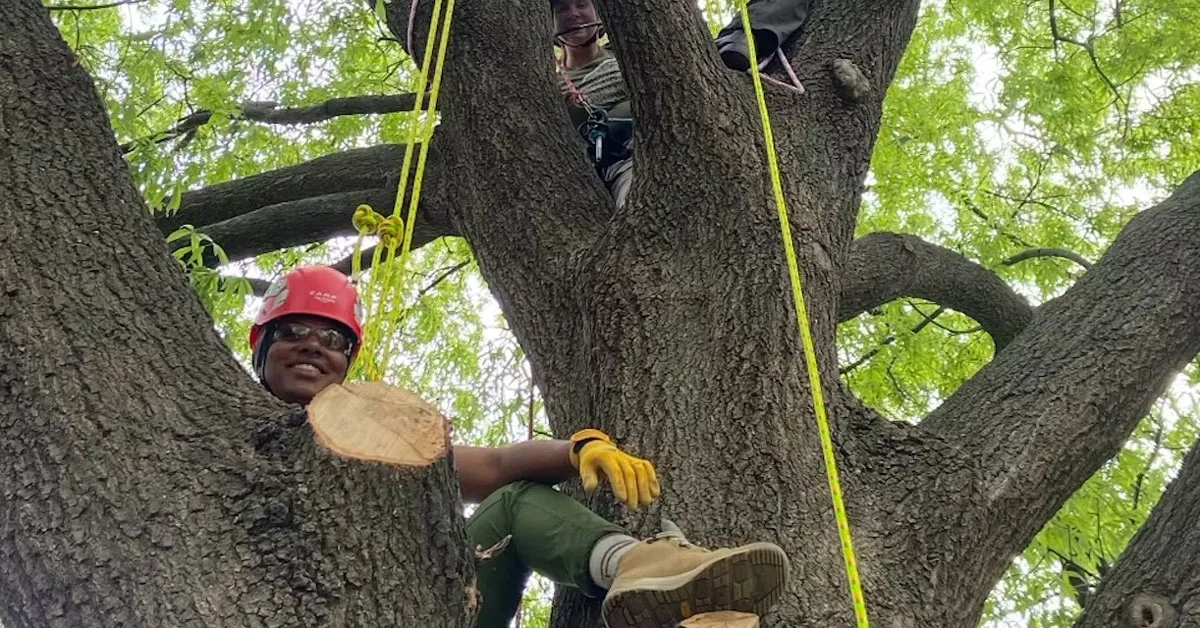
For most forestry students, the closest they get to a tree canopy is a textbook photo. They learn about roots, bark, and leaves, but rarely get to experience them up close and personal. You know, like, actually climbing the thing.
One instructor at the University of Tennessee, Knoxville, looked at this glaring gap in hands-on education and thought, "This won't do." So she went and learned how to climb trees herself. Because apparently, if you want something done right, you sometimes have to scale a 50-foot oak.
Now, her students in the new urban forestry program are trading lecture hall fluorescent lights for dappled sunlight. They're still hitting the books, but they're also learning practical skills — knot-tying, setting climbing lines, and navigating a canopy — from up to 69 feet off the ground. Which, if you think about it, is both impressive and slightly terrifying.
We're a new kind of news feed.
Regular news is designed to drain you. We're a non-profit built to restore you. Every story we publish is scored for impact, progress, and hope.
Start Your News DetoxReaching New Heights for Urban Trees
The "Principles of Urban Forestry" course isn't just about the thrill of heights. It's about understanding the unique challenges of city trees. These aren't your wild forest specimens; they're the ones growing precariously close to power lines, sidewalks, and your neighbor's prize-winning petunias. Getting up there safely to prune a branch, check for disease, or assess a risk is a crucial skill.
Students spend the first 10 weeks learning the historical interplay between cities, people, and trees, all while building basic climbing competence with 6-foot ropes. Then, for the grand finale — the last five weeks — they tackle the real deal on campus. Most ascend about 50 feet, but some brave souls go for the 69-foot sawtooth oaks. Because if you're going to learn, might as well go big.
They start with the basics: moving up and down using a technique called body or hip thrusting. Then, it's on to the more advanced "limb walking," which is exactly what it sounds like — traversing thinner branches through the tree's crown. It's an exercise in understanding tree structure and care from an entirely new, leafy perspective.
The View From Above
The U.S. Forest Service has been advocating for urban trees for three decades, and for good reason. With 80% of the U.S. population living in urban areas as of 2020, city trees are doing some heavy lifting. They cool sweltering neighborhoods, absorb carbon dioxide, and pump out that sweet, sweet oxygen. Basically, they're the unsung heroes of asphalt jungles.
Even if these students don't become professional arborists, this course offers something invaluable. It teaches them to look up, to observe, and to understand how trees impact everything from shade and safety to a neighborhood's overall beauty and comfort. It's about seeing the world, quite literally, from a different angle.
Because sometimes, to truly appreciate what's on the ground, you need to spend a little time in the branches.