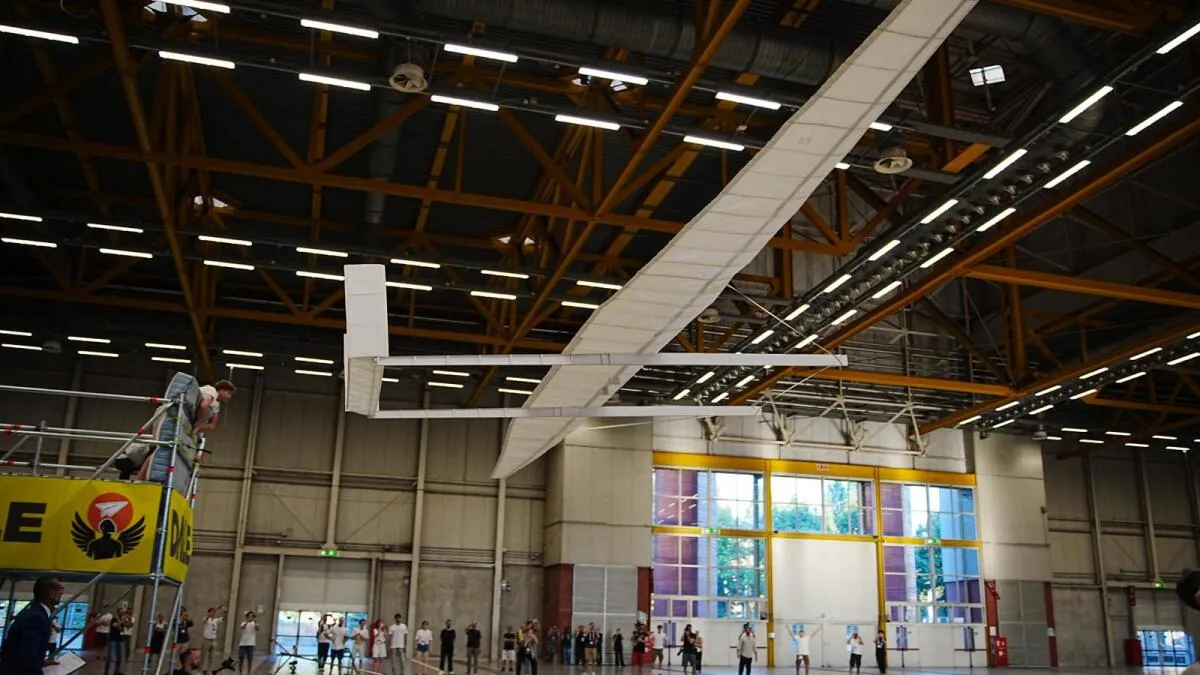
In news that will either inspire or deeply annoy every parent who's ever found a crumpled paper airplane wedged into their drywall, students in Pisa, Italy, have officially set a new Guinness World Record for the largest paper airplane ever flown. And it’s not just big; it’s really big.
Named ICARUS (because of course it was), this aeronautical marvel stretches 7 meters (23 feet) long with a wingspan that could practically shade a small car at 20.04 meters (65.8 feet). It weighs in at a respectable 28.49 kg (62.8 lb), which is roughly the weight of a very determined toddler. This behemoth then proceeded to glide a frankly impressive 59 meters (193.6 feet), shattering the previous record held since 2013.
More Than Just a Folded Sheet
What makes this story particularly delightful is that the students didn't just wing it (pun absolutely intended). They approached ICARUS with the kind of meticulous engineering usually reserved for actual passenger jets. We’re talking studies on stability, weight distribution, stiffness, and aerodynamics. Science communicator Jakidale, who supported the project, noted they applied the exact same logic as designing a commercial aircraft wing, just with, you know, paper and glue.
We're a new kind of news feed.
Regular news is designed to drain you. We're a non-profit built to restore you. Every story we publish is scored for impact, progress, and hope.
Start Your News DetoxTo achieve this feat, they used 300 kg (661 lb) of paper and 60 kg (132 lb) of industrial-strength glue. The paper itself wasn't just any printer paper; it was a mix of heavy-duty 120 g/m² for the structural bits and lighter 40 g/m² for the covering, all glued into a honeycomb structure. This ingenious method increased stiffness without adding excessive weight, ensuring the plane wouldn't just flop mid-air like a sad pancake.
For the record to count, the plane had to be launched by a single person from a platform no higher than 3 meters (9.8 feet) and travel at least 15 meters (49 feet). This meant stability and efficiency were paramount – essentially, it had to be a giant paper glider. Months were spent on simulations, tests, and corrections, because apparently, even a paper plane can be a demanding client.
Jakidale, reflecting on the project, summed it up perfectly: “For months we battled humidity, structure, aerodynamics, millimeters, and gravity. Seeing it fly and then crash into the columns at the end of the hangar is proof that it is always worth trying to build the impossible.” Because sometimes, the most profound engineering insights come from trying to make a truly absurd amount of paper defy gravity.