Polaris has introduced a new continuously variable transmission (CVT) in its 2027 Xpedition utility vehicle. This new system adds pneumatics to the existing mechanical CVT. The goal is to reduce noise and harshness when the engine isn't at maximum power.
The pneumatic system is an addition, not a full redesign. It includes an air compressor, a small air tank, and a pneumatic piston. These parts control the CVT's output compression. If the pneumatic system fails, the CVT still works mechanically. This keeps the utility terrain vehicle (UTV) operational.
How the New System Works
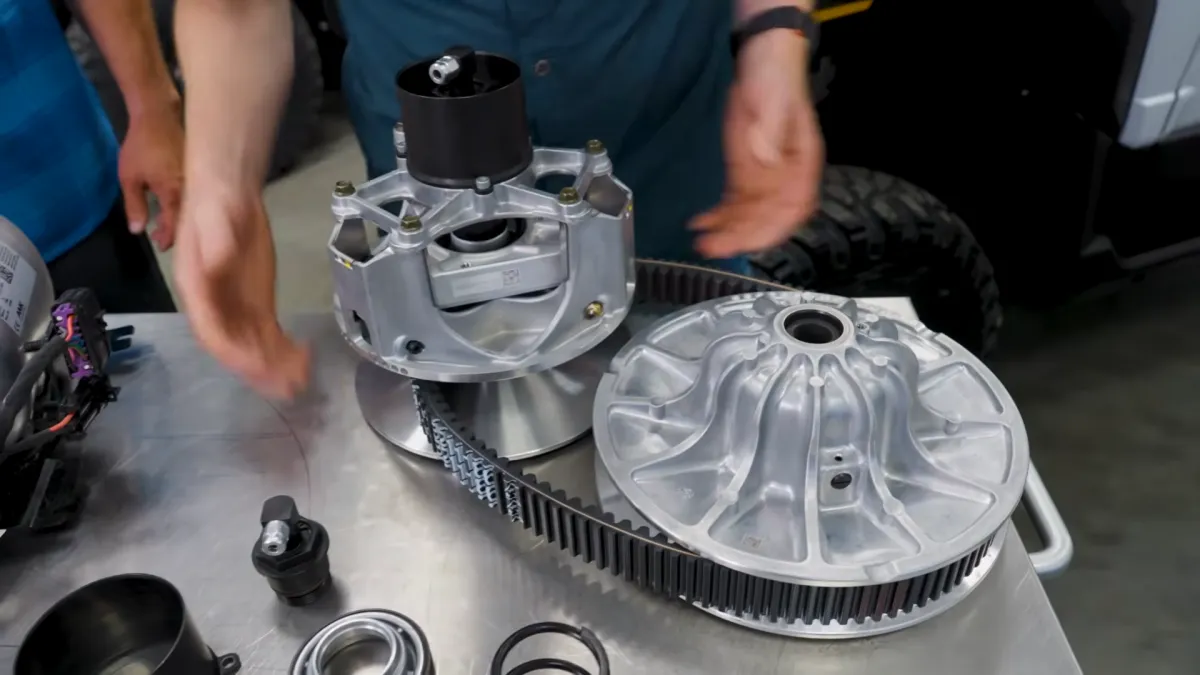
Polaris' mechanical CVT design is used in most of its vehicles. It has a drive clutch and a driven clutch connected by a belt. The drive clutch connects to the engine. It has springs and shift weights inside. At low engine speeds, it stays open.
We're a new kind of news feed.
Regular news is designed to drain you. We're a non-profit built to restore you. Every story we publish is scored for impact, progress, and hope.
Start Your News DetoxAs the engine speeds up, centrifugal force closes the drive clutch. This pushes the belt outward. At the same time, the driven clutch opens, letting the belt move inward. This shifts the CVT from a low ratio (more torque) to a higher ratio (more speed).
The new pneumatic system uses compressed air and a piston to compress the drive clutch. This lowers engine RPM, which means less engine noise and better fuel economy. The CVT also runs more quietly. This system activates during low-effort cruising or crawling when high torque isn't needed. In a large vehicle like the Xpedition, this makes the cabin quiet enough for normal conversation.
Drivers can control the air compression system with a rocker switch. It has three settings: Comfort, Standard, and Sport. Comfort mode prioritizes lower RPM. Sport mode mostly ignores the pneumatics, focusing on speed and power. Standard mode balances the two. This switch is next to the differential lock controls.
The pneumatic system significantly reduces noise. In Comfort mode, noise levels drop by about nine decibels at 35 mph (56 km/h). This is a 40% reduction compared to the standard CVT at that speed.
Added Benefits and Future Outlook
Adding an air compressor to the UTV has other advantages. The compressor is small, quiet, and powerful. It gets air through its own filtered nozzle. The connected tank holds enough air to inflate one tire from nearly empty. It can also air up all four tires from an off-road setting. This is done using a new air nozzle built into the left-rear fender. A removable panel provides access without tools.
This development shows how side-by-side vehicles are evolving. They have moved from simple designs to complex, trail-ready machines. Adding air for both tire inflation and drivetrain control is a logical next step. Polaris achieved this by improving existing technology rather than starting from scratch.
Deep Dive & References: Polaris via YouTube