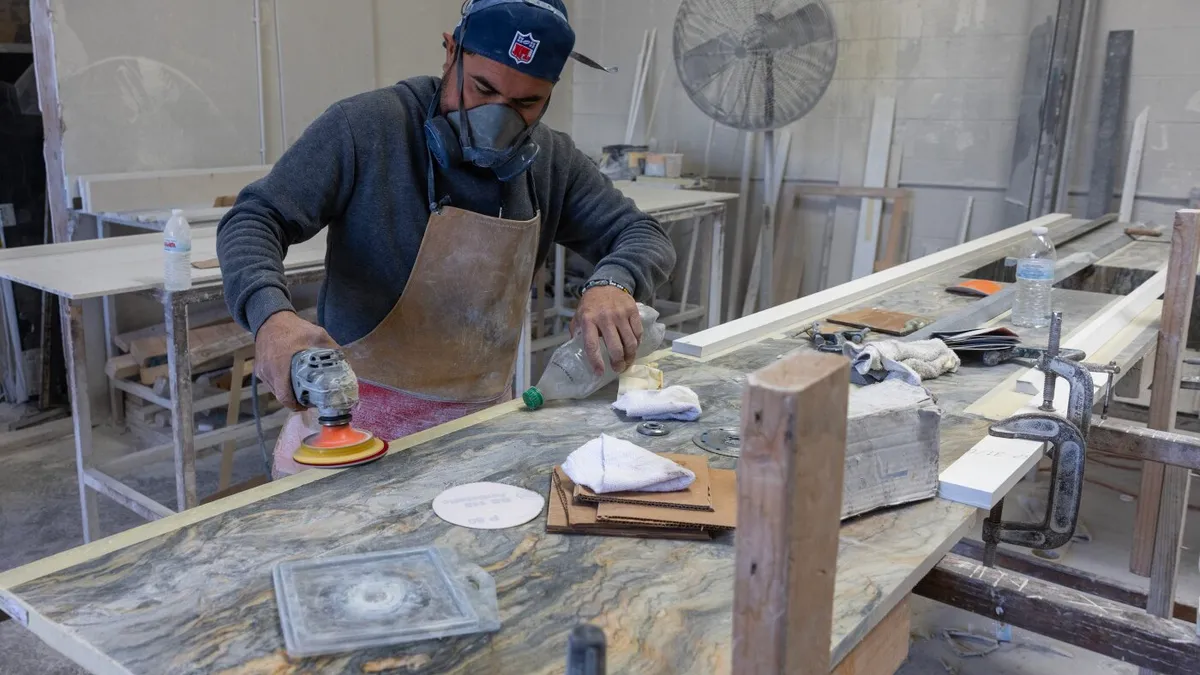
Nearly 500 workers in California have developed silicosis—a serious, irreversible lung disease—since 2019. More than 50 needed lung transplants. Twenty-seven are dead. Most are Hispanic men in their 30s and 40s, cutting engineered stone countertops in small fabrication shops.
The cause is clear: quartz and engineered stone slabs release far more lung-damaging silica dust than natural granite or marble when cut or polished. The problem is measurable. The solution is where things get complicated.
Two Opposite Responses
In California, workplace safety regulators are considering a ban on cutting engineered stone altogether—removing the material from the market. It's a blunt instrument, but the logic is straightforward: if the stone itself cannot be fabricated safely, don't fabricate it.
We're a new kind of news feed.
Regular news is designed to drain you. We're a non-profit built to restore you. Every story we publish is scored for impact, progress, and hope.
Start Your News DetoxMeanwhile, Republicans on a House Judiciary Committee subcommittee are pushing a bill that would do the opposite—ban workers' ability to sue the companies that manufacture and sell these stone slabs. Supporters frame this as refocusing accountability on workplace safety. Critics call it a "death sentence" that strips workers of their only real leverage.
Raphael Metzger, a California attorney representing countertop workers, is blunt about the mismatch: "They've got it backwards. It's not the lawsuits that should be banned, it's the stone slabs that should be banned, because they are deadly and they cannot be fabricated safely."
The Compliance Problem
Even where rules exist, they're not being followed. Over six months, California safety officials visited more than a hundred fabrication shops. They observed zero workers wearing appropriate respiratory protection. An estimated 25% of shops continue dry-cutting stone—the most dangerous method.
The disease is spreading beyond California. Workers have fallen ill in Texas, New York, Colorado, Washington, and Massachusetts. Each new case is someone's partner, parent, or sibling—a fact that Alice Berliner, with the Los Angeles County Department of Public Health, emphasized: "These are human lives, not just numbers."
Dr. Robert Blink, a workplace health expert, says the number of serious illnesses and deaths is "impossible to tolerate." The material, he notes, is even more dangerous than initially understood.
The Manufacturer's Position
Cambria, a major engineered stone manufacturer, disputes that the product itself is the problem. They argue the issue is unsafe cutting processes—a position that puts the burden of safety on workers and small shop owners rather than on the companies selling the raw material.
But as former OSHA director David Michaels points out, if manufacturers and distributors have no obligation to ensure their products can be used safely downstream, the outcome is predictable: "We will continue to see more and more cases of silicosis, more and more lung transplant cases, more and more deaths."
The trajectory is already climbing. California regulators fear the numbers will only grow. The question now is whether policy will move toward prevention—banning the stone—or liability protection—banning the lawsuits.