The planet speaks constantly in frequencies we've never heard. Glaciers calving, wildfires crackling, storms surging—they all emit acoustic energy below 20 hertz, infrasound so low that human ears simply can't catch it. These sounds travel thousands of miles as invisible waves, carrying information about distant geological events. Until recently, we had no way to access them.
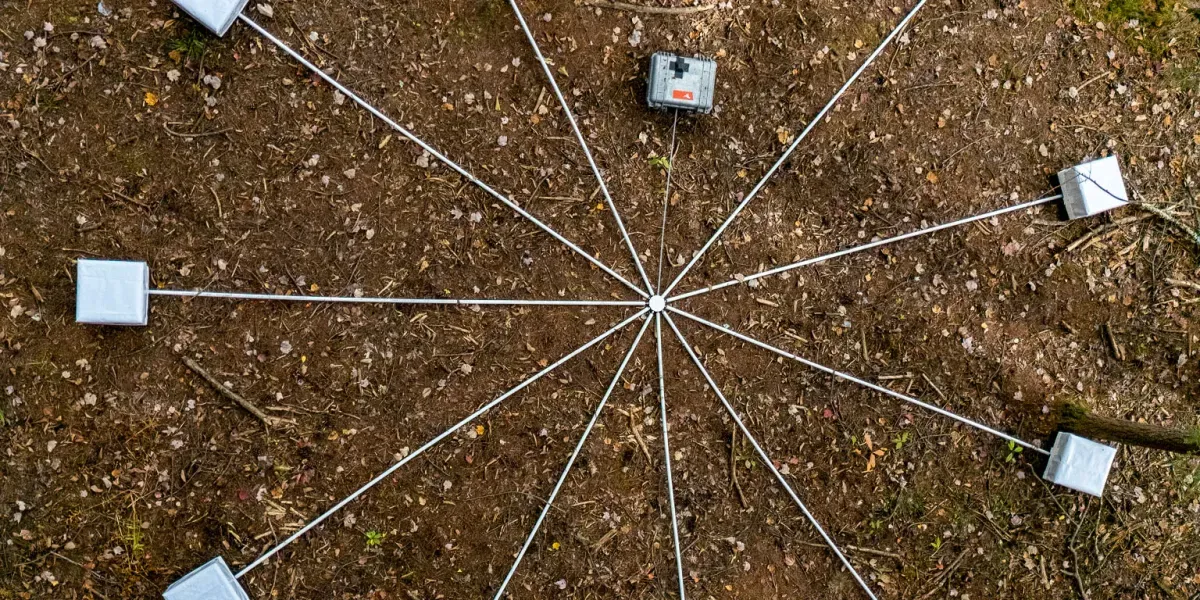
Musician and artist Brian House decided to listen anyway. His new album, Everyday Infrasound in an Uncertain World, compresses 24 hours of the Earth's inaudible rumbling into 24 minutes of otherworldly bass. The method is deceptively simple: House built three "macrophones"—tubes that funnel air into barometers capable of taking pressure readings 100 times per second. From his home in western Massachusetts, he captures what the planet is broadcasting. Then he speeds the recording up by a factor of 60, pushing infrasound into the range where human ears can finally perceive it.
"I am really interested in the layers of perception that we can't access," House says. "It's not only low sound, but it's also distant sound. That kind of blew my mind."
We're a new kind of news feed.
Regular news is designed to drain you. We're a non-profit built to restore you. Every story we publish is scored for impact, progress, and hope.
Start Your News DetoxWhat emerges is a 24-minute piece of ambient music like nothing most people have heard—an alternating sequence of low grumbling vibrations and soft, ghostlike whispers. A high-pitched whistle might be a distant train. An intense low-octave rattle could be a thunderstorm hundreds of miles away or a shifting ocean current. The mystery is deliberate. House doesn't always know what he's captured, and that uncertainty is part of the point.
Where Science Meets Listening
House's project sits at an intersection of art and science that's been quietly active for years. Barometers picked up the 1883 eruption of Krakatoa in London, thousands of miles away. Today, a global network of infrasound sensors helps enforce the nuclear test ban treaty by detecting underground explosions. Volcanologists like Leif Karlstrom at the University of Oregon use infrasound to monitor Mount Kilauea, watching for activity invisible to conventional seismographs.
Karlstrom helped House set up his recording array and interpret what he was hearing. "He's highlighting interesting phenomena," Karlstrom says, even though the exact source of each sound often remains uncertain—which is precisely what makes it compelling.
The album works because it makes the invisible tangible. Listening to it, you're not just hearing data or a scientific demonstration. You're touching something real: the living, shifting, rumbling planet beneath your feet. It's unsettling by design, a reminder that the world is far more active and complex than our senses typically allow us to perceive. And that's the kind of connection that might change how someone thinks about the ground they walk on.