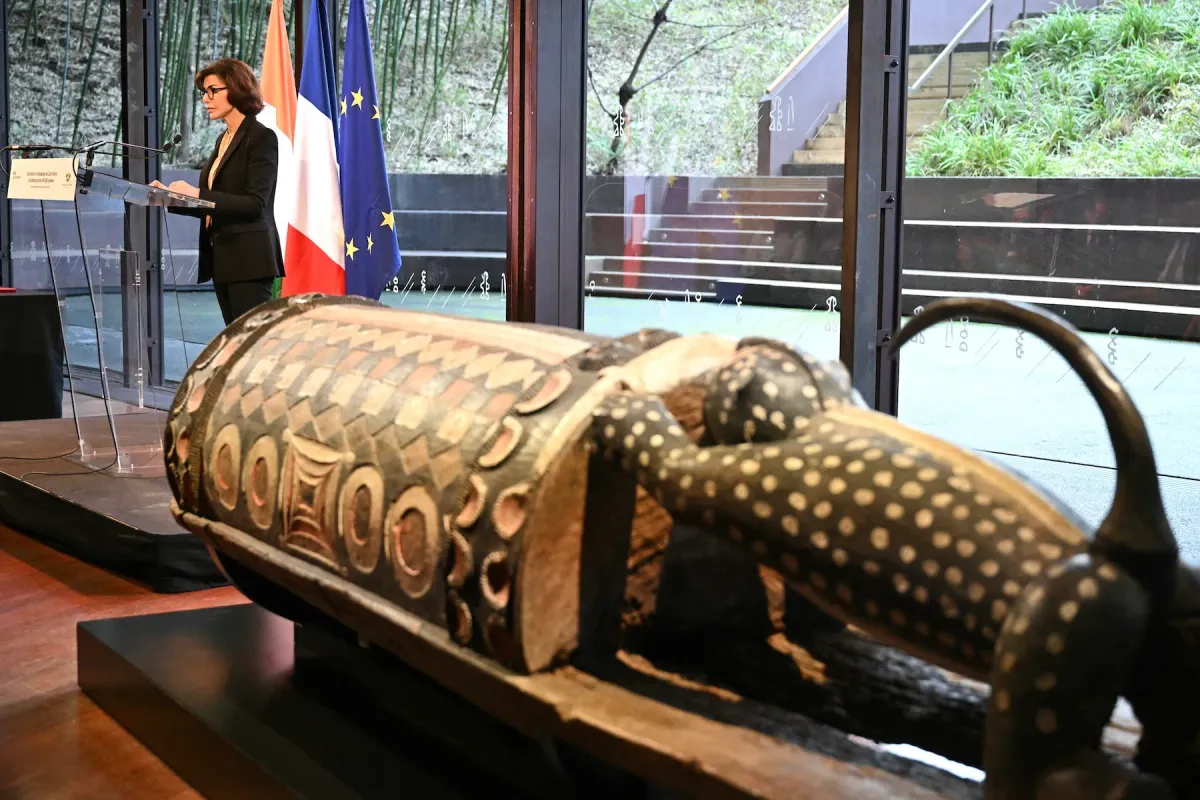
A ten-foot-long drum that once carried urgent messages between villages—warnings of forced recruitment, news of births and deaths—sat in a Paris museum for nearly a century. On Friday, it went home.
The Djidji Ayôkwé, known as the talking drum, was seized by French colonial authorities in 1916 as an explicit tool of suppression. The Atchan and Ebrié peoples of what is now Côte d'Ivoire had used it to transmit information across distances that would otherwise take days to cover. That power—the ability to organize, warn, communicate without French intermediaries—made it a threat worth confiscating.
The drum itself is a remarkable object. Carved from a single piece of wood and split lengthwise, it weighs 940 pounds and stretches ten feet long. A leopard leaps from one of the wooden planks extending from the opening. The soundbox is covered in carved faces and geometric patterns, each detail a record of craft and meaning that colonial authorities couldn't erase, only remove.
We're a new kind of news feed.
Regular news is designed to drain you. We're a non-profit built to restore you. Every story we publish is scored for impact, progress, and hope.
Start Your News Detox
For over a century, the drum lived in the Musée Quai Branly in Paris, where it was restored and preserved—carefully maintained by people who had no claim to it. The return became possible through a 2025 French parliamentary vote, following President Emmanuel Macron's 2017 commitment to repatriate looted African artifacts. Getting there required navigating French law, which treats publicly owned objects as permanently inalienable. Each restitution historically meant passing a separate law.
This return signals a shift. The French senate is now considering a broader bill that would streamline the repatriation of colonial-era objects, removing the need for case-by-case legislation. The talking drum topped a list of 148 objects that Côte d'Ivoire requested from France in 2019—it's the first major return, but likely not the last.
The drum is scheduled to be permanently exhibited at Côte d'Ivoire's Museum of Civilizations, where it will be seen by people whose ancestors' voices it once carried across the landscape.
The mechanics of restitution are still being worked out—France has returned relatively few objects compared to other European nations—but the direction is becoming clearer. What was taken as a symbol of control is being returned as a symbol of cultural sovereignty.