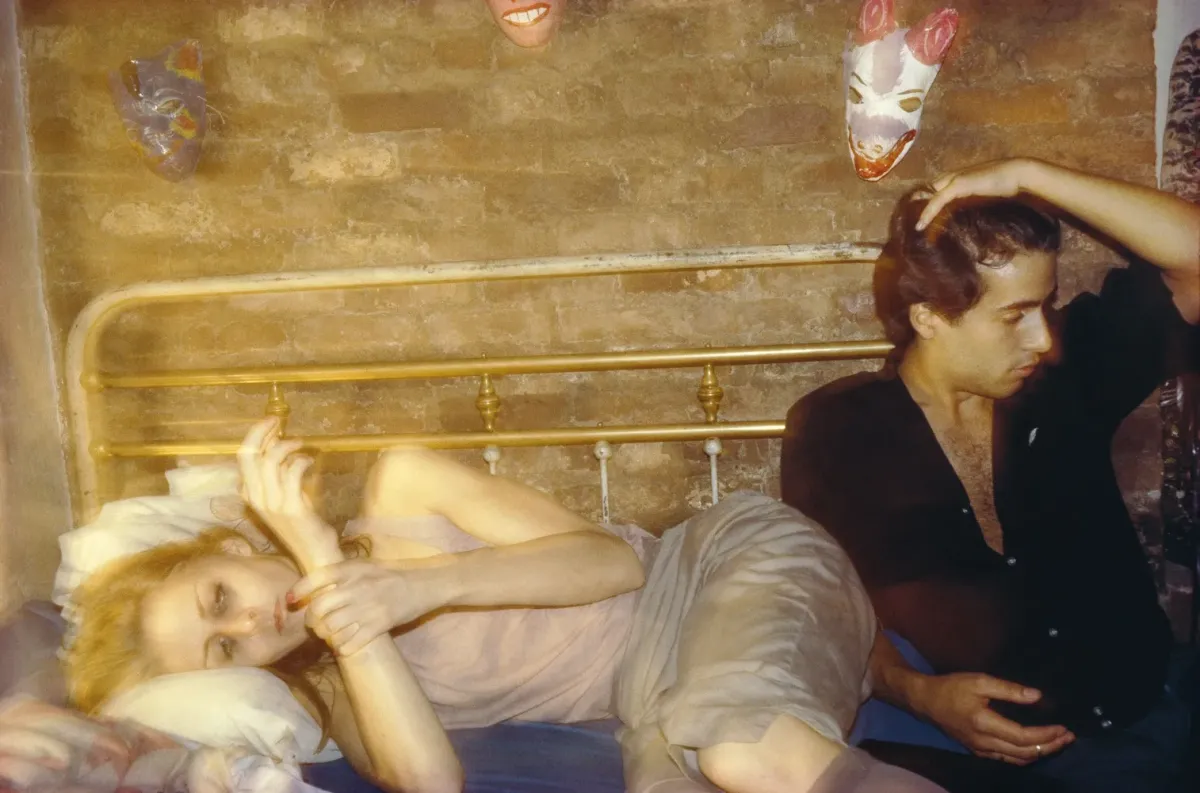
Forty years after its first publication, Nan Goldin's "The Ballad of Sexual Dependency" remains one of those rare works that doesn't just document a moment in time — it defines it. The photobook, which has sold through over 20 printings since 1986, is now on view in full at Gagosian's London gallery: all 126 photographs that changed how we think about intimacy, vulnerability, and what photography could do.
Goldin took most of these images between 1973 and 1986, moving through New York, Boston, Berlin, Provincetown, and Mexico with a camera and an unflinching eye. She photographed her friends, her lovers, drag queens, people struggling with addiction — the people around her, in bars and bedrooms and cars and beaches. What made this radical wasn't just the subject matter. It was that she used color film when serious photographers still worked in black and white. It was that she mixed the language of family albums, diary entries, fashion photography, and paparazzi into something entirely her own.
The work carries a weight most people don't know about. Goldin dedicated the Ballad to her older sister, Barbara, who died by suicide when Goldin was 11. As she wrote in the book's foreword — which she has never changed across all these years — "I lost the real memory of my sister. I remember my version of her, of the things she said, of the things she meant to me. But I don't remember the tangible sense of who she was. I don't ever want to lose the real memory of anyone again." That desire to hold onto people, to document and preserve them exactly as they were, runs through every photograph.
We're a new kind of news feed.
Regular news is designed to drain you. We're a non-profit built to restore you. Every story we publish is scored for impact, progress, and hope.
Start Your News DetoxOne image in particular has become iconic: a self-portrait Goldin took one month after being beaten by an ex-boyfriend. Her face is swollen, her eyes blackened, her red lipstick still on. It's a photograph about violence, yes, but also about survival and about claiming your own story.
Before it was a book, the Ballad existed as a slideshow performance — Goldin clicking through around 750 images set to an eclectic 40-song soundtrack. That multimedia version debuted at the Times Square Show in 1980, a collaborative exhibition that captured the energy of downtown New York. When the photobook came out the following year, critics understood immediately that they were looking at something generational. The New York Times photography critic Andy Grundberg compared it to Robert Frank's "The Americans," which had done the same thing for the 1950s.
Goldin herself has always been clear about what the work meant to her: "The Ballad of Sexual Dependency is the diary I let people read. The diary is my form of control over my life. It allows me to obsessively record every detail. It enables me to remember."
That impulse — to remember, to witness, to refuse to let people disappear — is why the Ballad still matters. It's why museums like MoMA and the Tate Modern have shown it. It's why, four decades later, seeing all 126 photographs together still feels like being let into someone's most private world.