Emily Carr spent her career chasing what she called "the green idea or ideal"—not just painting what British Columbia's forests looked like, but trying to capture how it felt to be inside them. Now, the Vancouver Art Gallery is showing the most comprehensive collection of her work in over 20 years, and it's a chance to see how completely she succeeded.
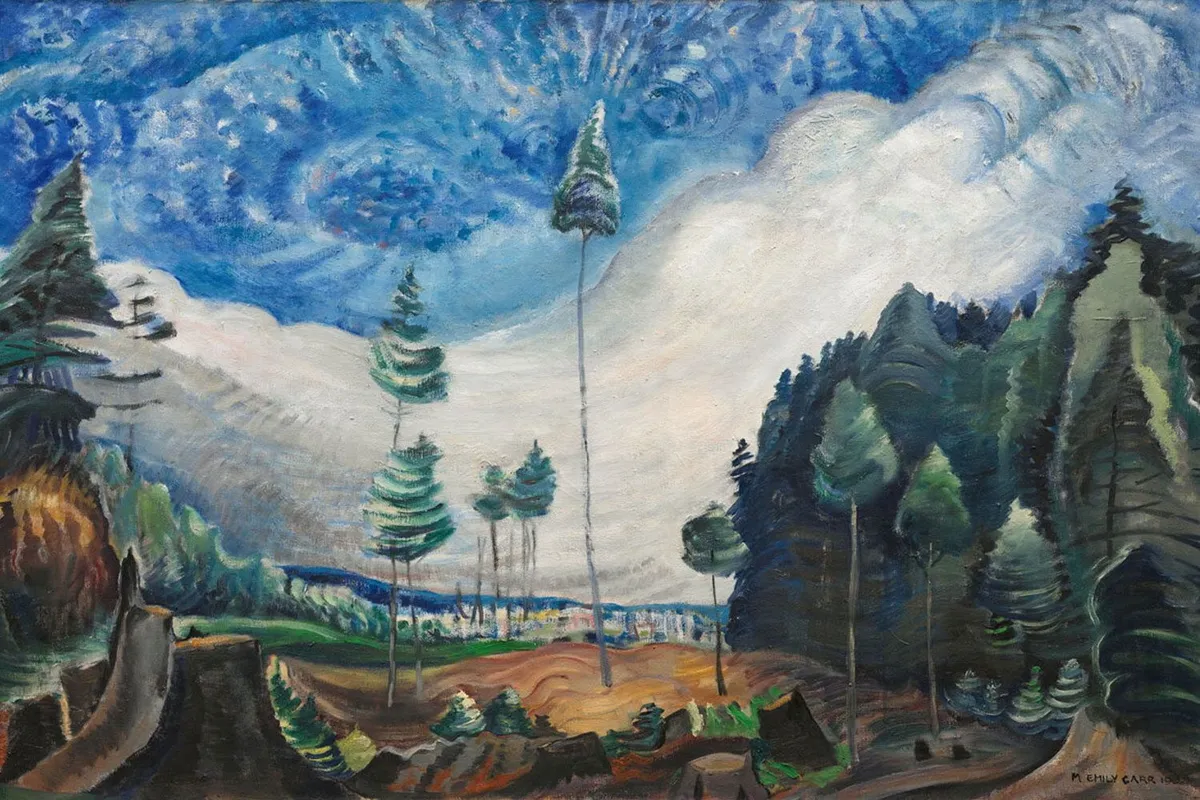
Loggers' Culls, Emily Carr, 1935 Collection of the Vancouver Art Gallery / Gift of Miss I. Parkyn
Carr was born in Victoria in 1871 and spent years studying in San Francisco, London, and Paris before returning home. When she first exhibited paintings of Haida Gwaii's totem poles in 1913, nobody was interested. But in 1927, a National Gallery of Canada exhibition suddenly revived her reputation, and over the next 15 years she created the swirling, dense forest scenes that made her name.
We're a new kind of news feed.
Regular news is designed to drain you. We're a non-profit built to restore you. Every story we publish is scored for impact, progress, and hope.
Start Your News DetoxWhat's striking about Carr's approach is how physical it is. "Her vision was so compelling that we now tend to take it for granted," says exhibition curator Richard Hill, "overlooking how her paintings continue to shape our visual understanding of the region." She didn't paint forests the way most landscape artists did—distant, composed, safe to look at from a distance. Instead, she painted them the way you experience them when you're actually lost in one: overwhelming, close, alive.
Pemberton Meadows, Emily Carr, 1933 Collection of the Vancouver Art Gallery / Emily Carr Trust
She spent time in nature as both a careful observer and something closer to a spiritual seeker. In her journals, she wrote: "Find the forms you desire to express your purpose. When you have succeeded in getting them as near as you can to express your idea, never leave them but push further on and on, strengthening and emphasizing those forms to enclose that green idea or ideal." It's the voice of someone not satisfied with representation—she wanted transcendence.
The exhibition, titled "That Green Ideal," includes paintings, drawings, and rarely seen works on paper—charcoal studies and mixed-media pieces that show her constantly experimenting with how to get closer to that essence. By her final works, she'd moved from trying to paint spatial proximity to nature into imagining herself as part of it entirely.
Among the Trees, Emily Carr, 1936 Collection of the Vancouver Art Gallery / Emily Carr Trust
It's worth noting that Carr's relationship with Indigenous communities is more complicated than her legacy sometimes suggests. Her connection to the Haida people and other First Nations was genuine, but she sometimes identified as Indigenous herself despite her white settler background—something that's now understood as cultural appropriation, even if her intentions came from a place of deep respect and spiritual seeking.
Carr died in 1945, but her market value has only climbed. A painting she created in 1935 sold for $576,000 at auction last year. In 2024, a work that had been sitting in someone's collection, purchased for $50, sold for $250,000 after being identified as an original Carr. Her vision of the Pacific Northwest landscape has become so foundational to how we see that region that it's hard to imagine it any other way.
"That Green Ideal: Emily Carr and the Idea of Nature" runs through November 8, 2026.