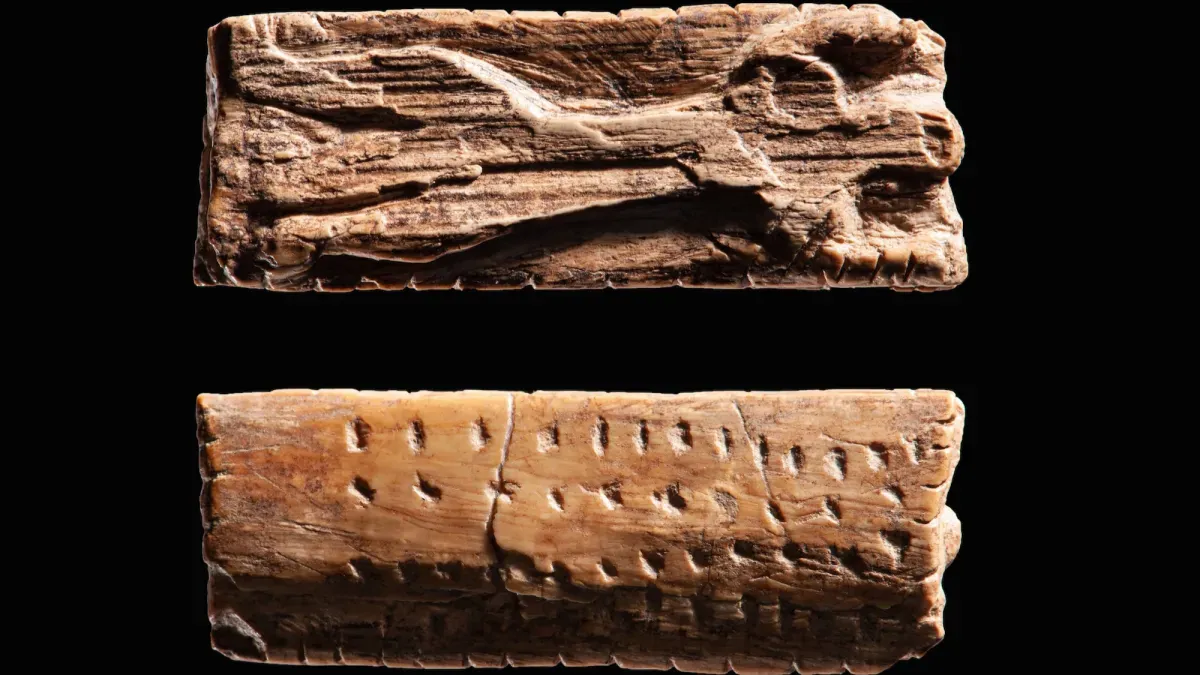
A mammoth tusk carved with deliberate marks. An ivory figurine with outstretched arms. Lines, crosses, dots, notches—repeated in patterns across Stone Age artifacts from a remote German mountain range. Archaeologists have long wondered what these symbols meant. Now, new research suggests they were something humans were actively experimenting with tens of thousands of years before civilization built its first cities.
The discovery, published in the Proceedings of the National Academy of Sciences, pushes back the origins of symbolic writing by roughly 37,000 years. The earliest writing systems we knew about—Mesopotamian proto-cuneiform—emerged around 3000 BCE. These Stone Age carvings from Germany's Swabian Jura date to around 40,000 years ago, when Homo sapiens was still settling Europe and encountering Neanderthals.
Decoding the Past Without Translation
Ewa Dutkiewicz and her team at Berlin's Museum of Prehistory and Early History spent years analyzing 260 artifacts recovered from cave sites in the Swabian Jura. They catalogued over 3,000 geometric carvings into a Stone Age sign database, then used computational analysis tools to compare these symbols with writing systems that emerged much later. The approach was deliberately different from traditional archaeology: rather than trying to translate what the symbols meant, researchers examined their measurable characteristics—how they were structured, how often they repeated, how they combined.
We're a new kind of news feed.
Regular news is designed to drain you. We're a non-profit built to restore you. Every story we publish is scored for impact, progress, and hope.
Start Your News DetoxChristian Bentz, a co-author from Saarland University, explains the insight: "The human ability to encode information in signs and symbols was developed over many thousands of years. Writing is only one specific form in a long series of sign systems."
Using quantitative linguistics and statistical modeling, the team compared Paleolithic carvings to proto-cuneiform and modern writing. One finding surprised them: proto-cuneiform looked more like its Stone Age ancestors than like contemporary writing systems. This suggests that the fundamental way humans encode information—the basic architecture of symbolic communication—may have remained remarkably stable for tens of thousands of years.
Bentz notes another clue in the patterns themselves. "The signs on the archaeological objects are frequently repeated—cross, cross, cross, line, line, line. This type of repetition is not a feature found in spoken language." The symbols weren't transcribing speech. They were doing something else entirely: storing information in a form that could be carved, preserved, and presumably understood by others.
What these specific symbols communicated remains unknown. But their very existence points to something profound about human cognition. Stone Age people possessed the same capacity for abstract thinking, pattern recognition, and information design that we do today. They weren't waiting for civilization to invent writing. They were already experimenting with it, carving their attempts into bone and ivory.
Dutkiewicz acknowledges the work is just beginning. "There are many sign sequences to be found on artifacts. We've only just scratched the surface." As researchers continue mapping these ancient symbols, they're learning that the history of human communication isn't a sudden leap from speech to writing. It's a conversation that began in caves, 40,000 years ago, and never stopped.