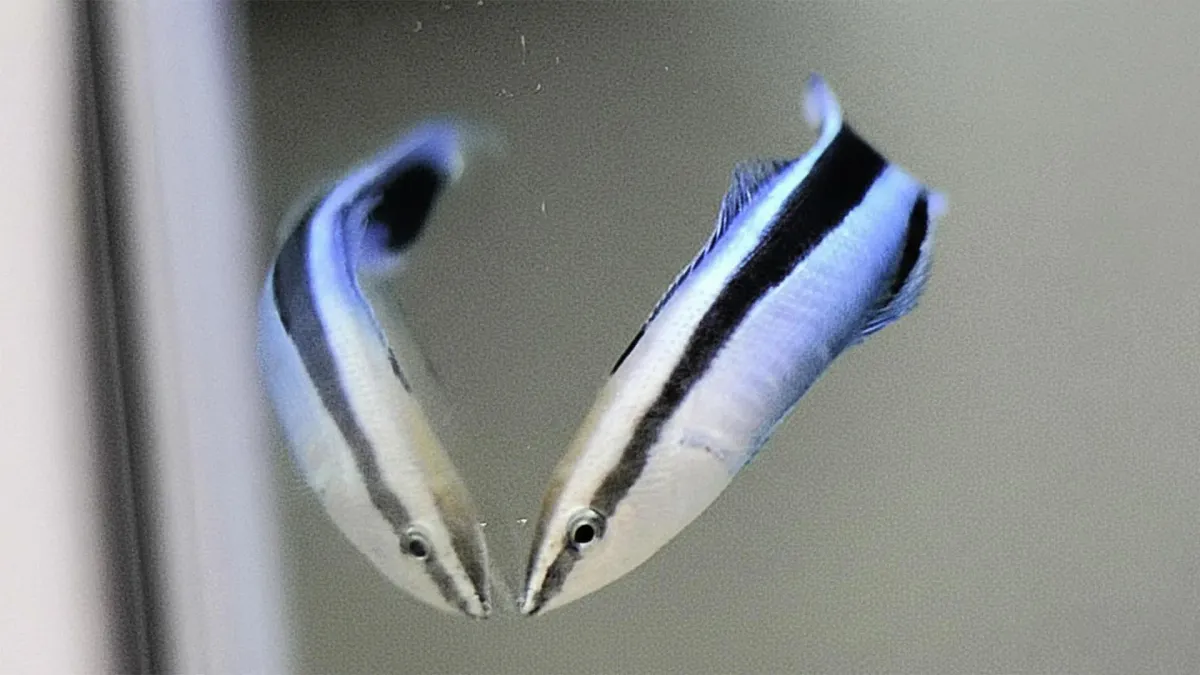
A small fish in the Indian Ocean just demonstrated something that most animals can't: it figured out what a mirror is, and then tested that knowledge deliberately.
Cleaner wrasse are already remarkable — they're social fish that pick parasites off larger reef dwellers, a job that requires trust and communication. But researchers at Osaka Metropolitan University in Japan discovered something unexpected when they introduced mirrors to these fish. Not only did the wrasse recognize their own reflections; they started experimenting with the mirror using objects, a level of thinking previously documented only in dolphins and manta rays.
Here's what happened. Scientists marked the fish with artificial parasite-like spots, then showed them a mirror for the first time. Most fish took four to six days to notice the marks and try to remove them. These wrasse did it in 82 minutes on average. Some scratched at the marks within the first hour. The speed matters because it suggests the fish already knew something was wrong with their bodies — they just needed visual confirmation.
We're a new kind of news feed.
Regular news is designed to drain you. We're a non-profit built to restore you. Every story we publish is scored for impact, progress, and hope.
Start Your News DetoxBut the truly striking part came next. After several days with the mirror, some fish picked up bits of shrimp from the tank floor, carried them toward the mirror, and released them. As the shrimp drifted downward, the fish watched the reflection and touched the glass repeatedly, tracking the movement in the mirror. They weren't testing themselves. They were testing the mirror itself.
Researchers call this "contingency testing." The wrasse were deliberately investigating how reflected space works — comparing what they saw in the mirror with what was actually happening. It's the kind of deliberate, flexible thinking that suggests genuine self-awareness rather than simple conditioning or confusion.
"These findings suggest that self-awareness may not have evolved only in the limited number of species that passed the mirror test," said Dr. Shumpei Sogawa, who led the research, "but may be more widely prevalent across a broader range of taxonomic groups, including fish."
What this means is that our understanding of which animals are conscious, which animals understand themselves, is probably incomplete. We've been looking for self-awareness in the big, obvious places — primates, cetaceans, elephants. But intelligence might be distributed far more widely across the tree of life than we've assumed. A fish the size of your hand just showed us that.
The implications ripple outward. How we treat animals in captivity, how we design medical research, even how we think about building artificial intelligence — all of it rests partly on understanding consciousness and self-awareness. If these traits are more common than we thought, the ethical questions become harder and more urgent.
The research team is already planning to look further, examining self-awareness across invertebrates and other overlooked species. The next discovery might come from somewhere equally unexpected.