Researchers at the University of Pennsylvania are exploring a new way to power future AI systems. They are looking into using light-matter particles instead of just electrons. This could change how computers work, much like the first electronic computer, ENIAC, did eighty years ago.
ENIAC used electrons for calculations. Modern computers still use this method. However, as AI systems grow, traditional electronics face limits due to physical and energy issues.
Why AI Needs a New Approach
Electrons carry an electrical charge. This creates problems as computer chips get more advanced. Moving electrons generates heat and resistance, which wastes energy and makes cooling systems harder. These issues are growing because AI hardware needs to process huge amounts of data.
We're a new kind of news feed.
Regular news is designed to drain you. We're a non-profit built to restore you. Every story we publish is scored for impact, progress, and hope.
Start Your News DetoxTo tackle this, Penn physicists, led by Bo Zhen, are studying if photons (light particles) can take over some tasks from electrons.
Li He, a co-first author of a paper in Physical Review Letters, explained that photons carry information quickly with minimal loss. This makes them great for communication technology. However, photons don't interact much with their environment. This makes them poor at the signal-switching logic that computers need.
Light is efficient for moving information. But it usually lacks the strong interactions needed for computing operations like switching and making decisions.
Light-Matter Particles for All-Light Computing
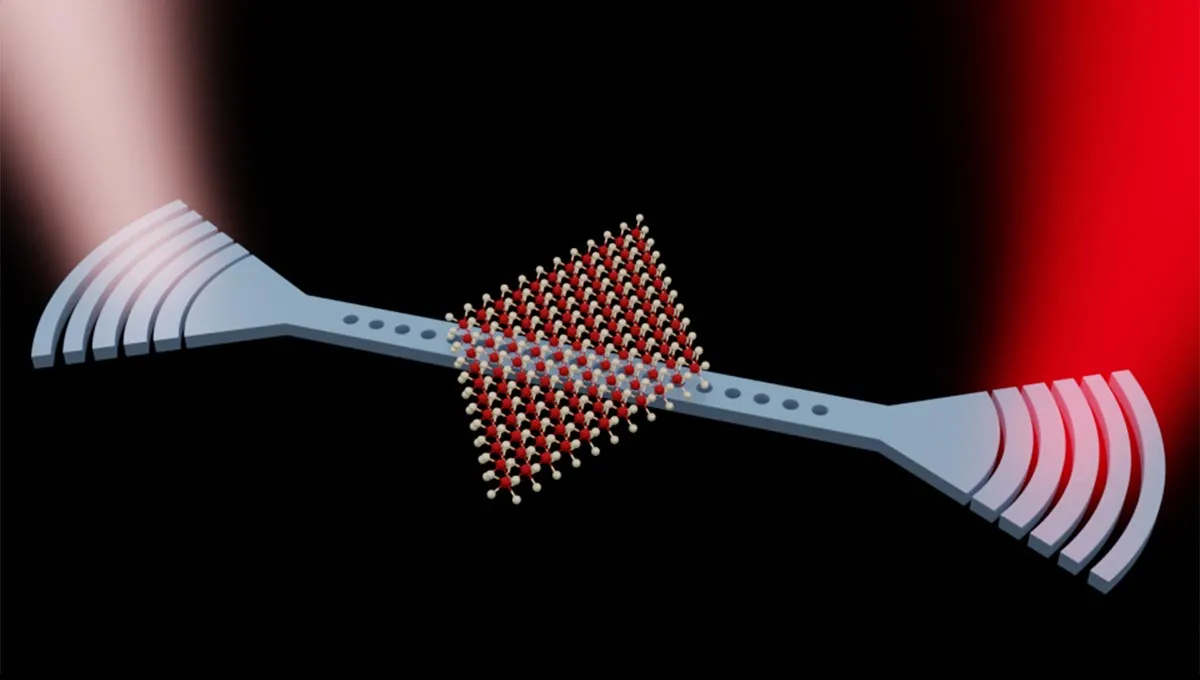
Zhen's team found a solution by creating special particles called exciton-polaritons. These particles form when photons and electrons combine inside a very thin semiconductor. The result is a hybrid particle that has the speed of light and the stronger interactions of matter.
This discovery could be very important for AI computing. Many photonic AI chips already use light for fast calculations. But for decision-related operations, they often convert optical signals back to electronic ones. These conversions slow things down and use more power, reducing the benefits of photonic computing.
The Penn team used exciton-polaritons to show all-light switching. It used only about 4 quadrillionths of a joule of energy. This is an extremely small amount, much less than what a small LED light needs.
The Future of AI Chips
If this technology can be scaled up, future photonic chips could process light directly from cameras. They would not need to constantly switch between light and electricity. Researchers believe this could greatly lower the energy needs of large AI systems. It might also support basic quantum computing functions on chips.
Deep Dive & References: Strongly Nonlinear Nanocavity Exciton Polaritons in Gate-Tunable Monolayer Semiconductors - Physical Review Letters, 2026