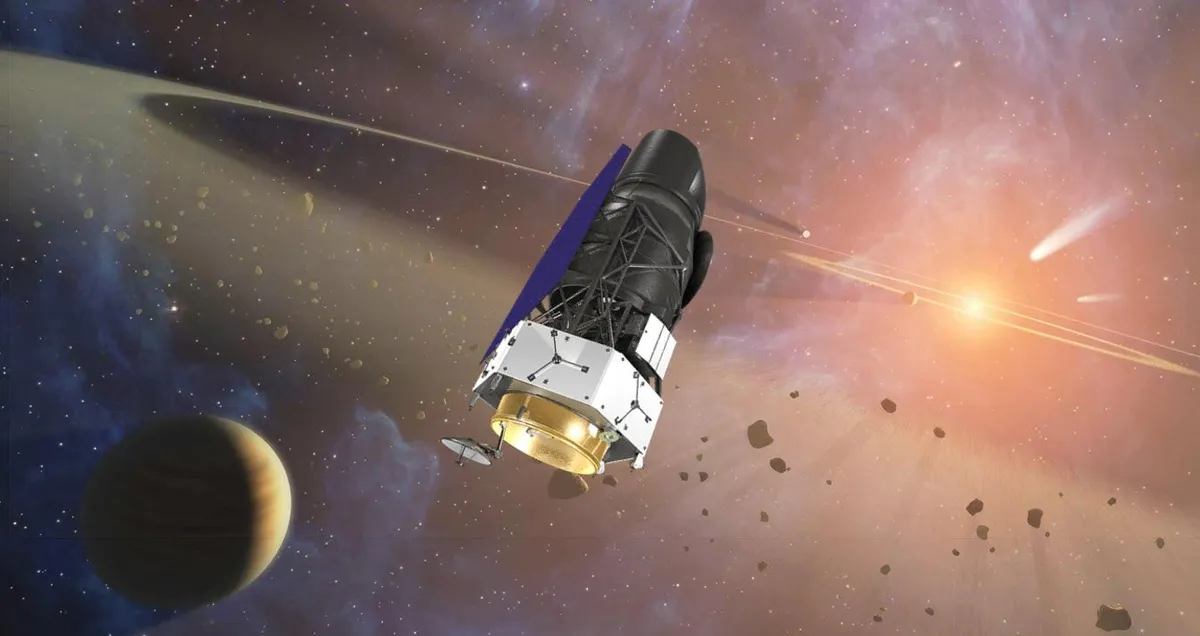
Good news for anyone who enjoys their cosmic mysteries with a side of stunning clarity: NASA’s Nancy Grace Roman Space Telescope is gearing up for launch even sooner than expected. Originally slated for May 2027, this universe-peeping marvel is now aiming for a September 2026 liftoff. That's right, an entire eight months ahead of schedule, which in government projects usually means someone forgot to carry the one. But hey, we'll take it.
This isn't just another pretty picture machine. Roman is designed to tackle some of the biggest head-scratchers in the cosmos, from the elusive dark matter to the even more elusive dark energy, and, because why not, a few hundred thousand exoplanets for good measure.
The Universe, Unblurred
Think of it as the ultimate wide-angle lens for the universe. Roman will use high-resolution infrared imaging to capture vast swathes of the sky, letting astronomers see things on a scale that was previously more theoretical than observable. It's like upgrading from a peephole to a panoramic window, and the view promises to be spectacular.
We're a new kind of news feed.
Regular news is designed to drain you. We're a non-profit built to restore you. Every story we publish is scored for impact, progress, and hope.
Start Your News DetoxIts main mission? To unravel the secrets of dark energy and dark matter – the invisible forces making up about 95% of the universe that we still know virtually nothing about. It'll also be an exoplanet hunter, expected to sniff out around 100,000 worlds orbiting distant stars. Plus, with its advanced tools, scientists are hoping it'll stumble upon entirely new phenomena that we haven't even thought to look for yet. Because apparently that's where we are now: designing telescopes to find things we don't know exist.
Over its five-year mission, Roman is expected to hoover up about 20,000 terabytes of data. That's enough information to study hundreds of millions of galaxies and billions of stars. Let that satisfying number sink in. These broad surveys are precisely what researchers hope will uncover those rare, unexpected cosmic events that could completely rewrite our understanding of everything.
When it finally blasts off, it'll be riding a SpaceX Falcon Heavy rocket from Kennedy Space Center in Florida. Consider it a cosmic collaboration, proving that when public investment, expert knowledge, and private companies play nice, we get to explore the universe faster. Which, if you think about it, is both impressive and slightly terrifying. Get ready to have your mind expanded, eight months early.