Dark matter makes up most of the universe's matter, but scientists cannot see it directly. It does not interact with light or electromagnetic forces. Gravity is the only known way to detect it.
Now, researchers believe colliding black holes could offer a new way to find clues about this invisible substance.
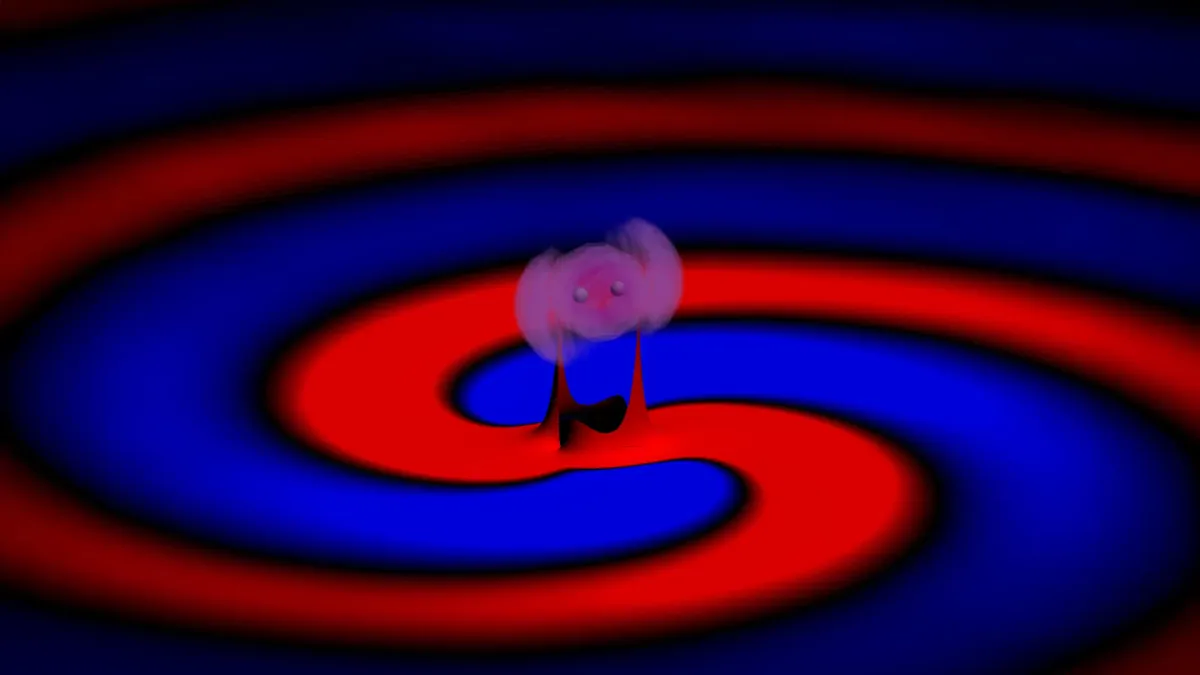
Physicists at MIT and European institutions created a method to spot possible signs of dark matter in gravitational waves. These waves are ripples in space and time. They form when huge objects like black holes spiral together and merge. If these black holes move through dense dark matter clouds before colliding, the gravitational waves might carry subtle traces of this interaction.
We're a new kind of news feed.
Regular news is designed to drain you. We're a non-profit built to restore you. Every story we publish is scored for impact, progress, and hope.
Start Your News DetoxThe team tested their method using public data from LIGO-Virgo-KAGRA (LVK). This international network of observatories tracks black hole mergers and other cosmic events.
Searching Gravitational Waves for Dark Matter Clues
The researchers looked at signals from LVK's first three observing runs. They focused on 28 of the clearest gravitational wave events.
For 27 events, the signals matched what scientists expected from black holes merging in empty space. But one signal, called GW190728, looked different. The team's analysis suggests its gravitational wave pattern might show evidence of interacting with dark matter.
The researchers emphasize this is not a confirmed dark matter discovery. Instead, the new technique helps scan gravitational wave data for promising signals. These signals could then be studied further.
"We know that dark matter is around us," said Josu Aurrekoetxea, a postdoc in the MIT Department of Physics. "It just has to be dense enough for us to see its effects." He added that black holes can increase this density. Scientists can now search for this by analyzing gravitational waves from mergers.
The findings were published in Physical Review Letters. Aurrekoetxea co-authored the study with Soumen Roy, Rodrigo Vicente, Katy Clough, and Pedro Ferreira.
How Black Holes Could Amplify Dark Matter
Dark matter is a major mystery in physics. Scientists infer it exists because gravity around galaxies seems stronger than visible matter alone can explain. Observations of gravitational lensing, where light bends around galaxies, point to an unseen source of mass.
Estimates suggest dark matter could make up over 85% of the universe's matter. However, researchers still do not know what dark matter is made of.
One idea involves very light particles called "light scalar" particles. Theories suggest these particles can act like coordinated waves near black holes.
Scientists think that when these waves meet a fast-spinning black hole, the black hole's rotational energy can transfer to the dark matter waves. This greatly increases their density. This process, called superradiance, is like whipping cream into butter.
If the density gets high enough, the dark matter could change the gravitational waves produced when black holes collide.
Predicting Dark Matter Imprints in Space-Time
To explore this, the researchers created detailed simulations of black hole mergers. They looked at many different conditions. They changed factors like the black holes' masses and sizes, and the amount and density of surrounding dark matter.
Using these simulations, the team predicted how gravitational waves would look if black holes merged in a dense dark matter environment. This was compared to merging in empty space.
The model also considered how these waves would change as they traveled millions of light-years to reach detectors on Earth.
The researchers then compared their predictions with actual LVK observations. Out of the 28 strongest signals, GW190728 was the only one that matched the dark matter scenario.
GW190728 was first detected on July 28, 2019. Earlier studies showed the signal came from two black holes. Their combined mass was about 20 times that of the sun. The new analysis suggests these black holes may have merged within a dense cloud of dark matter.
A Promising New Tool for Dark Matter Research
"The statistical significance of this is not high enough to claim a detection of dark matter," Aurrekoetxea said. He noted that other groups should perform further checks. "What we think is important to highlight is that without waveform models like ours, we could be detecting black hole mergers in dark matter environments, but systematically classifying them as having occurred in vacuum."
Researchers believe the growing number of gravitational wave observations could make this method more useful.
"We now have the potential to discover dark matter around black holes as the LVK detectors keep collecting data in the coming years," said co-author Soumen Roy, who led the data analysis. "It is an exciting time to search for new physics using gravitational waves."
"Using black holes to look for dark matter would be fantastic," added co-author Rodrigo Vicente, who developed the analytical model. "We would be able to probe dark matter at scales much smaller than ever before."
Deep Dive & References
Scalar Fields around Black Hole Binaries in LIGO-Virgo-KAGRA - Physical Review Letters, 2026