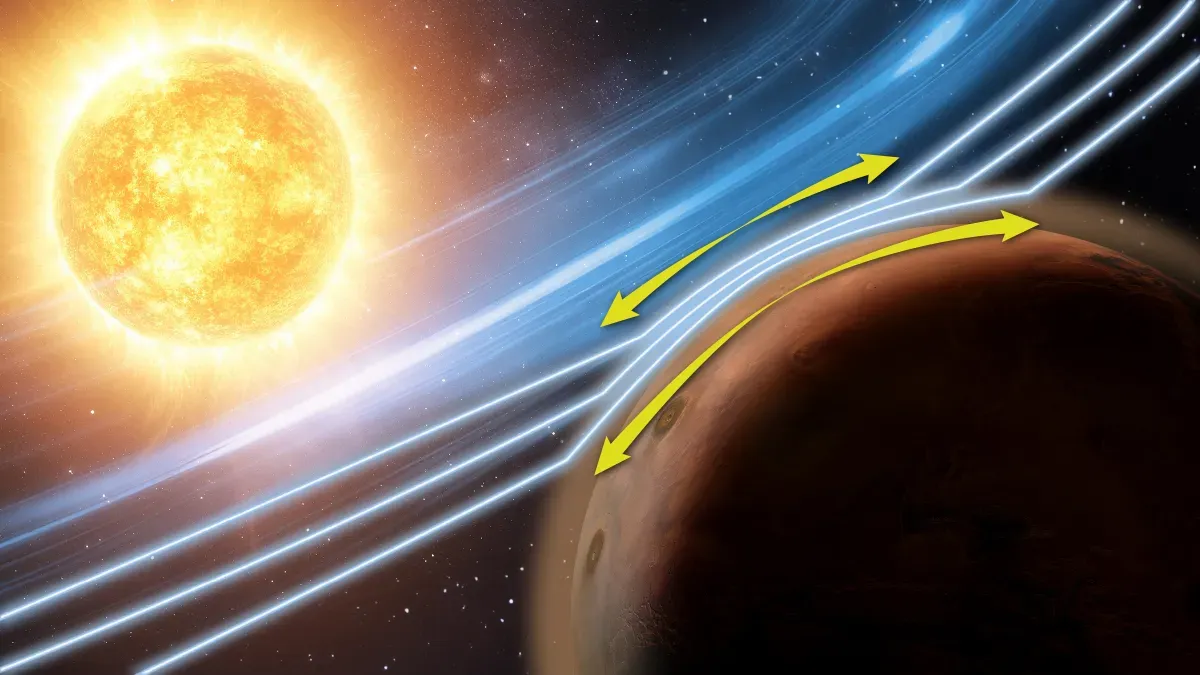
Turns out, Mars' atmosphere is a bit more dramatic than we thought. Scientists, using NASA's MAVEN mission, just spotted something called the Zwan-Wolf effect deep within the Martian air. And apparently, it's been doing a little dance.
This effect, first identified in 1976, was previously thought to be an exclusive club for magnetospheres — the magnetic bubbles around planets like Earth that deflect solar wind. It's basically a cosmic bouncer, squeezing charged particles to push away solar tantrums. Mars, famously, doesn't have a global magnetic field, so finding this effect in its atmosphere was like finding a fish riding a bicycle.
Christopher Fowler, the West Virginia University research assistant professor who led the study, described finding "very interesting wiggles" in the data. Which, if you're a scientist, is basically code for "What the heck is going on here?"
We're a new kind of news feed.
Regular news is designed to drain you. We're a non-profit built to restore you. Every story we publish is scored for impact, progress, and hope.
Start Your News DetoxThe Atmosphere's Secret Squeeze
Unlike Earth's sturdy magnetic shield, Mars has what's called an induced magnetosphere. Think of it as a temporary, solar-wind-activated force field that pops up when the sun throws a fit. It's less a bouncer, more a highly reactive, sometimes-there security guard.
Fowler and his team saw the Zwan-Wolf effect doing its thing in Mars' ionosphere, a charged layer of atmosphere less than 200 kilometers above the surface. The data showed particles getting squeezed and spread around, especially when a big solar storm decided to pay Mars a visit. It seems these powerful space weather events kick the Zwan-Wolf effect into high gear, making it strong enough for MAVEN to spot.
Before this, no one expected to see this kind of magnetic particle choreography in an atmosphere. It means our understanding of how the Sun messes with Mars just got a new, wiggly chapter. And it's not just Mars; this could offer clues about similar effects on other magnetic-field-challenged bodies, like Venus or Saturn's moon Titan.
Understanding these atmospheric aerobics is crucial, especially as we send more tech to the Red Planet. Knowing how solar storms can literally reshape Mars' atmosphere helps us protect our equipment and, you know, not lose track of a multi-billion dollar rover because the ionosphere decided to throw a party.
Shannon Curry, MAVEN's principal investigator, put it simply: knowing how space weather interacts with Mars is "vital." And the MAVEN team, launched in 2013 to study how Mars lost its atmosphere, just keeps proving her right, one wiggly discovery at a time. It’s almost as if Mars still has a few secrets up its sleeve, even without a proper magnetosphere.