A new type of worm, called Caenorhabditis apta, has been found in the wild. Researchers believe it may have traveled to Europe by "hitchhiking" on invasive beetles. This discovery reveals an unexpected partnership hidden inside rotting fruit.
In 2025, scientists in Konstanz were studying rotting fruit in orchards. They saw hundreds of worms stretching upwards together, forming structures called "towers." This behavior had only been seen in labs before.
The team later recreated this in the lab. They found that these worm towers could stick to fruit flies. This supports the idea that worms use other animals to move to new places. However, the specific animals carrying the worms in the wild were still unknown.
We're a new kind of news feed.
Regular news is designed to drain you. We're a non-profit built to restore you. Every story we publish is scored for impact, progress, and hope.
Start Your News DetoxBeetles as Carriers
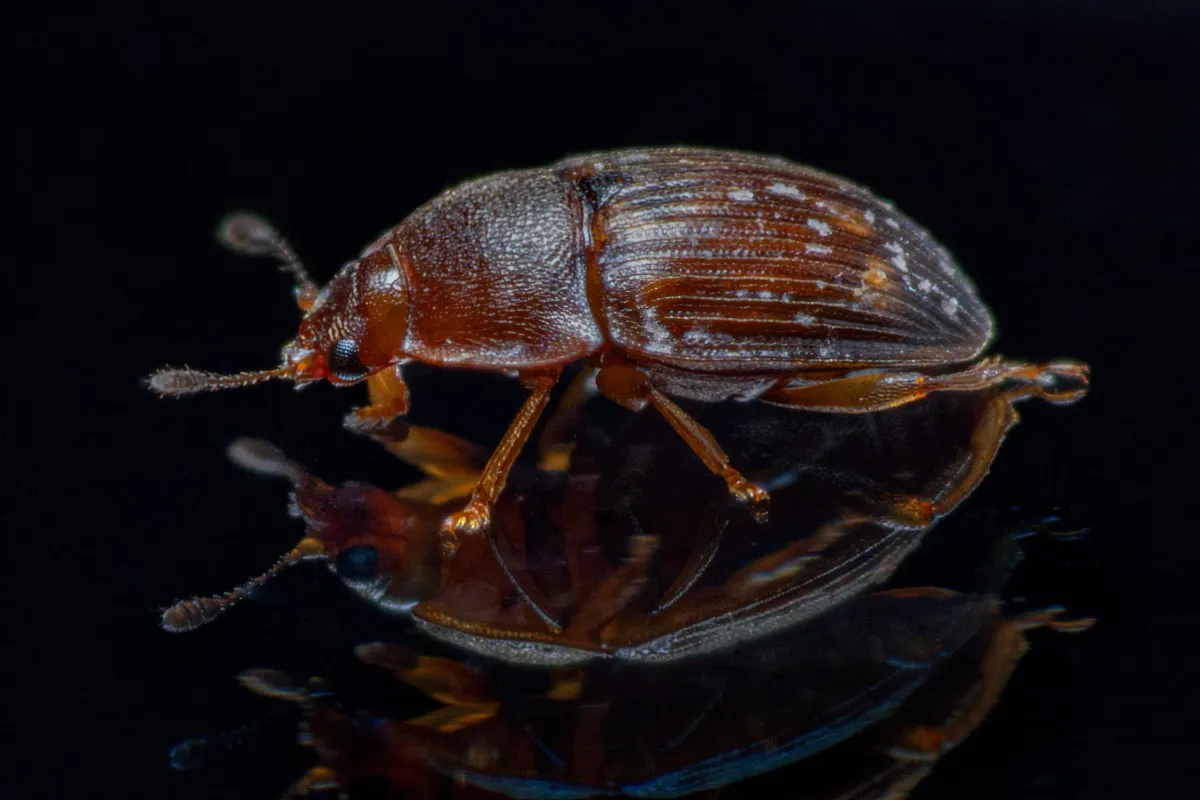
Scientists now think two types of invasive sap-feeding beetles in Europe might be carrying these worms. While they never saw towers attach to beetles directly, they checked many invertebrates from orchard fruit. They found large groups of worms only on these two beetle species.
Genetic tests showed that the worms forming the towers are a new species, Caenorhabditis apta.
Dr. Ryan Greenway, a research coordinator, noted that C. apta prefers to attach to only these two beetles. He said this is surprising, given how many other invertebrate species they checked. Researchers are now looking into how these worm clusters form on beetles.
Stelidota geminata*), one of two invasive beetle species found to serve as vectors for the newly described nematode species Caenorhabditis apta. Credit: Gustavo Alarcon-Nieto / Genes and Behavior Group*
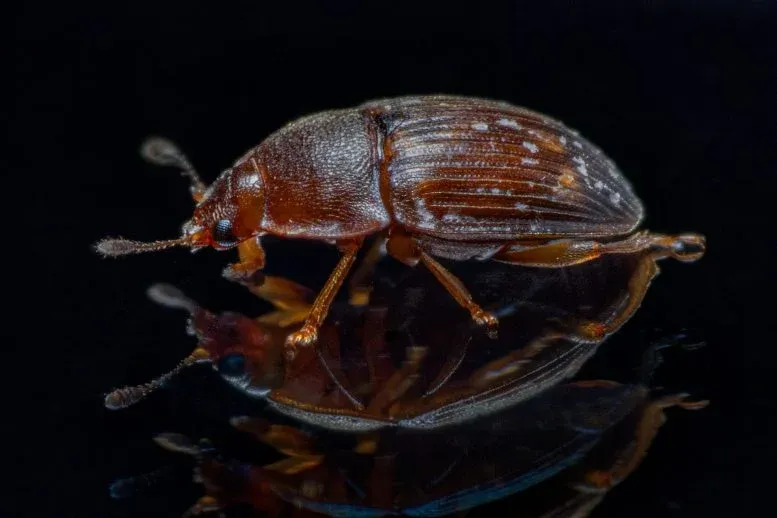 Caption: Caenorhabditis apta gathered in clusters on the underside of the wing cover of a strawberry sap beetle, Stelidota geminata. Credit: Ryan Greenway / Genes and Behavior Group
A Hidden World of Hitchhiking
Nematodes are the most common animals on Earth. Yet, scientists know little about how many species spread. Because worms are so small, many rely on larger animals, called vectors, to carry them to new places.
These relationships can greatly affect the environment and farming. Some nematodes spread plant diseases using insect carriers. For example, the pinewood nematode, carried by longhorn beetles, has destroyed forests worldwide.
However, outside of a few important cases, researchers know little about which animals carry most nematodes in nature. This knowledge gap makes it harder to understand how these organisms spread, invade ecosystems, and shape natural processes.
Did Worms Arrive With Invasive Beetles?
After finding the link between C. apta and the beetles, researchers wondered if this partnership existed beyond German orchards.
The newly found nematode species has only appeared in European collections since 2010. Both beetle species arrived in Europe in the early 2000s. One beetle came from North America, the other from the western Pacific. This timing suggested a possible connection.
Greenway asked if C. apta might have "hitched a ride" into Europe on the beetles.
To test this, the team compared global records of the beetles with known collections of C. apta and related species. They found overlapping areas in North America involving the strawberry sap beetle. This suggests a possible way the nematode entered Europe.
Ecological Impact and Future Research
If C. apta recently arrived in Europe, it could already be affecting local ecosystems. Researchers believe the nematode might influence food webs and how fruit breaks down in orchards.
Greenway noted that a new nematode species in Europe might not seem like a big deal. But he explained that nematodes can help their carriers spread, and vice versa.
The team is now studying if C. apta helps or harms the beetles.
Greenway also mentioned that they might find ways to use C. apta to control these sap beetles. These beetles are known crop pests.
Researchers say this study offers rare insights into how nematodes evolve and interact with their environment.
Dr. Serena Ding, who leads the Genes and Behavior Group, said they know surprisingly little about nematodes in nature. This is true even though C. elegans is one of the most studied organisms in biology. She added that this study shows what can be learned by observing them in their natural habitats.
Deep Dive & References
Differential Phoretic Vector Use Among Sympatric Caenorhabditis Nematodes and an Association With Invasive Nitidulid Beetles in Southwestern Germany - Ecology and Evolution, 2026