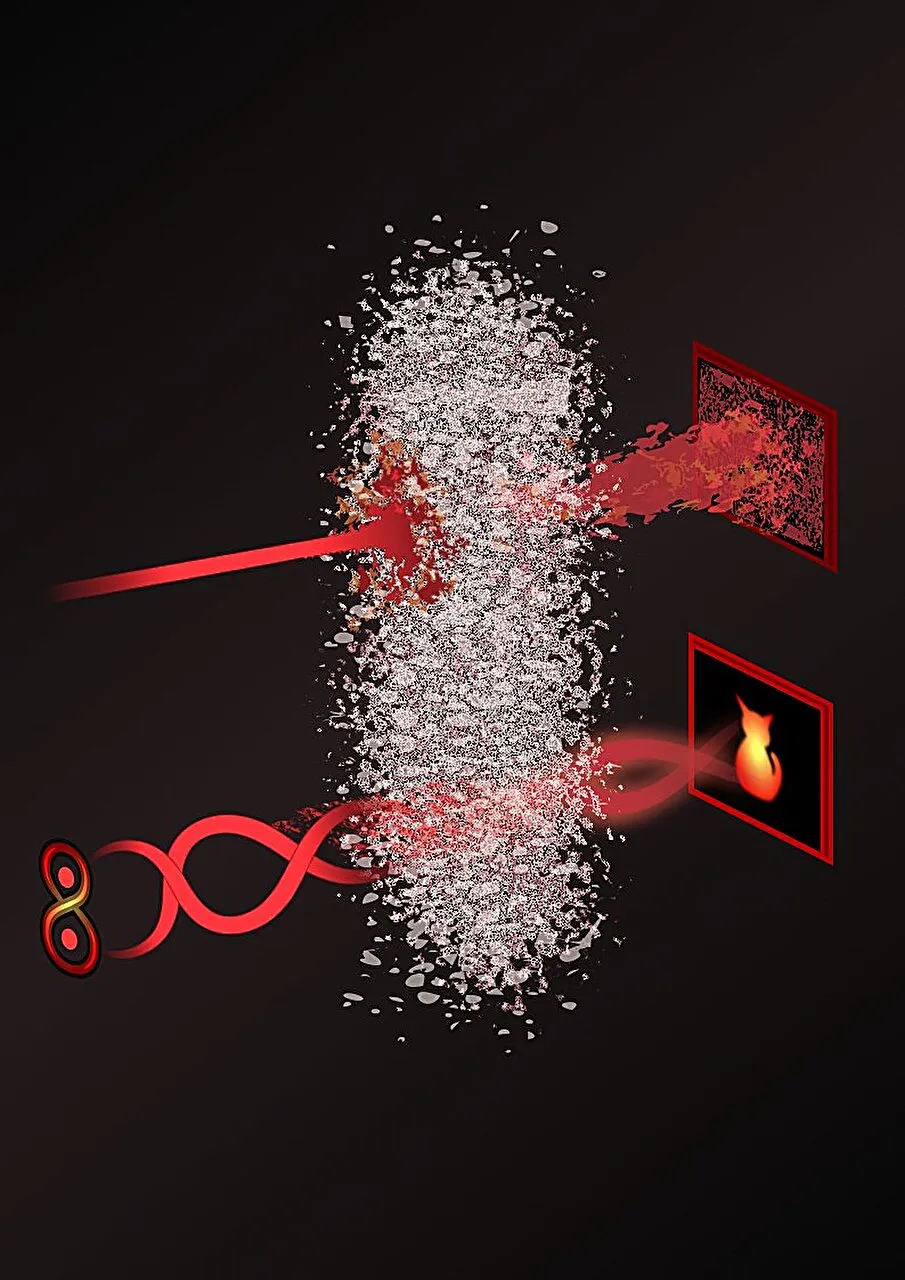
Imagine trying to take a crystal-clear photo through a blizzard, or perform surgery by looking through frosted glass. That's essentially the challenge scientists face when light hits a "disordered material" — think biological tissue, murky water, or even just stormy air. Light scatters, images blur, and all useful information vanishes into a fuzzy mess.
For years, researchers have been trying to un-blur the world using something called "wavefront shaping." It's a bit like precisely wiggling the light before it hits the mess, so it comes out the other side perfectly coherent. Impressive, but it was always playing catch-up, just reversing the damage.
Now, a team from Paris and Glasgow has figured out a new trick. They're not just reversing the mess; they're making the mess itself choose what to see. And it's all thanks to quantum entanglement.
We're a new kind of news feed.
Regular news is designed to drain you. We're a non-profit built to restore you. Every story we publish is scored for impact, progress, and hope.
Start Your News DetoxThe Quantum Secret Weapon
Their method essentially turns a chaotic, light-scrambling material into a highly selective bouncer. To regular, classical light, the material remains a brick wall — completely dark and impenetrable. But for information carried by entangled photon pairs? It's a wide-open door.
Entanglement, for the uninitiated, is that famously spooky quantum connection where two particles are linked, no matter the distance. Change one, and the other instantly reacts. The researchers found a way to use the spatial correlations of these entangled pairs as a kind of quantum key.
They adjust a "phase mask" (think of it as a super-precise set of tiny light manipulators) to preserve these spatial correlations even after the photons have waded through the scattering material. The result? The image carried by the entangled photons emerges intact, while any classical light trying to sneak through is utterly destroyed. It's like having a secret handshake only your information knows.
This isn't just a clever parlor trick. It fundamentally changes how we think about optical disorder. Instead of a nuisance to be overcome, it becomes an active, programmable component. Which, if you think about it, is both impressive and slightly terrifying.
This quantum bouncer could pave the way for hyper-secure communication, where only entangled photons can deliver the message. And it might even let doctors image through biological tissues without needing a supercomputer to untangle the light afterward. Because apparently, that's where we are now: making chaos work for us, one entangled photon at a time.