Astrophysicist Alex Filippenko will share the 2026 Gruber Cosmology Prize. The Gruber Foundation announced the award on May 19.
This prize is one of the most respected awards for research into the universe's origins and future. Filippenko will split the $500,000 prize with theoretical physicists Ken’ichi Nomoto from the University of Tokyo and Stanford Woosley from UC Santa Cruz.
The scientists were recognized for changing how we understand supernovae. They turned these stellar explosions into a reliable way to measure the universe.
We're a new kind of news feed.
Regular news is designed to drain you. We're a non-profit built to restore you. Every story we publish is scored for impact, progress, and hope.
Start Your News DetoxFilippenko, a professor of astronomy at Berkeley, helped clarify different types of Type Ia supernovae. This allowed these exploding stars to be used as "standard candles" to measure the universe's expansion. He also found two other types of Type I supernovae.
Filippenko said he was honored, but felt many other astronomers in the field were equally deserving.
He was part of two groups that announced in 1998 that the universe's expansion was speeding up. This led to the idea of dark energy, a mysterious force driving this acceleration. The leaders of these groups, Berkeley physicist Saul Perlmutter and astronomer Brian Schmidt, along with Adam Riess, received the 2011 Nobel Prize in Physics. Riess was a postdoctoral fellow in Filippenko’s group at the time.
The Gruber Prize citation noted that the work by Filippenko, Nomoto, and Woosley connects how stars evolve, how heavy elements form, and how the universe's chemistry changes. This work also supports using supernovae for precise cosmology.
From Backwater to Breakthrough
In 1985, when Filippenko was a young researcher at Berkeley, exploding stars were mostly studied by theorists. There wasn't much observational data to test these theories. Many known supernovae were found by amateur astronomers. Filippenko had found supernova conferences boring. But one night, while using the Palomar Observatory telescope, he discovered his first supernova and became fascinated.
Filippenko said that supernova studies were "a backwater." He started working on them after discovering a "weird" one. He added that as a teenager, he loved chemistry and "things that go bang." Exploding stars are among the biggest explosions in the universe.
At that time, astronomers thought there were only two types of supernovae. Type I supernovae are white dwarf stars that explode after gathering enough mass from a companion star. Type II supernovae happen when a massive star's core collapses, leaving behind a neutron star or black hole. Nomoto and Woosley's theoretical work helped explain these explosions.
Filippenko's supernova, SN 1985F, was different from typical Type I supernovae. Its spectrum showed oxygen, magnesium, and calcium, which are usually found in Type II supernovae. But it had no hydrogen or helium, like other Type IIs. This meant it exploded from a core collapse but had lost its hydrogen and possibly helium before exploding.
He explained that his observations proved that not all Type I supernovae were the same. Today, SN 1985F would be called a Type Ib or Ic. He described it as "a Type II supernova in Type I clothing."
Another observation in 1987, when he was a new professor at Berkeley, showed that the classification system hid similarities between supernovae. Supernova 1987K first looked like a Type II, then changed to look like a Type Ib. This meant the star had lost most of its hydrogen before exploding. He called it "Type II in youth, Type Ib in old age."
Eventually, classic white dwarf explosions were named Type Ia. Other types, similar to core-collapse Type II supernovae, became Type Ib, Ic, and so on, depending on how much of their outer layer the star shed before exploding. Last year, Filippenko and others observed the first Type Ie supernova. This star was shedding its silicon and sulfur layers when it exploded.
He noted that this expanded astrophysicists' understanding of core-collapse supernovae. Much of this work happened between 1985 and the early 1990s.
The Accelerating Universe
In the early 1990s, Filippenko was a leading expert on supernovae. A team of physicists at Lawrence Berkeley National Laboratory, led by Perlmutter, noticed his work. They wanted to use Type Ia supernovae as "standard candles" to measure the universe's expansion. If all Type Ia supernovae have the same brightness, their distance can be easily calculated. But any brightness variations would affect these calculations.
Filippenko studied two unusual Type Ia supernovae, one too bright and one too faint. This helped a colleague, Mark Phillips, find a link between how long a supernova's brightness declines and its peak brightness. This allowed even unusual Type Ias to be used as standardizable candles. Filippenko worked with Perlmutter's Supernova Cosmology Project, providing data from the Keck telescopes. This allowed the team to use most Type Ias to measure the expanding universe.
Due to "cultural differences," Filippenko joined a rival group, the High-z Supernova Search Team. Adam Riess, a Miller Research Fellow, led the analysis of this team's supernovae. He corrected for brightness differences, dust dimming, and other factors to plot velocity versus distance.
In 1998, both teams reported similar findings. They used different sets of supernovae but found that for a given velocity, supernovae were farther away than expected. This suggested the universe's expansion was speeding up, not constant or slowing down due to gravity.
Both groups received many awards for their discovery, including the 2011 Nobel Prize in Physics and the 2007 Gruber Cosmology Prize.
Automated Supernova Search
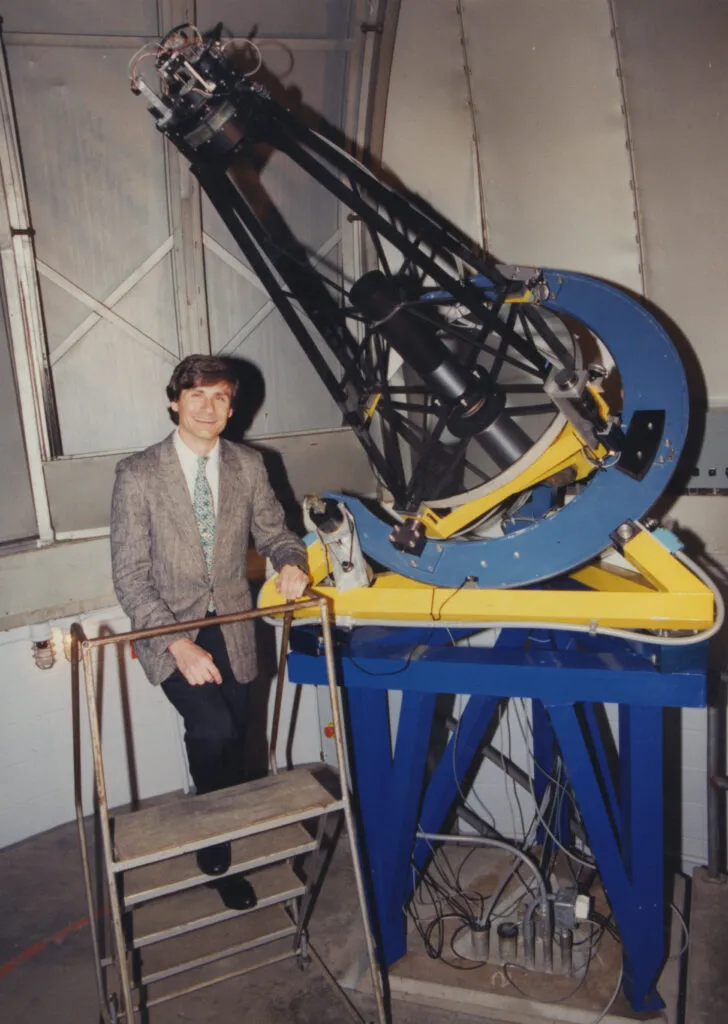
To find new supernovae faster, Filippenko built his own telescope at Lick Observatory. This was called the Katzman Automatic Imaging Telescope (KAIT). Between 1998 and 2008, KAIT found almost 800 nearby supernovae, more than all other searches combined.
The Lick Observatory Supernova Search helped him find subtle details in Type Ia supernovae. This improved their reliability for measuring cosmic distances. When his team found a new supernova, they used other University of California Observatories telescopes, like Lick and Keck, for follow-up studies and spectral analysis.
He explained that over half of these nearby supernovae were young. This led to many studies by his team and others. They studied these bright, nearby supernovae in detail to compare them with theoretical models by Woosley and Nomoto. He said they found many interesting ways stars behave before and during explosions. For example, sometimes gases are ejected unevenly, which theorists need to explain.
KAIT has been surpassed by newer all-sky surveys. However, it is still used to record light curves of supernovae, gamma-ray bursts, active galaxies, and variable stars. Filippenko noted that KAIT was a pioneer for wide-angle surveys.
Filippenko continues to study the universe's expansion. Recently, with Riess and others, he published evidence that the current expansion rate is faster than expected. This is true even when accounting for known acceleration. This "Hubble tension" is a major mystery in cosmology.
Filippenko initially studied chemistry at UC Santa Barbara. His interest in astronomy grew, and some accidental chemical explosions made him switch to physics. He graduated in 1979 and earned his Ph.D. in astronomy from Caltech in 1984.
He is a Distinguished Professor of Astronomy and the Class of 1954 Chair. His honors include election to the National Academy of Sciences and the American Academy of Arts and Sciences. He is also an American Astronomical Society Fellow and received the society’s Education Prize. As a member of both supernova search teams, he co-received the 2015 Breakthrough Prize in Fundamental Physics.
Berkeley students have voted him "Best Professor" nine times. In 2006, he was named the CASE/Carnegie National Professor of the Year.
The three Gruber Cosmology Prize recipients will receive their awards on November 10. The ceremony will be at the "Illuminating the Cosmos" conference in Heidelberg, Germany.