A foot-long curved horn jutting from its skull. A body the length of a school bus. And a taste for fish in shallow Saharan rivers—all hallmarks of Spinosaurus mirabilis, a newly identified dinosaur species that hunted in ways its relatives didn't.
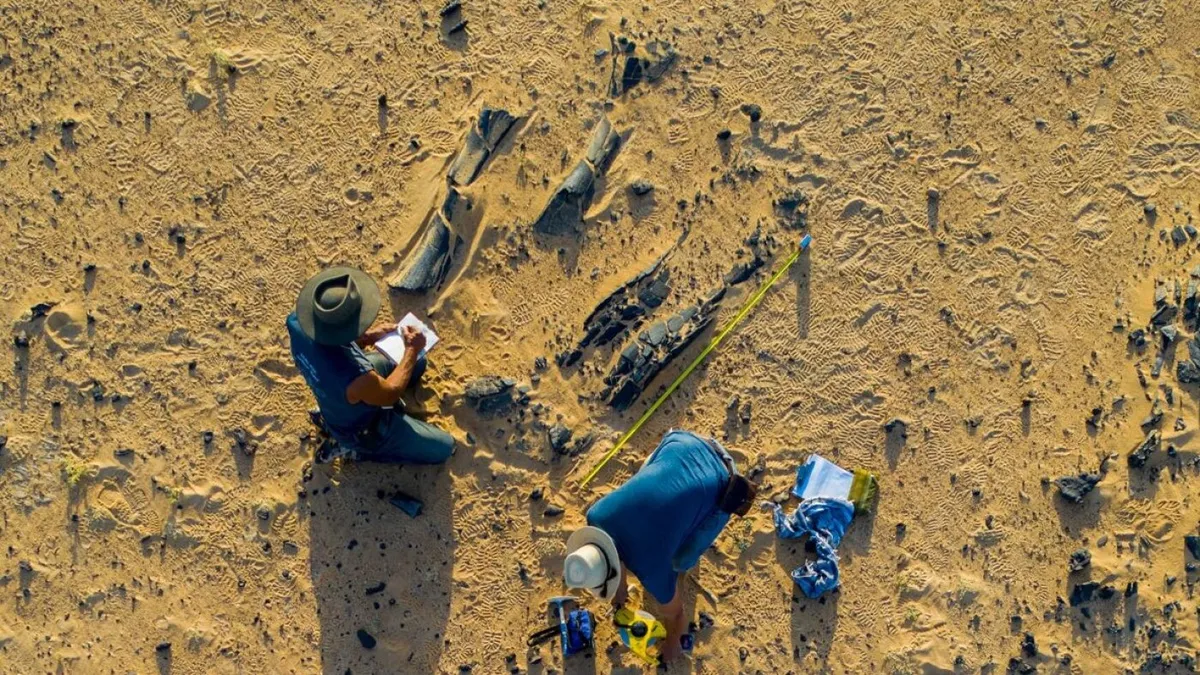
Paleontologists led by Paul Sereno at the University of Chicago unearthed the fossils in Niger, marking the first new Spinosaurus species confirmed in over a century. The discovery, published in Science last week, reveals a predator that thrived about 95 million years ago in what is now the central Sahara—though back then, the desert was a network of marshy rivers teeming with fish up to 9 feet long.

What makes Spinosaurus mirabilis distinctive isn't just its size. The horn—curved, roughly a foot long, and textured in ways that suggest it may have been brightly colored—likely played a role in attracting mates or signaling within the group. But the real insight comes from how this dinosaur hunted. Sereno compares it to modern herons: animals that wade into shallow water, stand perfectly still, and strike when prey comes within reach. "I suspect that this animal was fishing largely in about 3 feet of water," he explained, though it could stand in water twice that deep without floating.
We're a new kind of news feed.
Regular news is designed to drain you. We're a non-profit built to restore you. Every story we publish is scored for impact, progress, and hope.
Start Your News DetoxThis matters because Spinosaurus research has been pulling in different directions. In 2020, another team studying fossils from Morocco suggested that a different Spinosaurus species was a powerful swimmer, with a tail built for diving and pursuing prey underwater. But Spinosaurus mirabilis tells a different story—one of a dinosaur that was, by Sereno's assessment, "a poor swimmer that never dives for its meals." Instead of competing with its aquatic cousins, this species found its own ecological niche: the shallow-water fisher.
The team first spotted one of the crucial crest fossils during a 2019 expedition, then returned in 2022 to the remote dig site and found more specimens. Each discovery added texture to the picture of how these massive predators adapted to their specific environments. Not all Spinosaurus were built the same way. Not all hunted the same way.
As paleontologists continue mapping the family tree of these fish-eating giants, Spinosaurus mirabilis suggests that the Cretaceous rivers of Africa supported multiple hunting strategies—and multiple ways of being a apex predator.