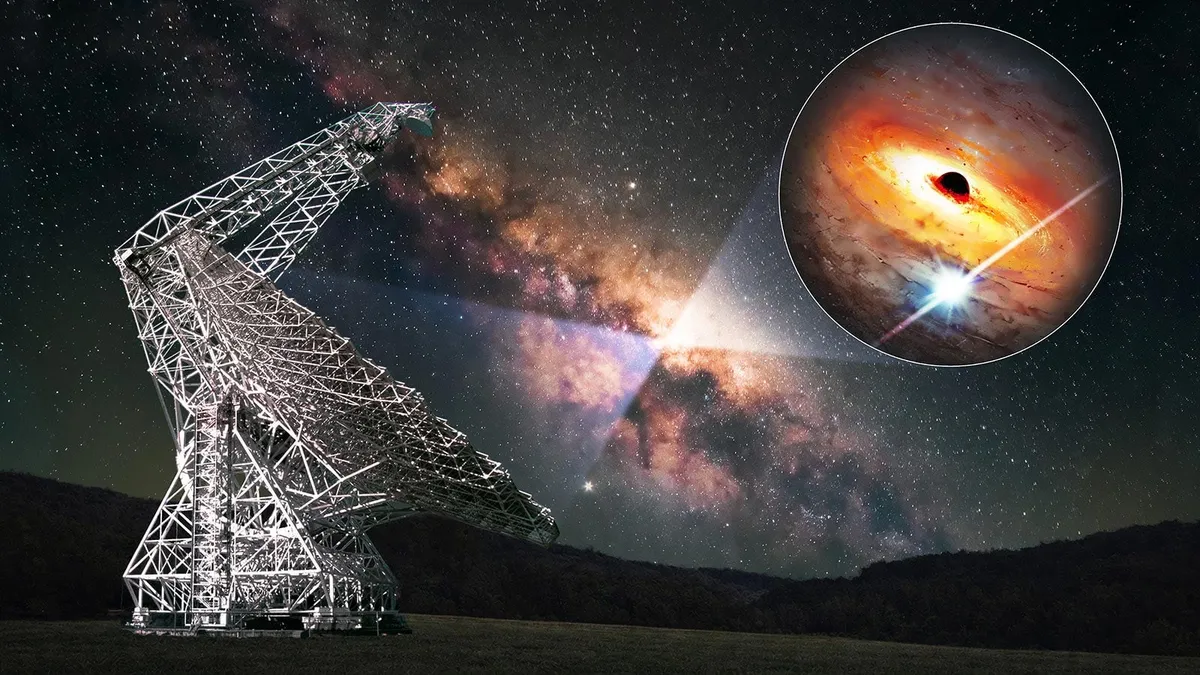
At the center of the Milky Way, about 26,000 light-years from Earth, something is pulsing with remarkable regularity. Scientists at Columbia University and the Breakthrough Listen initiative have identified what could be a millisecond pulsar orbiting dangerously close to Sagittarius A*, the supermassive black hole anchoring our galaxy. If confirmed, this discovery would hand physicists an unprecedented tool: a natural laboratory for testing Einstein's theories in the most extreme environment imaginable.
The finding emerged from the most sensitive radio survey of the galactic center ever attempted. Karen I. Perez, who led the research as part of her PhD at Columbia, and her team sifted through data from observations targeting the chaotic core of our galaxy—a region packed with stars, gas, and radiation that makes detection extraordinarily difficult. What they found was a signal arriving every 8.19 milliseconds, with the kind of precision that suggests something very specific: a neutron star spinning at extraordinary speed.
Pulsars are the universe's most reliable timekeepers. When a massive star exhausts its fuel and collapses, it can leave behind a neutron star—a remnant so dense that a teaspoon of its material would weigh as much as a mountain. These objects spin rapidly and emit focused beams of radio waves that sweep across space like lighthouse beams. Millisecond pulsars spin especially fast, completing hundreds of rotations per second, which makes their timing signals even more stable and predictable than ordinary pulsars.
We're a new kind of news feed.
Regular news is designed to drain you. We're a non-profit built to restore you. Every story we publish is scored for impact, progress, and hope.
Start Your News DetoxWhat makes this particular candidate exceptional is its location. Sagittarius A* contains roughly four million times the mass of the Sun, warping spacetime so severely that the normal rules of physics begin to bend. A pulsar this close to such a massive object would experience gravitational effects so extreme that they'd leave measurable signatures in the timing of its pulses—tiny delays and distortions predicted by General Relativity. These deviations would be invisible in any other setting, but here they become readable, like words written in the language of gravity itself.
"If confirmed, it could help us better understand both our own Galaxy and General Relativity as a whole," Perez said. The work is still in its early stages. Researchers are analyzing follow-up observations to verify that the signal truly comes from a pulsar and not some other source. To accelerate discovery, Breakthrough Listen has released all observational data publicly, inviting scientists worldwide to examine the evidence independently and contribute their own insights.
The next phase will determine whether this cosmic clock is real—and if so, whether it becomes one of the most powerful tools ever available for understanding gravity at its most extreme.