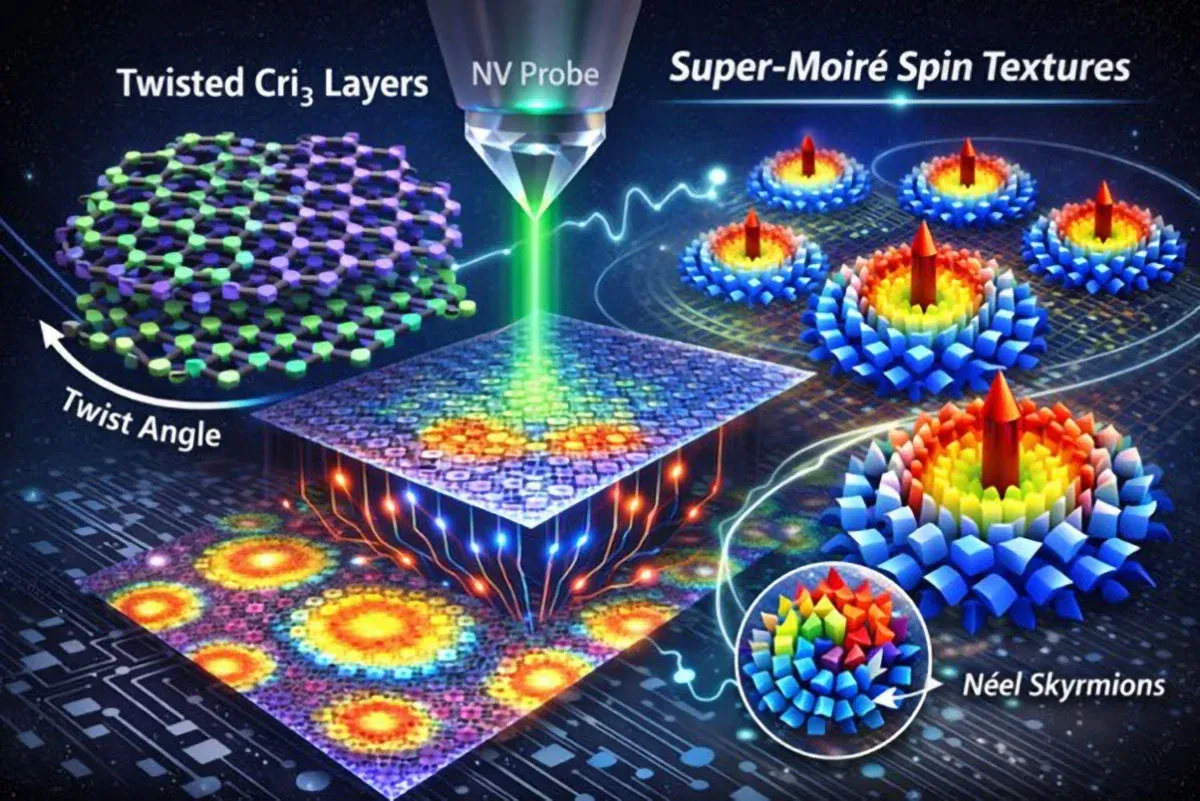
Physicists have discovered something counterintuitive: when you rotate two ultrathin crystal layers by just a degree or two, the magnetic fields that emerge don't follow the expected rules. Instead of organizing at the tiny scale you'd predict, they sprawl across structures hundreds of nanometers wide—roughly ten times larger than the underlying geometry should allow.
This finding, published in Nature Nanotechnology, reveals that magnetism responds to geometric manipulation in ways scientists didn't anticipate. The team studied twisted layers of chromium triiodide using a quantum sensor based on a diamond defect, mapping magnetic fields with nanoscale precision. What they found challenges how physicists think about moiré engineering—the emerging field of building designer quantum materials simply by stacking and rotating ultra-thin layers.
The Geometry Shifts the Balance
For the past decade, researchers have known that rotating stacked 2D layers creates moiré patterns—repeating geometric designs that reshape how electrons move. It's like laying two window screens on top of each other at a slight angle: the overlapping grid creates a larger pattern than either screen alone. This trick works for electronics, but magnetism seemed to follow different rules.
We're a new kind of news feed.
Regular news is designed to drain you. We're a non-profit built to restore you. Every story we publish is scored for impact, progress, and hope.
Start Your News DetoxThe surprise came when researchers varied the twist angle. As they decreased the angle, the moiré wavelength increased—but the magnetic textures grew largest near 1.1°, then vanished above 2°. This reversal suggested something deeper was happening. The twist wasn't simply stamping a pattern onto the magnetic field. Instead, it was retuning the competition between three physical forces: exchange interactions (how neighboring spins influence each other), magnetic anisotropy (preferred spin directions), and Dzyaloshinskii–Moriya interactions (a relativistic effect that favors twisted spin arrangements).
Each force pulls the system toward a different magnetic state. By rotating the layers, physicists can shift which force wins—like adjusting the balance on a stereo to hear different instruments. The twist angle becomes a thermodynamic control dial, and the result is the emergence of large, stable structures called Néel-type skyrmions: knot-like spin configurations that span multiple moiré cells.
Why This Matters for Computing
Skyrmions have attracted intense interest because their topology—their fundamental shape—makes them robust against disturbances. They're like magnetic knots that don't easily come undone. For decades, creating them required lithography, special materials with heavy metals, or strong electrical currents. This discovery is different: the structures emerge through twisting alone, with no added complexity.
That matters because skyrmions could carry information in computing devices far more efficiently than conventional magnetic bits. Their topological protection means they dissipate less energy, and their mesoscale size makes them easier to detect and manipulate than atomic-scale structures. Researchers are now investigating how these textures could integrate into post-CMOS computing architectures—the next generation of energy-efficient processors.
Elton Santos, a theoretical physicist at the University of Edinburgh who led the modeling work, described the finding as revealing "a magnetic knob" hidden in geometric control. "We're seeing collective spin order self-organize on scales far larger than the moiré lattice," he noted. "It opens the door to designing topological magnetic states simply by controlling angle."
The path from laboratory discovery to practical devices remains long, but the principle is now clear: geometry and magnetism are more deeply intertwined than physicists realized. By simply rotating layers, researchers can coax quantum systems into useful configurations—a reminder that sometimes the most powerful tools are the simplest ones.