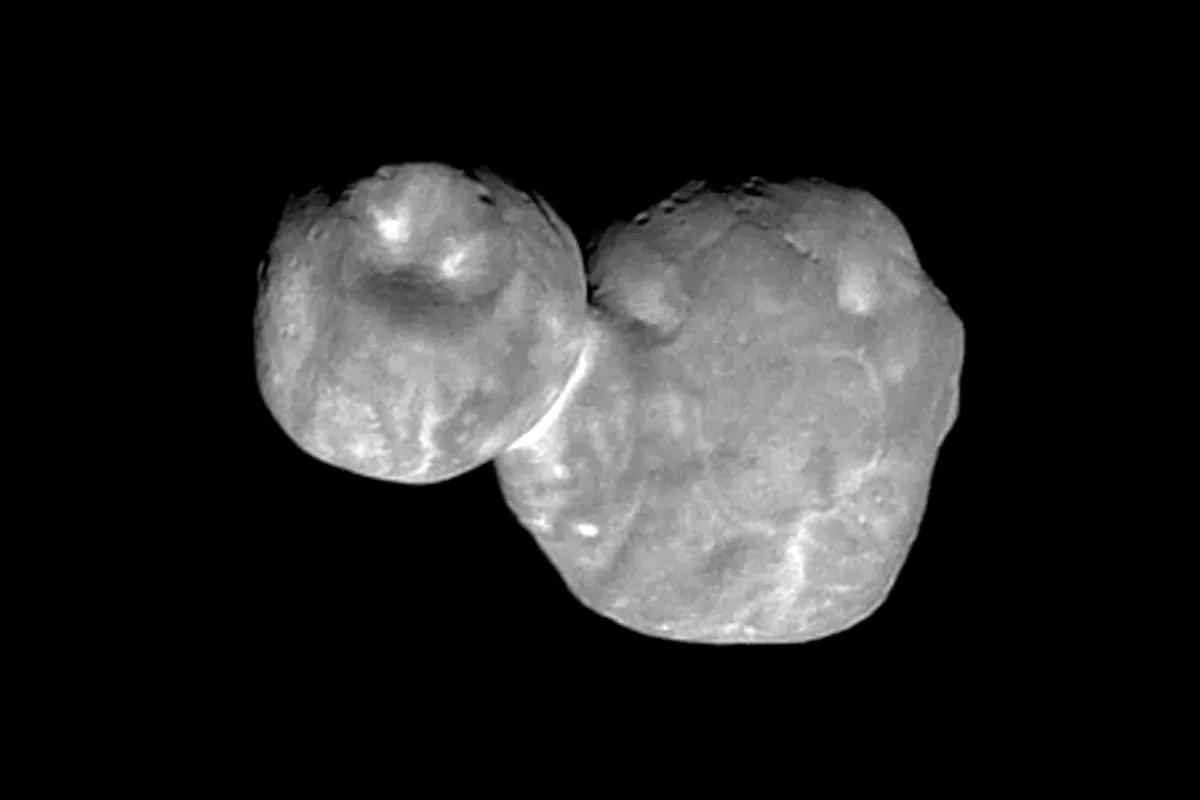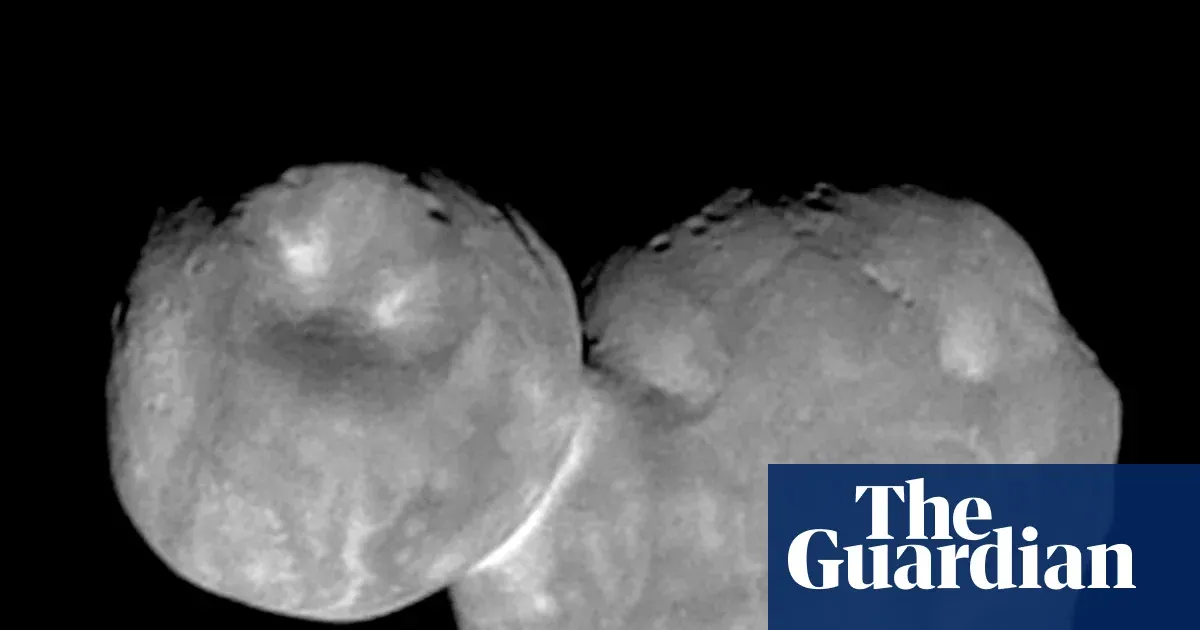
Four billion years ago, in the cold reaches beyond Neptune, two small worlds spiraled toward each other and gently collided. The result: Arrokoth, a snowman-shaped object that has puzzled astronomers since NASA's New Horizons spacecraft flew past it in 2019.
Now researchers think they've cracked how it happened.
Arrokoth sits in the Kuiper belt, a vast ring of icy debris that marks the outer edge of our solar system. It's one of the most distant and primitive objects ever visited by a spacecraft from Earth—and one of the strangest. About 10 to 25 percent of planetesimals (the solid building blocks that eventually become planets) in this region have two lobes, like a peanut or a snowman. Arrokoth is the most famous example.
For years, astronomers suspected these double-lobed objects formed through "gravitational collapse"—a process where clouds of pebbles in the early solar system clumped together under their own gravity. But no one had successfully simulated how two separate lobes could actually stick together without merging into a single sphere.
We're a new kind of news feed.
Regular news is designed to drain you. We're a non-profit built to restore you. Every story we publish is scored for impact, progress, and hope.
Start Your News DetoxThe Breakthrough
Jackson Barnes and his team at Michigan State University ran 54 computer simulations, each following the dance of pebbles colliding and clustering in the primordial solar system. The key insight was surprisingly practical: they accounted for the physics of how particles actually rest against each other when they touch. Earlier simulations had skipped this detail, which is why they always predicted collisions would result in one smooth ball.
With this physics included, something remarkable emerged. Two small planetesimals could orbit each other, gradually spiral inward, and meet at just the right speed—about 5 meters per second, slower than a car in a parking lot—to stick together without bouncing apart or smashing into one larger shape. The result: a contact binary, two lobes gently fused at their point of contact.
"Some of the contact binaries in our model look strikingly like Arrokoth," Barnes said. For the first time, researchers could see the entire process from start to finish—not just theorize about it.
Alan Stern, who led the New Horizons mission that first imaged Arrokoth, called the finding significant. It supported the long-held view that planetesimals formed through gentle processes, not violent collisions. That matters because it shapes how we understand the early solar system and, by extension, how planetary systems form elsewhere.
Still, the work isn't the final word. Alan Fitzsimmons at Queen's University Belfast noted that the simulations suggest only 4 percent of Kuiper belt objects form this way, while telescopic surveys suggest the fraction is much higher. There may be other formation pathways that future, even more detailed simulations will reveal. But for now, the mystery of Arrokoth's snowman shape has moved from pure speculation to something researchers can actually watch unfold in code.