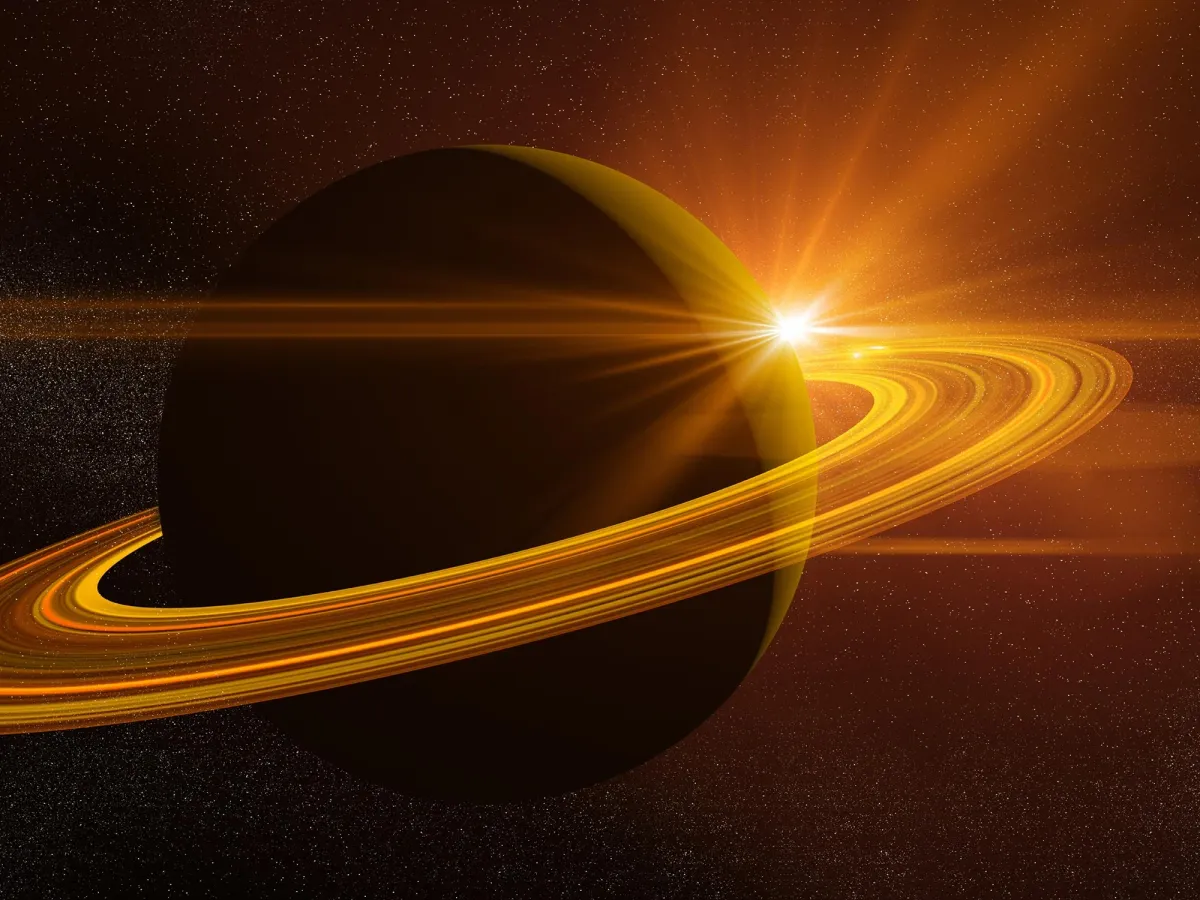
Saturn's rings look permanent through a telescope, but they're probably only a few hundred million years old — which means Saturn's moon system has a hidden chapter scientists are only now beginning to read.
The story starts with a puzzle. Cassini's final measurements showed Saturn's mass is slightly more concentrated toward its core than expected, which throws off the planet's gravitational relationship with Neptune. To explain this mismatch, researchers at the SETI Institute led by Matija Ćuk proposed something radical: Saturn once had an extra moon that got ejected after a close encounter with Titan, and its debris became the rings we see today.
The evidence comes from an unlikely place — Hyperion, a small, chaotically tumbling moon that looks like a cosmic potato. Hyperion is locked in a gravitational dance with Titan, their orbits moving in a stable ratio. "Hyperion provided us the most important clue about the history of the system," Ćuk said. When researchers ran simulations of their proposed collision scenario, Hyperion usually got lost — except in rare cases. This suggests the Titan-Hyperion connection is relatively young, only a few hundred million years old.
We're a new kind of news feed.
Regular news is designed to drain you. We're a non-profit built to restore you. Every story we publish is scored for impact, progress, and hope.
Start Your News DetoxHow Titan May Have Been Born
The model proposes that Titan itself is the product of a merger between two earlier moons: a massive body called Proto-Titan and a smaller companion, Proto-Hyperion. A collision at that scale would have resurfaced Titan, which may explain why it has surprisingly few visible impact craters compared to similar moons like Jupiter's Callisto.
Titan's orbit is slightly elongated but gradually becoming more circular — a telltale sign of recent gravitational disturbance. Before the merger, Proto-Titan probably looked cratered and barren, lacking the thick nitrogen atmosphere that makes Titan unique today. The collision itself may have triggered the atmospheric chemistry we observe now.
But if Titan was born from this cosmic merger, what about Saturn's rings. The researchers propose that Titan's slightly off-center orbit destabilized inner moons, triggering a cascade of collisions that scattered debris into rings. It's a chain reaction — one moon collision setting off others, ultimately creating the iconic feature we see today.
NASA's Dragonfly mission, scheduled to land on Titan in 2034, could test this theory. If Dragonfly finds evidence of a massive impact roughly 500 million years ago, it would suggest Titan was indeed born from a colossal collision that reshaped Saturn's entire moon system. For now, the rings remain beautiful and mysterious — but the mystery may finally be solvable.