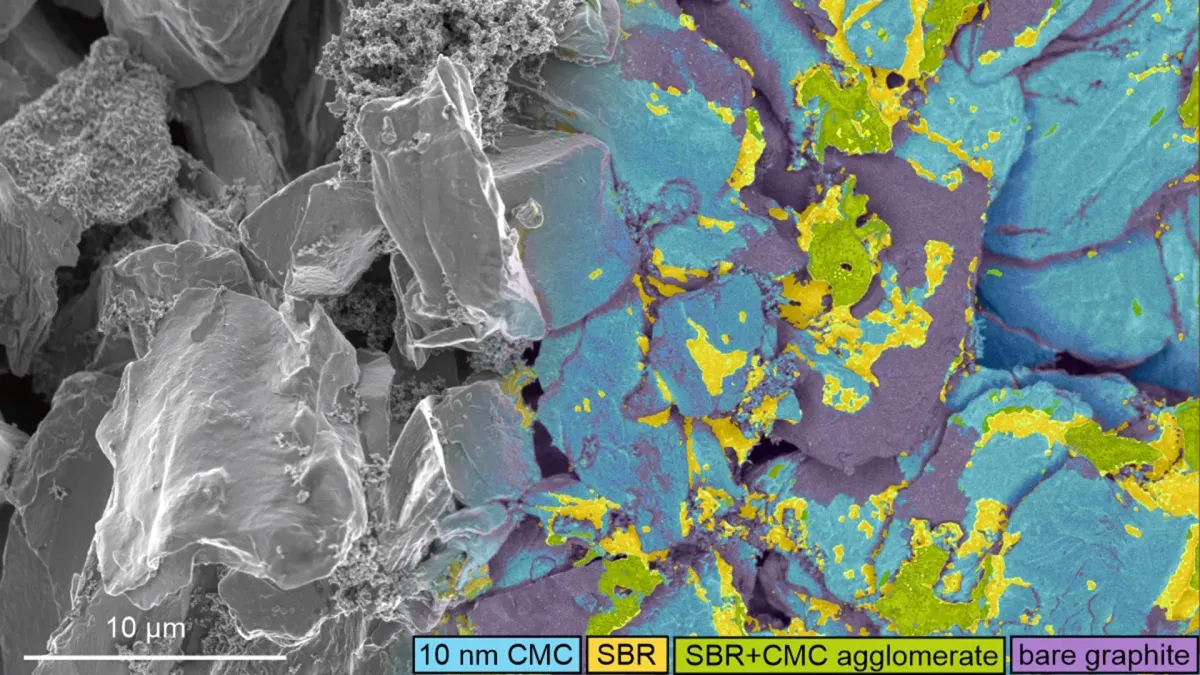
Inside every lithium-ion battery sits a tiny, invisible problem. For years, scientists have known that polymer binders—the glue holding electrode materials together—shape whether your phone charges in 30 minutes or three hours. But they couldn't actually see these binders. They make up less than 5% of the electrode by weight, yet they control charging speed, durability, and how many times a battery can cycle before it degrades. It's like trying to tune an engine you can't look at.
Researchers at the University of Oxford just changed that. By attaching traceable silver and bromine markers to standard binders, they've created a way to visualize their exact location inside battery electrodes at the nanoscale. The technique, published in Nature Communications in February, works like adding dye to water—suddenly you can see where it flows and how it settles.
What the Invisible Revealed
Dr. Stanislaw Zankowski and his team used electron microscopes to map binder distribution with unprecedented precision. They could spot carboxymethyl cellulose (CMC) layers just 10 nanometers thick—thinner than a virus—and see how these coatings break apart during electrode manufacturing. What looks like a uniform coating becomes a patchy, fragmented mess during processing. That fragmentation weakens the battery's ability to conduct charge and survive repeated cycles.
We're a new kind of news feed.
Regular news is designed to drain you. We're a non-profit built to restore you. Every story we publish is scored for impact, progress, and hope.
Start Your News DetoxOnce they could see the problem, they could fix it. By adjusting how the electrode slurry is mixed and dried, the team reduced internal resistance by up to 40%. That's not a minor tweak. A 40% drop in resistance directly translates to faster charging without sacrificing longevity. The same approach works with both today's graphite anodes and next-generation silicon-based designs, meaning this isn't a one-off discovery—it's a tool that scales.
Professor Patrick Grant, who led the work, described it as opening "an entirely new toolbox for understanding how modern binders behave." For the first time, scientists can correlate what they see under the microscope—the actual physical distribution of binders—with how the battery performs in real conditions. That connection between structure and performance is where battery breakthroughs live.
The research has already caught the attention of major battery manufacturers and electric vehicle makers. The Faraday Institution's Nextrode project funded the work, recognizing its potential to reshape how batteries are designed and made. This isn't theoretical physics. This is manufacturing insight that could reach production lines within a few years.
The path forward is clearer now. Engineers can use this imaging technique to optimize binder placement for specific applications—prioritizing speed for phones, durability for EVs, or longevity for grid storage. Each choice becomes data-driven instead of guesswork. That's how incremental improvements compound into the faster, longer-lasting batteries that make electric vehicles and renewable energy grids genuinely viable.