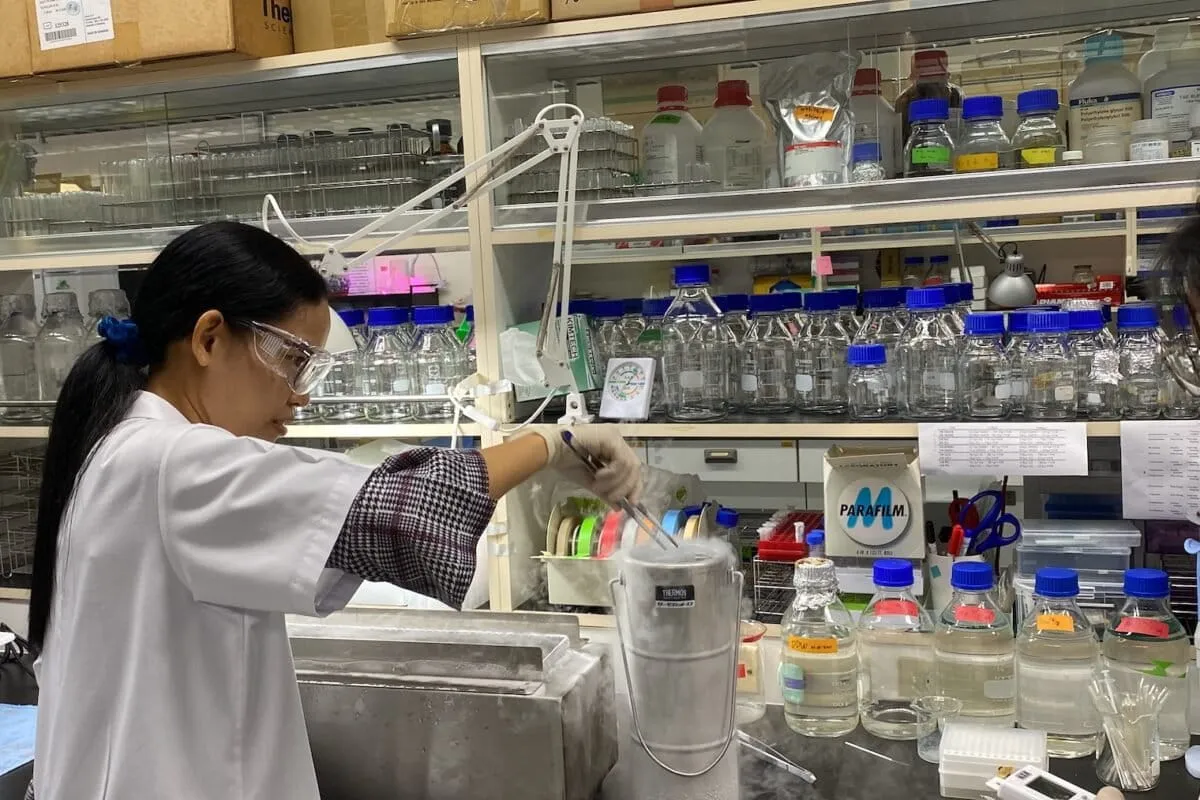
In a laboratory at Phuket Rajabhat University in southern Thailand, molecular biologist Preeyanuch Thongpoo is working against one of the ocean's most urgent timelines. Suspended in liquid nitrogen at -196°C, inside vials no larger than a fingertip, are microscopic algae and coral larvae—a living archive of genetic material that might help restore Thailand's dying reefs.
What makes this work different from standard conservation is what's being preserved. Preeyanuch's team has frozen the symbiotic algae that live inside coral tissue, the algae that feed the coral itself. They've also preserved larvae from cauliflower coral (Pocillopora), a hardy species known for recolonizing damaged reefs. The logic is straightforward: if you can bank these genetic blueprints now, you have something to work with when restoration becomes possible later.
The timing matters. Thailand's coral reefs, which support over 300 species of reef-building corals, have been hammered. Between 2022 and early 2024, successive marine heat waves triggered mass bleaching events that stripped reefs of their color and structural complexity. Surveys show the reefs are not just losing corals—they're shifting in species composition, becoming simpler and more fragile. The heat stress is expected to continue through 2024-2025.
We're a new kind of news feed.
Regular news is designed to drain you. We're a non-profit built to restore you. Every story we publish is scored for impact, progress, and hope.
Start Your News DetoxBuilding a Genetic Lifeboat
Preeyanuch's cryobank is part of CORDAP, the Coral Research & Development Accelerator Platform, an initiative designed to do something that sounds simple but has proven difficult: keep coral genetics alive in cold storage until the conditions exist to use them. The idea isn't new—seed banks have saved plant species for decades—but applying it to coral at scale is relatively recent.
Thailand's reefs face pressure from multiple directions. Climate change is the headline threat, but tourism, coastal development, and pollution compound the damage. A reef system weakened by heat stress becomes vulnerable to everything else. The cryobank can't fix the underlying problem—rising ocean temperatures—but it can preserve options. If restoration efforts expand, if marine protected areas prove effective, if global emissions eventually stabilize, these frozen larvae and algae become material for rebuilding.
What's happening in Phuket reflects a broader shift in conservation thinking. Rather than waiting for the crisis to pass, researchers are building insurance policies. The vials in Preeyanuch's lab represent genetic diversity that might otherwise vanish. They're a hedge against the assumption that reefs will simply bounce back on their own.
The work ahead is both technical and uncertain. Thawing and successfully breeding frozen coral requires precision. Reintroducing restored corals into warming oceans means managing expectations about what restoration can actually achieve. But the alternative—doing nothing while the window closes—has already proven to be the wrong choice.