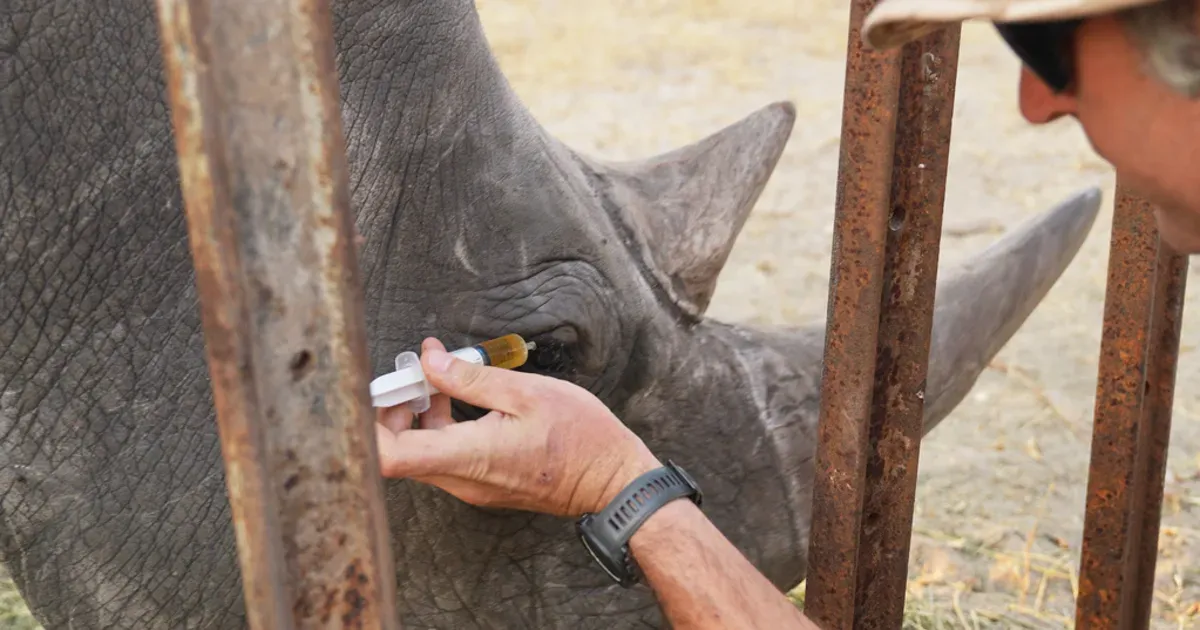
A male rhino named Thuza was losing his eyesight to a parasitic infection. Blind rhinos don't survive in the wild. So a team of animal behaviorists did something that sounded absurd: they taught him to stand still for eyedrops.
It worked.
Last August, trainers from Precision Behavior and the Palm Beach Zoo traveled to Zimbabwe after Thuza's caretakers at Imvelo Safari Lodges realized the infection threatened not just one animal, but an entire conservation pilot project. The Community Rhino Conservation Initiative had been reintroducing southern white rhinos to communal lands in Zimbabwe for the first time in the nation's history. Losing Thuza would have sent a message that the program couldn't protect its animals.
"A blind rhino is a dead rhino," said Angi Lacinak, one of the trainers who made the trip. "So no matter what it took, we were going to go over there and try."
We're a new kind of news feed.
Regular news is designed to drain you. We're a non-profit built to restore you. Every story we publish is scored for impact, progress, and hope.
Start Your News DetoxThe plan relied on a principle the Palm Beach Zoo had been using for years: teach animals to voluntarily participate in their own medical care. The team started by luring Thuza into a confined space with his favorite foods, then gradually desensitized him to humans touching his face and squirting water near his eyes. Within a week, they were applying the actual eyedrops. By the end of two weeks, they'd taught the anti-poacher scouts who work with Thuza how to do it themselves.
"Within about a week, we were actually putting the eye drops strategically in his eyes while he held for it," Lacinak said.
What made this work wasn't just patience — it was understanding that a wild animal could learn to cooperate with medical treatment if given the right incentives and time. The scouts now administer the drops daily, and Thuza's eyesight is recovering. The rhino is thriving, and the program has proven it can handle health emergencies without losing animals.
Southern white rhinos number around 16,000 in the wild, down from much higher populations decades ago. Poaching and habitat loss remain constant threats. But this moment in Zimbabwe shows something different: that conservation doesn't always mean hands-off management. Sometimes it means getting creative enough to reach an animal in need, even when the solution sounds ridiculous at first.
The scouts are now confident they can maintain Thuza's treatment indefinitely. And if this approach works for eye infections, it opens a door for treating other conditions in wild populations where veterinary intervention has always seemed impossible.