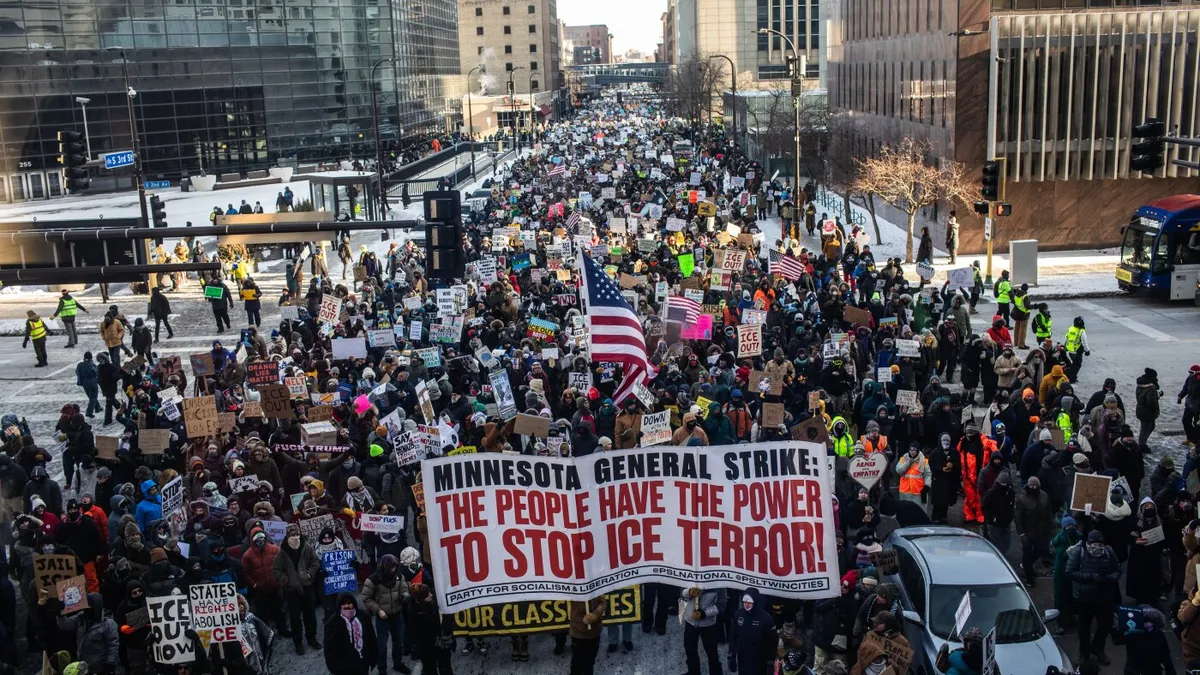
Thousands of Minnesotans stood in subzero cold on Friday to draw a line. They weren't protesting in the abstract — they were standing for neighbors too afraid to leave their homes, families being torn apart, and a community under pressure from 3,000 federal immigration officers deployed to the state.
The scale of the response was striking. Downtown Minneapolis filled with protesters despite temperatures that would keep most people indoors. Hundreds of businesses — restaurants, museums, shops — closed their doors the same day in what organizers called an "ICE Out" economic blackout. Labor unions, faith leaders, and community activists coordinated the demonstrations, which carried three clear demands: that immigration officers leave Minnesota, that Congress deny additional funding to ICE, and that the agent responsible for killing Renee Macklin Good be held accountable.
What's happening on the ground tells a different story than what federal officials describe. Protesters reported that immigration agents have used tear gas, flash bangs, and pepper balls to disperse crowds. One Latino U.S. citizen had their vehicle rammed by agents. People of color report being stopped and detained seemingly at random — even U.S. citizens have been caught up in the sweeps.
We're a new kind of news feed.
Regular news is designed to drain you. We're a non-profit built to restore you. Every story we publish is scored for impact, progress, and hope.
Start Your News Detox"We are in total crisis here in Minnesota with this ICE surge," said Martha Bardwell, a local pastor at the protest. "Thousands of agents are terrorizing our communities, not just Minneapolis, but across the state. They are tearing apart families."
The network behind the resistance
What started as a Friday protest has roots in something deeper: a vast network of community resistance that's been quietly organizing for weeks. Neighbors are delivering food to people too afraid to leave home. Parents are standing guard outside schools. Volunteers are tracking ICE movements to quickly mobilize when enforcement operations are spotted in their neighborhoods.
This isn't spontaneous. It's organized, distributed, and growing. Rev. Susanne Intriligator traveled from Massachusetts to join the Minnesota demonstrations. "We know that ICE is coming to our town, so we need to get ready," she said. "We've learned so much from the people of Minneapolis."
The federal government has escalated in response. Three protesters were arrested after a church disruption. Officials have threatened to invoke the Insurrection Act to deploy military forces in Minnesota without the state's consent. The pressure is real and it's intensifying.
Yet organizers say they're not backing down. Guy Hammink, one of the protesters, captured something essential about why people showed up in the freezing cold: "There are people who are scared to go outside. And people who aren't being targeted, I feel like there's an obligation for those people to stand up for those who are being targeted. So I'm just here to show my support for my neighbors."
That's the story underneath the headline — not just resistance, but a choice. A choice to show up when it's uncomfortable, to stand with people who are vulnerable, to believe that solidarity matters even when the forces arrayed against it are enormous.