

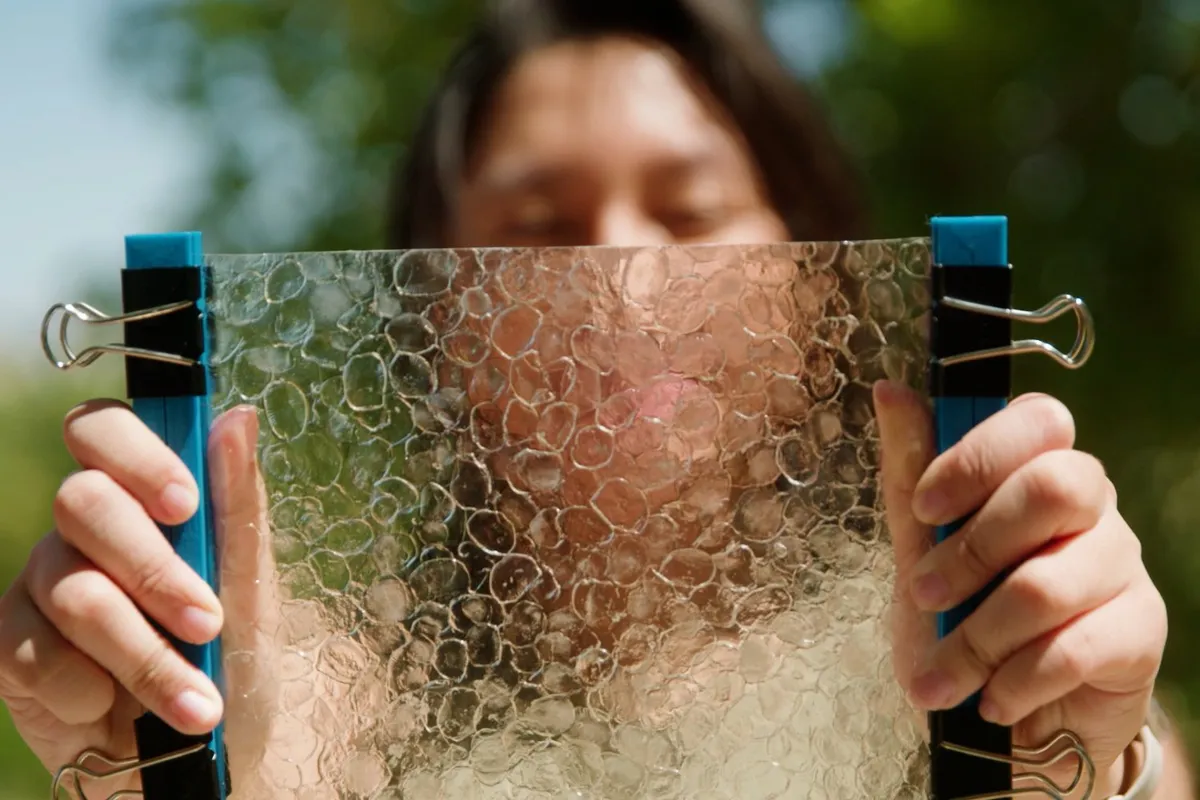
Jacqueline Prawira was wandering through an Asian fish market with her family when she noticed something most people throw away: fish scales. They were strong, flexible, lightweight — the exact properties that make plastic useful. So she asked herself a question that led to her senior thesis at MIT: what if we could turn this waste into something that actually biodegrades.
Prawira, a materials science student, spent months developing a transparent, thin-film material from fish offal that mimics plastic's properties while solving its central problem. Put her material in a composting environment, and it breaks down naturally, without chemical additives or special conditions. She's already created two versions: one from fish scales alone, and a composite that performs even better. Both work as grocery bags, food packaging, and disposable utensils — the exact applications where single-use plastic causes the most damage.
"They're fairly strong, thin, somewhat flexible, and lightweight," she explains of the fish scales. "And I thought: what other material has these properties? Plastics." The insight sounds simple, but it required seeing waste as a resource rather than a problem to ignore.
We're a new kind of news feed.
Regular news is designed to drain you. We're a non-profit built to restore you. Every story we publish is scored for impact, progress, and hope.
Start Your News DetoxThis isn't Prawira's only environmental project. In Professor Yet-Ming Chiang's lab at MIT, she helped develop a low-carbon cement process called silicate subtraction, which lets compounds form at lower temperatures and cuts fossil fuel use significantly. Cement is the world's most-used construction material and a major carbon emitter, so even small efficiency gains matter at scale. She and her lab mates are also using the same method to extract lithium with zero waste — a process that's now patented and being commercialized through a startup called Rock Zero.
For her work across these projects, Prawira recently received the Barry Goldwater Scholarship, one of the most competitive awards for undergraduates in science and engineering. What drives her, though, isn't the recognition. In a recent interview, she spoke about wanting daily life to feel less like a choice between convenience and environmental responsibility. "I'm hoping that we can have daily lives that can be more in sync with the environment," she said. "So you don't always have to choose between the convenience of daily life and having to help protect the environment."
That shift — from either/or to both/and — is what makes her work matter. Fish scales become packaging. Waste becomes material. And somewhere in an Asian fish market, what was once discarded now has a second life.





