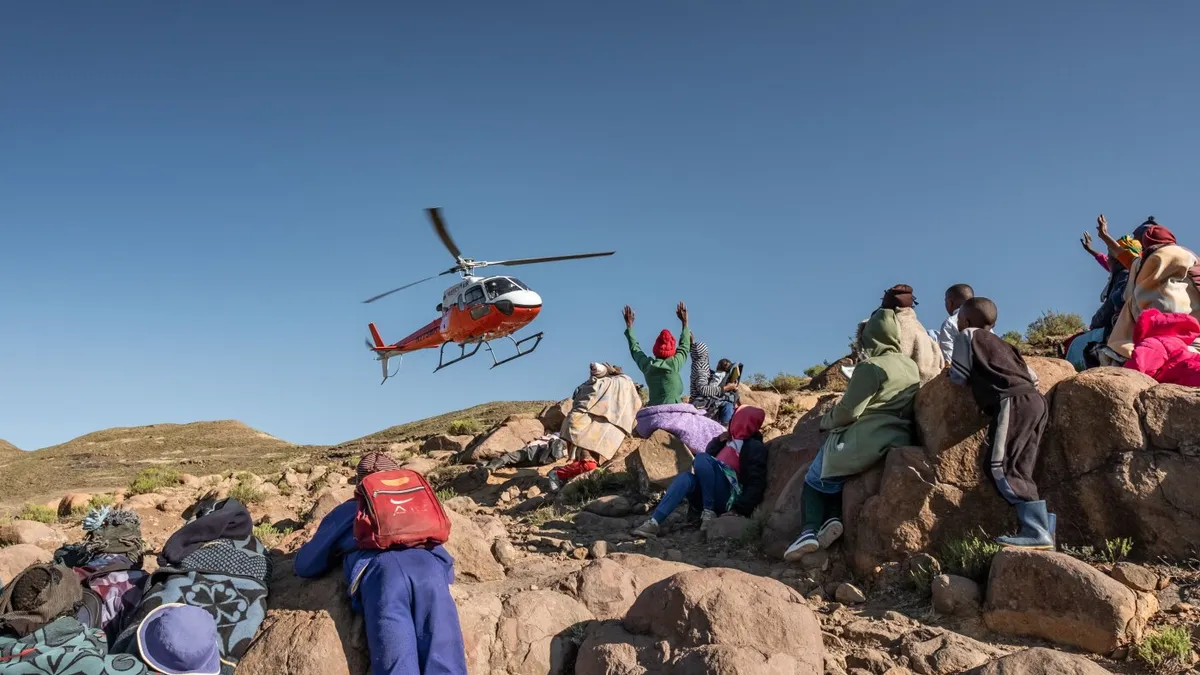
Senate Makhoali crouches low against the helicopter rotor wash, loads her dental equipment, and jumps aboard. She's already survived a hair-raising flight through mountain storms this morning. Now comes the bumpy ride across a steep ravine to a village where many haven't seen a doctor in years.
"One minute it's calm, the next you think you're about to die," she says of flying through Lesotho's turbulent weather. But the 27-year-old dental therapist has learned to live with it. For the past year and a half, she's served with the Lesotho Flying Doctor Service—a small team of airborne health workers bringing essential care to 300,000 people scattered across the remote highlands of southern Africa.
When the Flights Stopped
In the mountains of Mohale's Hoek district, the helicopter carrying Makhoali touches down beside bemused shepherds on a distant ridge. A crowd gathers quickly—word spreads fast in isolated villages. Makhaphetsi Makhaba, a 25-year-old mother of two, steps forward for her first-ever dental visit. By the end of the day, she's had a tooth extracted and a filling placed. "It's a relief," she says. "My teeth have been hurting me for years."
We're a new kind of news feed.
Regular news is designed to drain you. We're a non-profit built to restore you. Every story we publish is scored for impact, progress, and hope.
Start Your News DetoxThis is the work that nearly stopped entirely in January 2025. When the Trump administration cut foreign aid, Lesotho—a country where the government funds just 12 percent of national health spending—was hit hard. USAID alone had been covering over a third of the health system. When that money evaporated, the flying doctor service lost its funding overnight.
Of the 12 clinics the LFDS operated at the start of the year, 10 were abruptly transferred to local district teams with no air support. Flight schedules were slashed. Staff lost their jobs. The organization's chief doctor, who had flown with the service for 15 years, was reassigned to a hospital in the capital. By autumn, the mood was bleak. "To be here in the mountains trying to serve the nation but with no resources," says Karabo Lelimo, head of the LFDS, "it was something else."
The Reckoning
Then something shifted. As the cuts dragged on, Lelimo was appointed to lead the service in November 2025. Instead of simply trying to survive, he and his team began asking harder questions. What was actually broken here—and not just because of missing aid money?
What he found was sobering: massive gaps in data collection, chronic lack of oversight on spending, poor planning, little accountability. Planes routinely flew into the mountains half empty, sometimes returning with no cargo or passengers at all. "The cuts were a wake-up call," Lelimo says. "As African countries, we need to do more self-introspection to see how much capacity we have without relying on foreign aid."
The team got to work. They introduced mixed flights—every journey (except emergency evacuations) now carefully planned to combine patient transfers, nurse movements, and cargo. They created a new drug distribution system so that people with harder access to clinics could receive up to six months' supply of antiretrovirals instead of just one or two months. They trained village health volunteers to take over work previously done by paid staff. Budgets were reallocated. Communication with the ministry improved.
On December 19, 2025, the 10 transferred clinics were brought back under LFDS control. Flights resumed.
What Comes Next
Pilot Jo Adams, a 44-year-old from Washington state who's been based in Maseru since 2019, understands the stakes. When a 24-year-old named Tlotliso Lebeta fell from his horse and sustained head injuries, Adams was airborne within minutes. The journey that would take 10 hours by horseback and winding mountain roads took less than an hour by air. "Without the air service, people would die," Adams says simply.
Makhoali and her colleagues are now planning to build two new airstrips in 2026 and expand their network of mountain health posts. The emergency evacuation program—the only part of the service unaffected by the cuts—continues unabated. When Makhoali finishes a day of extractions in Ha Pheulane, a remote village perched on a steep escarpment, she's already thinking ahead.
"We're excited to continue serving these communities," she says, "and to do it even better than before." The flying doctors of Lesotho have learned that survival sometimes means getting better at the work itself—not just waiting for the next grant, but building something that can actually hold together when the money runs out.