
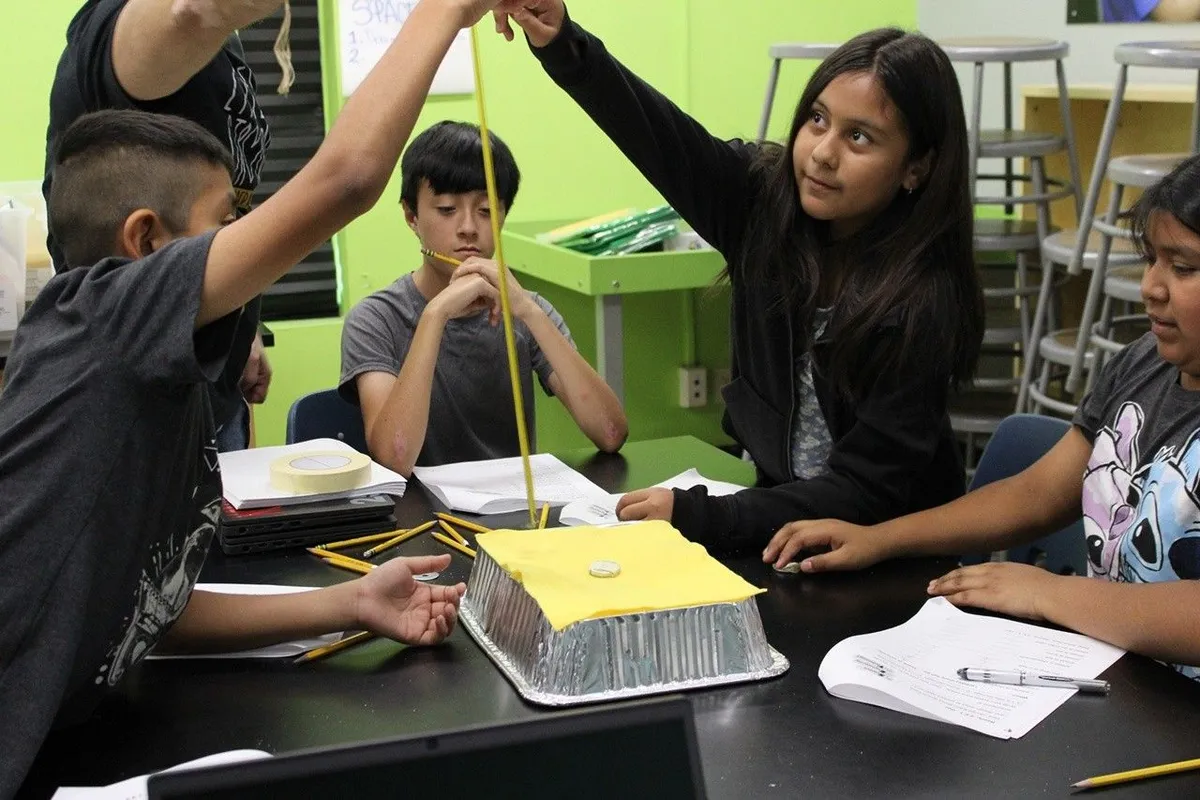
Three new out-of-school learning modules launched by Northern Arizona University are bringing real planetary science directly to students in grades 3–8, no tuition required.
The PLANETS project (Planetary Learning that Advances the Nexus of Engineering, Technology, and Science) spent years in development, pairing NASA planetary scientists from the USGS Astrogeology Science Center with education researchers to build something that actually works. The result: three units — Space Hazards, Water in Extreme Environments, and Remote Sensing — that let students tackle genuine science and engineering problems rather than simulated versions.
What makes this different is the intentional design for access. The curriculum was built with multilingual learners, Indigenous students, and those with varying physical abilities in mind from the start, then tested and refined across out-of-school programs nationwide. This wasn't an afterthought; it shaped how every activity works.
We're a new kind of news feed.
Regular news is designed to drain you. We're a non-profit built to restore you. Every story we publish is scored for impact, progress, and hope.
Start Your News DetoxWhat students actually do
In Space Hazards (grades 3–5), students play a card game to learn about hazards on Earth and in space, then design a space glove that protects astronauts while keeping their hands functional. It's tactile, it's collaborative, and it mirrors how real engineers think.
Water in Extreme Environments (grades 6–8) starts with a problem: fresh water is scarce everywhere, including for astronauts. Students map where water actually exists in our solar system using data cards, then design a filtration system they could theoretically use. The science isn't abstract — it's tied to survival.
Remote Sensing puts students in the role of NASA spacecraft engineers. They design instruments to study planetary surfaces, then use actual NASA data to choose a landing site for a Mars rover. They're not pretending to be scientists. They're doing the work.
All three units can be taught separately or woven together, depending on what an after-school program or community center has time and space for. Everything is free and available at planets-stem.org.
The broader point: this is NASA treating out-of-school time seriously. Not as a backup to classroom learning, but as its own legitimate space where kids can spend an afternoon actually thinking like planetary scientists. That matters for the students who encounter it — and it matters for what we're signaling about who gets to see themselves as a scientist or engineer.