
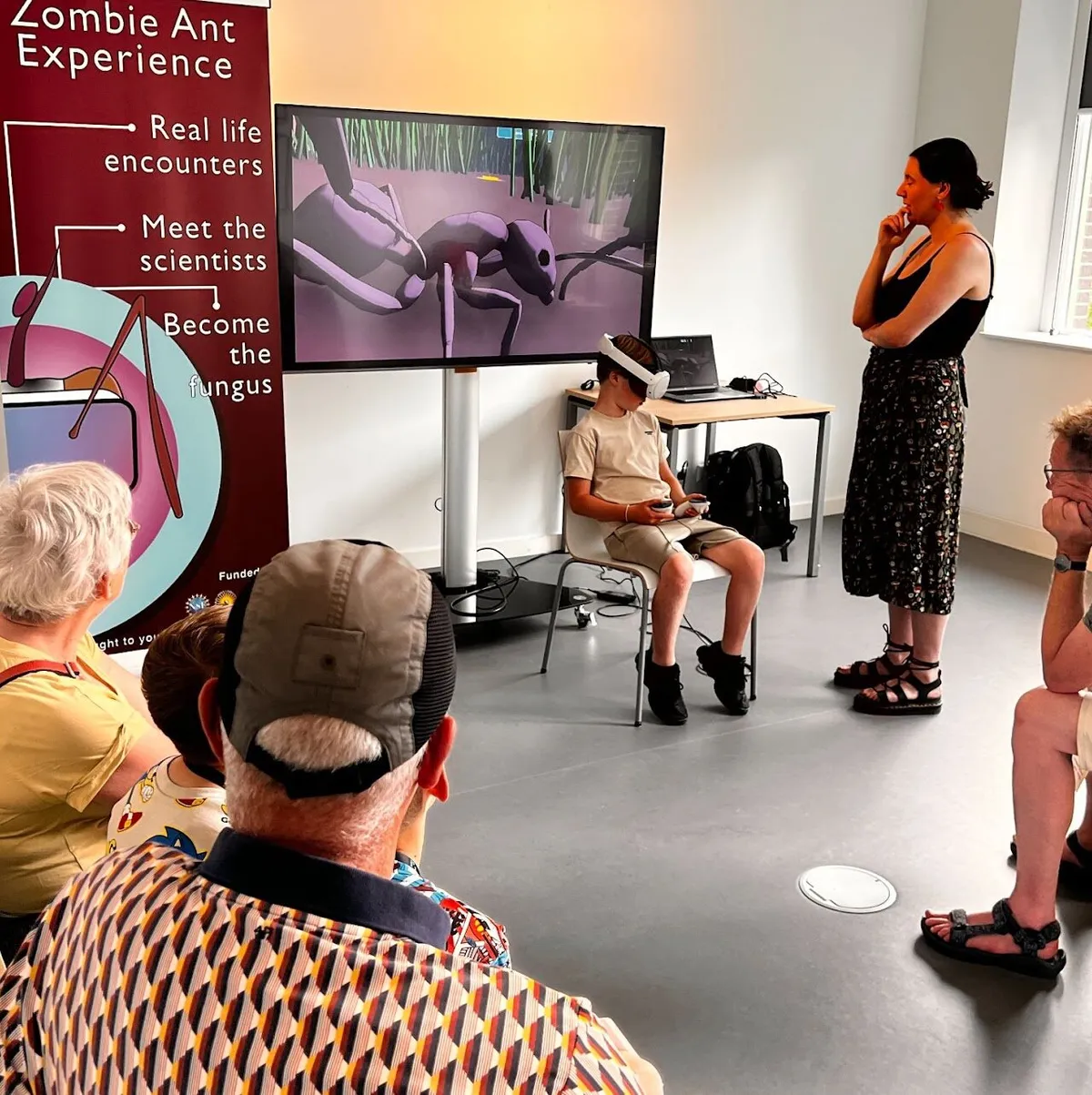
Playing a virtual reality (VR) game about zombie ants can help people understand evolution better. Researchers from Utrecht University invited museum visitors to play "Zombie Ants VR: Definitive Edition."
After playing, people showed a greater understanding of natural selection. This was based on questionnaires they filled out before and after the game.
Why Understanding Evolution Matters
Evolution happens all the time. For example, germs are becoming resistant to medicines because of how we use antibiotics.
We're a new kind of news feed.
Regular news is designed to drain you. We're a non-profit built to restore you. Every story we publish is scored for impact, progress, and hope.
Start Your News DetoxWilliam Beckerson, a researcher, explained that knowing how evolution works helps us make smart choices about antibiotics and vaccines. He noted that some people might not accept evolution due to their beliefs, or they might misunderstand it.
Teaching evolution can also be tricky because it can bring up strong feelings. The research team wanted to see if a game could teach these ideas without using words like "evolution" or "natural selection."
Their study was published in the European Journal of STEM Education.
How the Game Works
The game shows how the Ophiocordyceps fungus infects ants in real life. Players start as a tiny fungal spore. Their goal is to infect an ant and make it act strangely.
The infected ant must leave its group, climb a plant, and bite down firmly. Then, the fungus grows out of the ant like a mushroom, releasing new spores from a high spot. This helps the wind carry the spores to infect more ants.
The game uses a "trial-and-error" approach. If a player fails a mission, they get to try again. Researcher Charissa de Bekker said the game tells players that each time they fail, they start as a new spore. This simple idea helps players grasp natural selection.
Game Improves Understanding
The researchers gave participants a questionnaire before and after playing the game. One question checked their understanding of how diseases evolve.
Before the game, only eight out of 28 players chose the correct answer about evolution. After playing, 17 out of 28 players answered correctly. Notably, six of the seven players who initially chose a creationist answer then gave the correct evolutionary answer.
Beckerson believes this shows the game can teach evolutionary ideas even to people with creationist views.
A Valuable Experience
The team spent several weekends at the University Museum Utrecht for testing. De Bekker mentioned that many more people played than the 28 included in the study. They only included players aged 12 and older.
Even with a small number of participants, the results showed interesting trends. De Bekker also noted that the museum experience was helpful beyond just testing. The game sparked many conversations with children and parents about parasites and evolution.
Teamwork Makes the Game
Beckerson had experience in biology education research. However, the team needed help to create a VR game. They worked with John Murray, an Assistant Professor of Digital Media at the University of Central Florida.
Students developed the main part of the game during Murray's bachelor's course. Other students then refined it, focusing on specific parts like ant models, movement, and gameplay improvements.
Funding and Future Plans
The game started in the United States and was improved in the Netherlands. Brendan Miller, a Master's student from Utrecht University's Game & Media Technology program, helped with this.
Beckerson received a Public Engagement Seed Fund from Utrecht University. This funding helped adapt the game for a Dutch audience and test its educational value.
The researchers hope that since the game is free, other educators will use it with students from different cultures and backgrounds worldwide.
"Zombie Ants VR: Definitive Edition" is available for free on Steam VR and Meta Quest.
Deep Dive & References
Zombie ants VR: Using trial-and-error gameplay mechanics to intuitively teach players about natural selection - European Journal of STEM Education, 2026