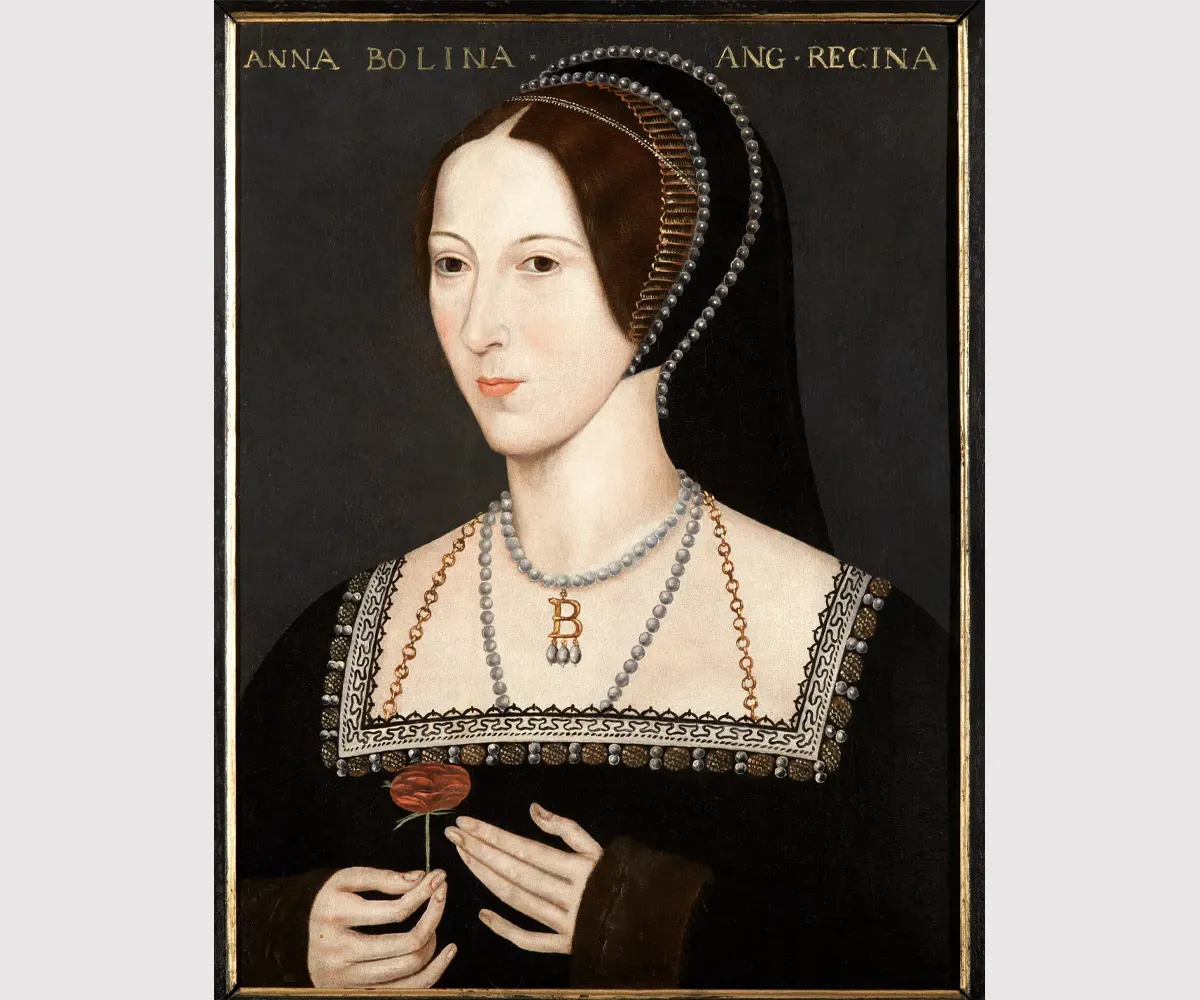
A portrait hanging in Hever Castle has revealed a centuries-old act of image rehabilitation. Using infrared technology, historians discovered that the painting of Henry VIII's second wife was deliberately altered to counter a vicious rumor: that Anne Boleyn had six fingers and was therefore a witch.
The evidence is in what wasn't there originally. Infrared scans show the artist's initial sketch didn't include Boleyn's hands at all. But in the final painting, both hands are visible and perfectly normal—five fingers each. Someone made a deliberate choice to add them.
This matters because in the 1580s, such rumors could destroy a reputation. The portrait dates to around 1583, during the reign of Elizabeth I—Boleyn's daughter. By then, Anne had been dead for nearly 50 years, beheaded in 1536 after failing to give Henry VIII a son. But her ghost still haunted the Tudor dynasty.
We're a new kind of news feed.
Regular news is designed to drain you. We're a non-profit built to restore you. Every story we publish is scored for impact, progress, and hope.
Start Your News DetoxThe Whisper Campaign
A Catholic activist named Nicholas Sanders had begun circulating a particularly damaging claim: that Elizabeth I's mother was "unnatural" and possessed six fingers on her right hand. In the political chaos of the Reformation, this wasn't mere gossip—it was a weapon. If Boleyn was a witch, then Elizabeth's claim to the throne was tainted by association.
The portrait appears to be Elizabeth's direct answer. By commissioning (or at least allowing) a painting that showed Boleyn with two perfectly ordinary hands, she was doing something quietly powerful: reclaiming her mother's humanity and, by extension, her own legitimacy.
"It's Elizabeth's way of not only reclaiming her own legitimacy and lineage, but also restoring the legitimacy of her mother," Kate McCaffrey, an assistant curator at Hever, told the Guardian. "It's impossible to say that Elizabeth herself commissioned this portrait, but it certainly seems too much of a coincidence for it not to be in response to rumors that were circulating at this time."
What makes this discovery striking isn't just the detective work—though the infrared reflectography is genuinely clever. It's the reminder that image-making has always been political. In the 1580s, as now, a portrait wasn't just a picture. It was an argument. It was a way of saying: This is who we are. Believe this version of the story.
The painting will be featured in the exhibition "Capturing a Queen: The Image of Anne Boleyn," opening in February 2027 at Hever Castle and Gardens.