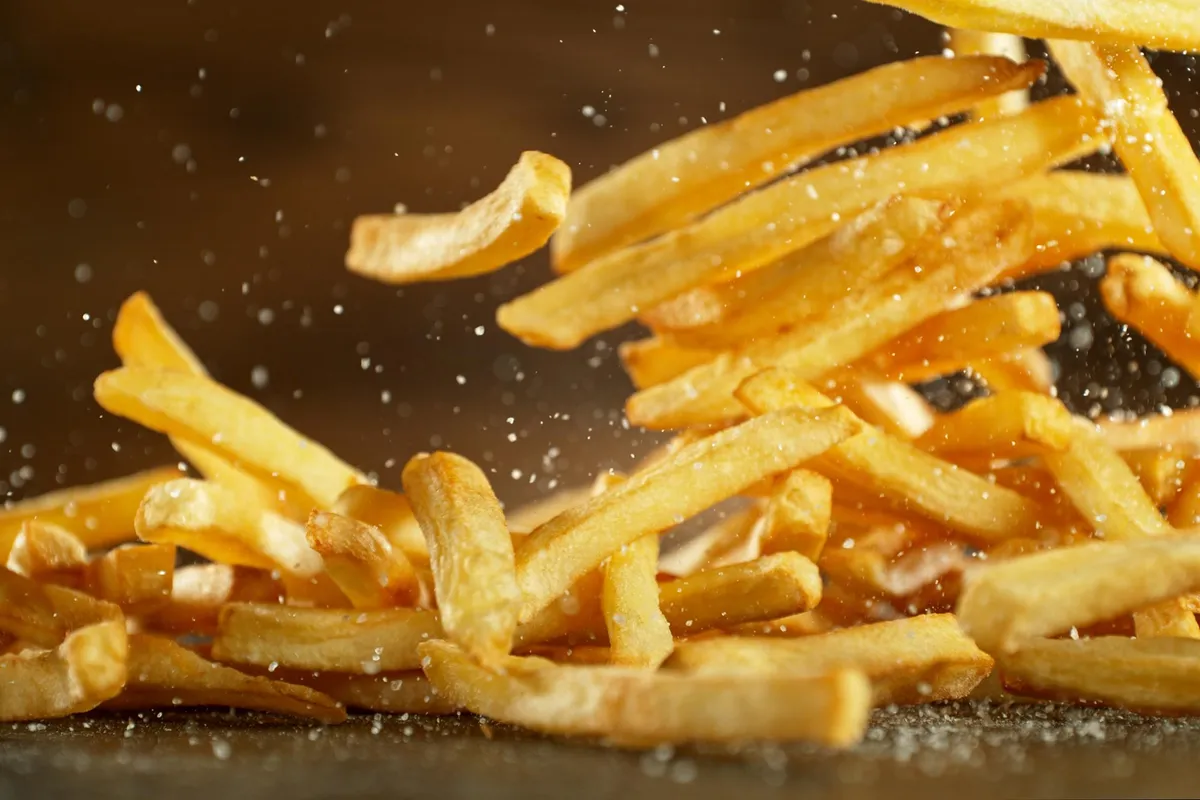
The problem with french fries has always been honest: they taste good because they're soaked in oil, and that oil comes with calories and health consequences most of us would rather avoid. Researchers at the University of Illinois have found a way to break that bargain.
By combining conventional frying with microwave heating in a single cooking process, food engineers can produce fries that absorb significantly less oil while staying crispy. The technique works because it manipulates pressure inside the potato itself — the same force that normally pulls oil deeper into the food.
Why Oil Gets In (And How to Stop It)
When you fry a potato, the water inside it evaporates as heat rises. That evaporation creates empty pores, and those pores act like tiny straws drawing oil into the food through negative pressure. "As much as 90% of the frying process occurs under negative pressure," explains Pawan Singh Takhar, the food engineer leading the research. "It's a constant pull."
We're a new kind of news feed.
Regular news is designed to drain you. We're a non-profit built to restore you. Every story we publish is scored for impact, progress, and hope.
Start Your News DetoxMicrowaves change this equation. Unlike conventional ovens that heat from the outside in, microwaves penetrate the entire potato and agitate water molecules from within. This internal heating creates positive pressure — the opposite of a vacuum — which actually pushes oil away rather than pulling it in.
The catch: microwave frying alone produces soggy, disappointing results. So Takhar's team proposed what sounds simple but required understanding the physics underneath: use microwaves to reduce oil absorption, then switch to conventional heat to crisp the outside. The two methods work in sequence to solve what neither could solve alone.
From Lab to Factory Floor
Washington State University collaborators built a specialized microwave fryer to test the concept at two different frequencies. The results were clear. Fries cooked with the hybrid method showed faster moisture loss, shorter cooking times, and measurably less oil absorption compared to traditional deep frying — all while maintaining the texture that makes fries worth eating in the first place.
What makes this genuinely practical is the economics. Food manufacturers already operate large continuous fryers. Adding microwave generators to existing equipment is relatively inexpensive and uses widely available components. This isn't a "maybe someday" technology that requires building new factories from scratch. It's an upgrade path that existing operations could actually implement.
The broader context matters here: this research sits at the intersection of two real consumer tensions. People want healthier food, but at the moment of purchase, taste usually wins. If manufacturers can reduce oil content without sacrificing flavor or texture, they remove one barrier to choosing the less destructive option. It won't make fries a health food, but it could make them noticeably less unhealthy — which, for a food people genuinely enjoy, might be enough to shift behavior at scale.
The research points toward a near-term future where comfort foods don't require choosing between satisfaction and consequence. Whether food companies adopt the technique depends on whether health-conscious consumers start demanding it.