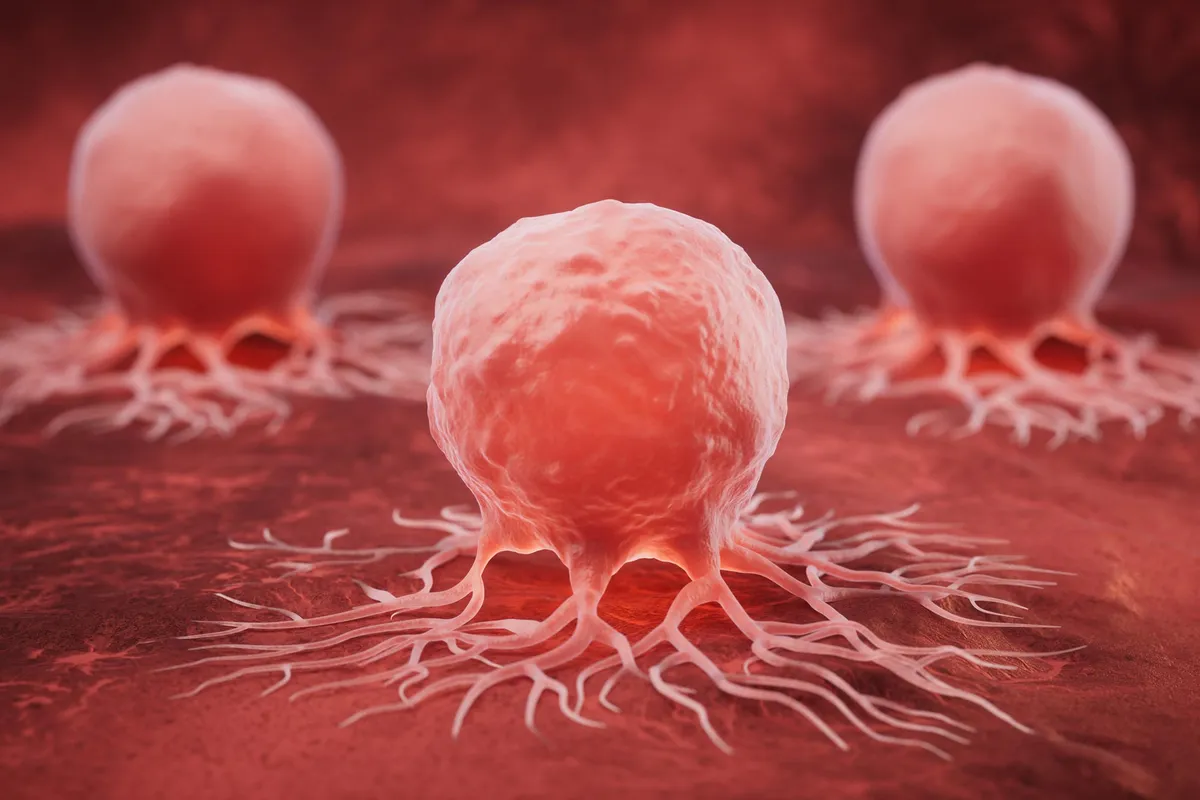
Cancer cells are famously addicted to glutamine, an amino acid they need to divide and grow. Block glutamine, and tumors should starve. Except they don't — most find a way around it. Now researchers at the University of Lausanne have figured out why, and the answer points to an unexpected vulnerability: vitamin B7.
The discovery, published in Molecular Cell, reveals that when cancer cells can't access glutamine, they switch to a backup fuel called pyruvate. But this metabolic escape route depends entirely on an enzyme that requires biotin — the scientific name for vitamin B7 — to function. Remove the biotin, and the workaround collapses.
"It's like a secret door in the tumor's defenses," explains Alexis Jourdain, the assistant professor who led the research. "We found the lock, and now we know what key opens it."
We're a new kind of news feed.
Regular news is designed to drain you. We're a non-profit built to restore you. Every story we publish is scored for impact, progress, and hope.
Start Your News DetoxFor decades, cancer biologists have known that tumor cells develop a strong dependence on glutamine. It's one of their most studied weaknesses. But when researchers tried to exploit this by blocking glutamine metabolism, many cancers simply switched strategies — they found alternative pathways to keep dividing. The Lausanne team wanted to understand how.
Their experiments, led by postdoctoral researcher Miriam Lisci, focused on pyruvate, a carbon-rich molecule that cells can use as an energy source. They discovered that pyruvate carboxylase, a mitochondrial enzyme, allows cells to convert pyruvate into fuel when glutamine runs dry. The catch: this enzyme only works when vitamin B7 is present. Without it, the enzyme stays dormant, and the cell's growth halts.
The researchers also uncovered a second piece of the puzzle. A gene called FBXW7, which is frequently mutated in cancer, normally helps control pyruvate carboxylase levels. When FBXW7 is mutated — which happens often in certain tumor types — the enzyme partially disappears, and cells can no longer use pyruvate efficiently. This forces them back into glutamine dependence, even though they've developed mutations meant to escape it. It's a metabolic trap: the same genetic changes that help some cancers survive actually create a new vulnerability in others.
Why This Matters for Treatment
The implications are significant. Current anti-cancer therapies that target glutamine metabolism fail partly because tumors escape through the pyruvate pathway. But if that escape route is blocked — by restricting biotin availability — the tumor loses both options at once. Jourdain's team is now exploring whether combining glutamine-blocking drugs with biotin restriction could prevent tumors from adapting.
This reflects a broader shift in cancer research: moving away from single-target therapies toward strategies that attack multiple metabolic pathways simultaneously. Cancer cells are remarkably flexible, able to rewire their internal chemistry when threatened. The new approach is to close multiple escape hatches at once.
The research also hints at something less obvious: cancer's metabolic flexibility, while a strength, creates hidden dependencies. The more pathways a tumor uses, the more vulnerabilities it potentially has. Finding and exploiting those vulnerabilities — especially ones tied to common nutrients like vitamin B7 — could reshape how oncologists think about treatment design.
The next phase involves clinical translation. Researchers are already exploring whether biotin restriction, either alone or combined with existing glutamine-targeting drugs, could slow tumor growth in laboratory models. If those early results hold, human trials could follow within the next few years.