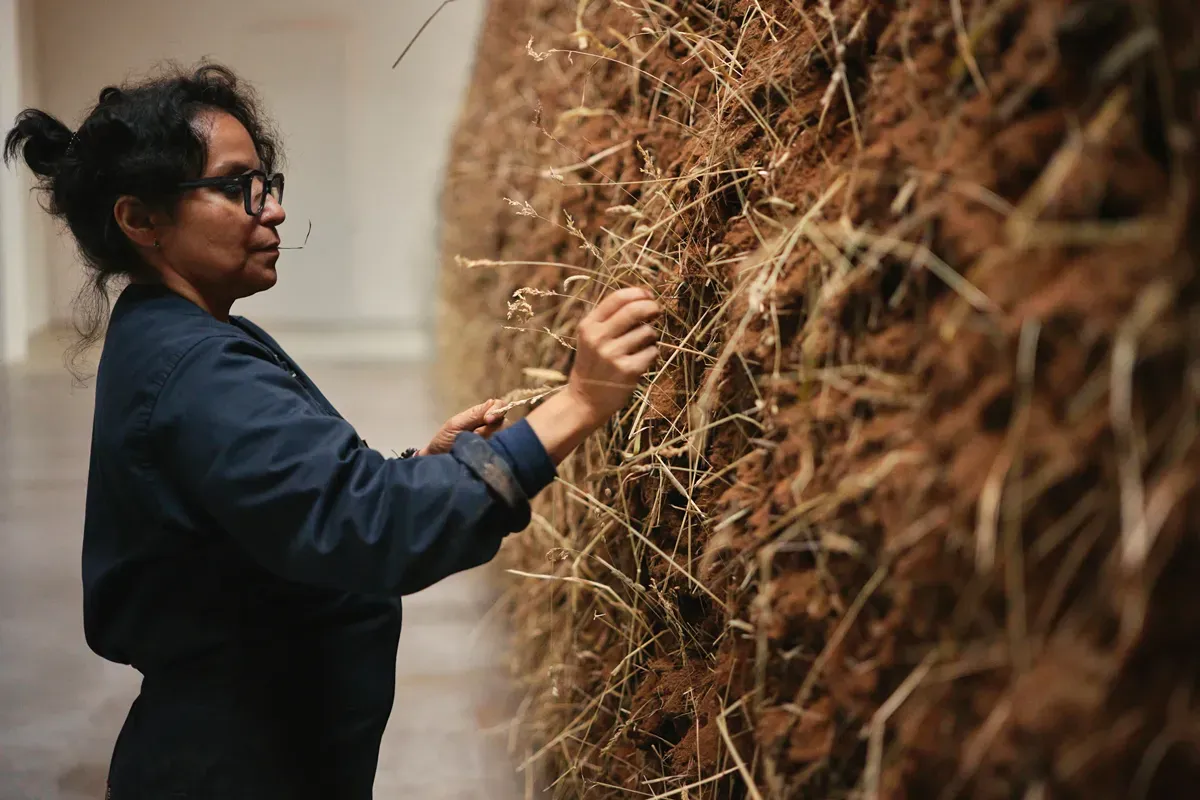
Delcy Morelos is building something you can walk into, touch, and smell. This May, the Colombian artist will open a massive oval pavilion in the Barbican's Sculpture Court in London—her first major commission in the UK and her most ambitious work yet. At 78 feet around, it's made entirely from soil, clay, spices, and plants. You won't just look at it. You'll inhabit it.
Morelos has spent the last few years creating immersive installations that blur the line between art and earth. At the 2022 Venice Biennale and later at New York's Dia Art Foundation, she built spaces designed to be felt as much as seen. Her 2023 Dia piece, El abrazo (The embrace), was a V-shaped alcove where visitors could step inside and feel soil embedded in the walls—literally surrounded by earth. The work earned her ARTnews's inaugural Established Artist of the Year award.
"There's something very feminine, very delicate," she told ARTnews about that piece. "The embrace happens literally when you get closer and feel the earth surround you."
We're a new kind of news feed.
Regular news is designed to drain you. We're a non-profit built to restore you. Every story we publish is scored for impact, progress, and hope.
Start Your News DetoxThe Barbican's new commission, running May 15 to July 31, marks a shift in how the institution uses its public spaces. It's the first major artwork to occupy the Sculpture Court since its redesign, and Devyani Saltzman, the Barbican's director for arts and participation, sees it as a deliberate choice. "Our public realm commissions invite artists to respond to the Barbican's iconic brutalist architecture," she said. By placing Morelos's fragile, organic installation against concrete and steel, the contrast becomes the point—a conversation between human-made permanence and natural impermanence.
The work is backed by the Bukhman Foundation, led by collector Anastasia Bukhman. In her statement, Bukhman described Morelos's practice as "rooted in earth, materiality, and ancestral wisdom." That's the heart of what Morelos does: she treats soil not as inert material but as something with memory, with presence, with the capacity to move you if you let it close enough.
When the pavilion opens in May, visitors won't need a catalog to understand it. They'll step inside, feel the texture of clay, catch the scent of spice, and experience what Morelos has spent years perfecting—the moment when art stops being something you observe and becomes something you're held by.