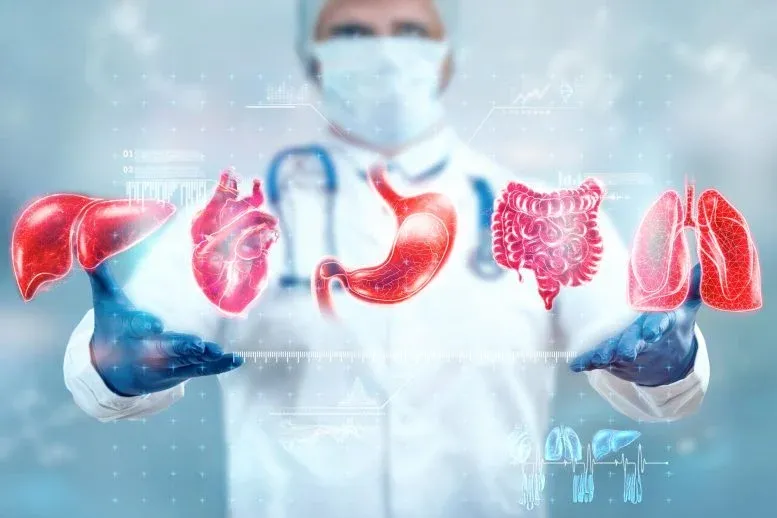
Ever feel like some parts of you are ready for a nap while others are still trying to run a marathon? Turns out, your organs might feel the same way. New research suggests your internal machinery isn't aging uniformly, but rather, each organ is on its own timeline.
Scientists at the CeMM Research Center for Molecular Medicine and the Ludwig Boltzmann Institute for Network Medicine (LBI-NetMed) have developed a rather clever AI. They've dubbed them "tissue clocks," and these digital seers can peer into the microscopic structures of your organs and tell you their biological age. Which, if you think about it, is both impressive and slightly terrifying.
After sifting through over 25,000 images from 40 different tissue types, the team confirmed what many of us probably suspected: not all organs get the memo to age at the same pace. Some of these age discrepancies can even be spotted in a simple blood test. The findings, published in Nature Medicine, could be a game-changer for early disease diagnosis and monitoring.
We're a new kind of news feed.
Regular news is designed to drain you. We're a non-profit built to restore you. Every story we publish is scored for impact, progress, and hope.
Start Your News DetoxAI: The Ultimate Age-Guesser for Your Insides
The researchers dove into data from the Genotype-Tissue Expression Project (GTEx), a treasure trove of samples from 983 people covering everything from brains to skin. These samples were digitized into high-resolution images, giving the AI a microscopic grand tour of the human body.
In total, 25,712 images were fed into advanced computer vision models, processing roughly 480 million tiny image sections. The AI wasn't specifically told to look for aging, but like a nosy relative, age turned out to be the most obvious factor changing how tissues looked across all 40 types.
From these patterns, the "tissue clocks" were born. These models can estimate an organ's biological age with an accuracy of about 4.9 years. And here's the kicker: they were better than existing DNA-based aging methods at pinpointing specific organ issues. The estimated ages even correlated with classic aging markers like shorter telomeres and the number of long-term diseases a person had. Because apparently, your tissues keep better records than you do.
André Rendeiro, a lead researcher, put it plainly: tissues are a detailed record of aging, and AI can spot patterns the human eye simply can't. It's like having a secret decoder ring for your own mortality.
Your Lungs Might Be Older Than Your Liver
The study found that aging isn't a one-size-fits-all journey. Lungs, kidneys, the pancreas, and adrenal glands often showed signs of accelerated aging as early as ages 20 to 40. Other tissues, however, had more complex timelines, with aging peaks hitting later. The uterus, for instance, showed significant changes around menopause, which, let's be honest, isn't exactly a shocker.
They also found clear links between organ-specific aging and health conditions. Kidney failure, for example, was tied to faster aging signals in several tissues, while diabetes showed a strong impact on the pancreas. Ernesto Abila, a co-first author, noted that deep learning helps them read these structural changes, viewing aging not just as molecular shifts but as visible wear and tear.
Since biopsies aren't exactly a party, the team wondered if these organ-specific aging patterns could be detected in blood. So, they compared gene activity in blood samples with the tissue age differences from images in the same people. The result? Tools that could predict organ-specific biological age from a simple blood test. Iva Buljan, another co-first author, called it a "conceptual leap." From tissue images to a blood test — now that's a glow-up.
These blood-based predictors uncovered aging patterns linked to Alzheimer's, Crohn's, cystic fibrosis, and diabetes, among others. In Alzheimer's patients, the strongest aging signal was in the brain (no surprises there), while Crohn's disease showed accelerated aging throughout the digestive system. Because apparently, your gut feels your pain.
Yimin Zheng, the third co-first author, summed it up perfectly: aging isn't just about the number of candles on your cake. Different organs age differently, influenced by both body-wide factors and tissue-specific quirks. This means your tissue structure might just be the ultimate diary of your health, reflecting a lifetime of changes and diseases.
In the future, these methods could lead to simple blood tests that track organ health and disease progression, giving doctors a real-time peek into your internal clockwork. It’s a fascinating glimpse into how AI is connecting pathology, gene activity, and patient data to paint a far more detailed picture of how we all, individually, grow old.