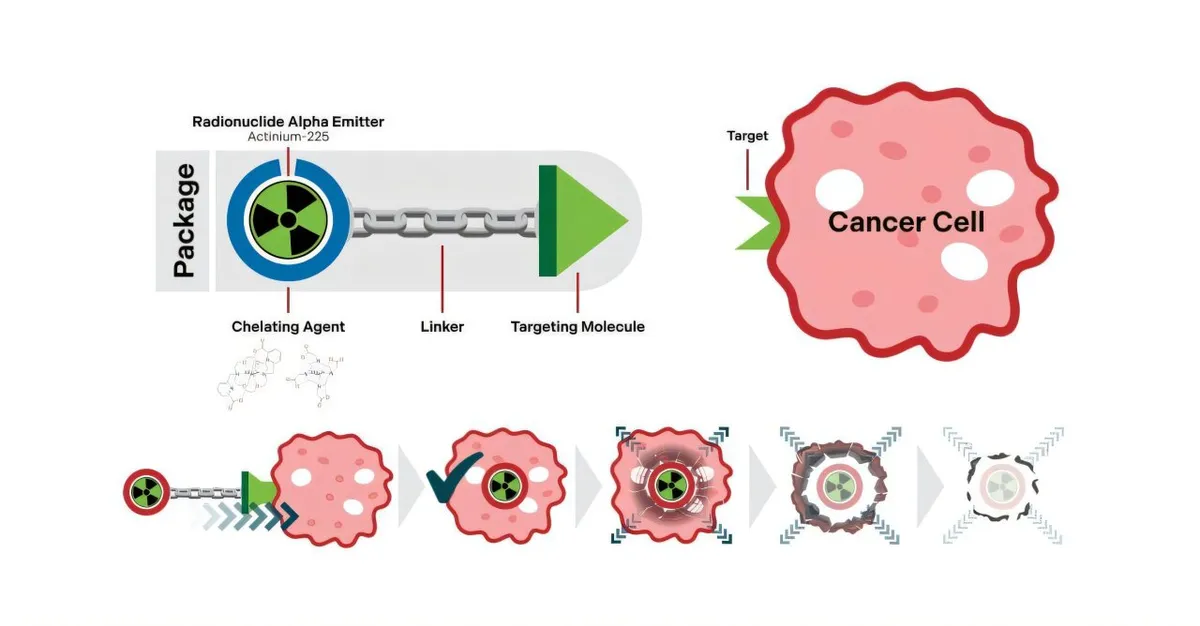
Imagine a single treatment that could both find cancer cells and then destroy them. Sounds like something from sci-fi, right? Well, scientists at Oak Ridge National Laboratory (ORNL) just took a big step closer to making that a reality. They've found a clever way to use special atoms to do both jobs at once.
ORNL has been a quiet powerhouse in medical science for decades, supplying over 300 different special atoms (called radioisotopes) to researchers. These aren't just any atoms; they're tiny, radioactive particles that are key to new medical breakthroughs. Some are already used in treatments, and others are making waves in clinical trials for all sorts of cancers.
Now, a team led by ORNL chemist Nikki Thiele has found a single molecule, called PYTA, that can bind to at least four different crucial radioisotopes. This is pretty nuts because it means PYTA can act like a universal connector for various cancer-fighting tools. Think of it like a special adapter for all your devices.
We're a new kind of news feed.
Regular news is designed to drain you. We're a non-profit built to restore you. Every story we publish is scored for impact, progress, and hope.
Start Your News DetoxOne of these isotopes, actinium-225, is an "alpha emitter." That means it blasts cancer cells with tiny, powerful particles. Another, lutetium-177, is a "beta emitter," which uses a different kind of radiation to do the same thing. But here's the really cool part: PYTA can also link up with isotopes used for imaging, like indium-111 and scandium-44.
These imaging isotopes let doctors see exactly where cancer is in the body. Indium-111 is used in SPECT scans, which create 3D maps of what's happening inside you. Scandium-44 works with PET scans, giving super-sensitive views of how your body's cells are working. So, with PYTA, doctors could potentially use one compound to first find the cancer and then deliver a targeted blast to it.
This approach, called "theranostics," is a huge deal. It means less guesswork and more precise treatment. Instead of broad treatments that affect healthy cells too, this could keep the radiation focused right where it needs to be. The team is even using AI and quantum simulations to make sure these tiny cancer-fighters hit their mark every time. It's like giving doctors a super-smart, microscopic guided missile system for cancer.