
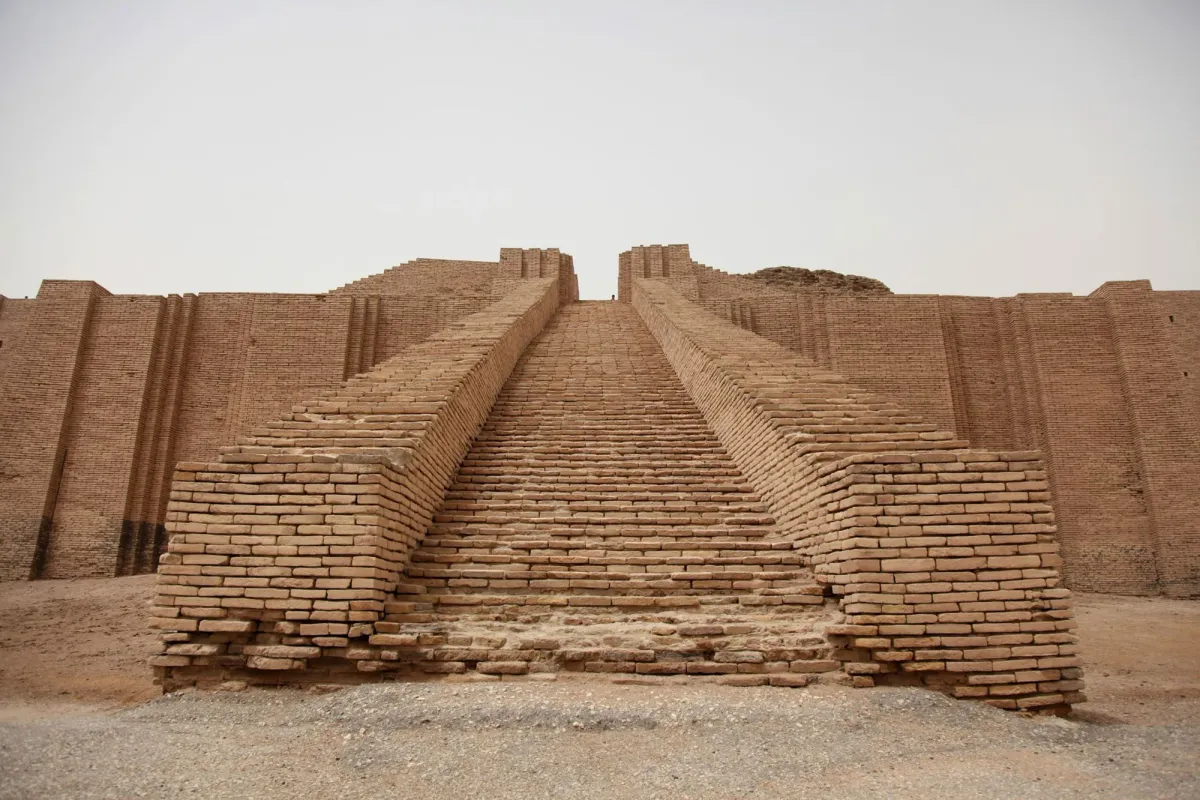
Four thousand years before the Empire State Building rose above Manhattan, architects in ancient Mesopotamia were solving the same problem: how to reach skyward when your materials are limited and your ambitions are not.
They built ziggurats — stepped pyramids of sun-dried mud that served as temples, power statements, and literal bridges between gods and humans. From roughly 4000 to 500 BCE, these structures dotted what is now Iraq and Iran, each one a feat of engineering that required constant repair and unwavering faith that it was worth the effort.
The architecture of aspiration
Ziggurats had no internal chambers. The shrine sat at the top, accessible only by climbing — a design that made the building itself an act of devotion. Stone was scarce in Mesopotamia, so builders worked with what they had: mud bricks, dried in the sun. To make them last, they coated the bricks with limestone and bitumen (a tar-like substance that still smells like ancient ambition when archaeologists unearth it). The walls were grooved, whitewashed, sometimes glazed in colors that would have caught the light in ways we can barely imagine now.
We're a new kind of news feed.
Regular news is designed to drain you. We're a non-profit built to restore you. Every story we publish is scored for impact, progress, and hope.
Start Your News DetoxThe oldest known ziggurat was built at Uruk, in what is now southern Iraq, around 4000 BCE. It was dedicated to Anu, the sky god — fitting, since the whole point was to reach upward. By 3500 BCE, someone had built the White Temple on top of it: a 12-meter-high shrine so thoroughly whitewashed inside and out that its name tells you everything about how it looked.
Other cities built their own. Nimrud had a ziggurat for Ninurta, god of war. Nippur had one for Enlil. And in Babylon, King Nebuchadnezzar II constructed Etemenanki, dedicated to Marduk, the king of the gods. Etemenanki was so famous — so impossibly tall — that it likely inspired the Tower of Babel in the Old Testament.
But here's the thing about mud bricks: they need help. Constant help. Etemenanki had to be rebuilt several times before Alexander the Great finally ordered it destroyed in 323 BCE. The Ziggurat of Ur fared better, preserved by time and luck. So did Chogha Zanbil in Iran, which still stands as proof that even temporary materials can outlast empires if you maintain them carefully enough.
The skyline inheritance
When the Art Deco movement swept through New York in the 20th century, architects didn't consciously reach back to Mesopotamia. But they reached back anyway. The tiered, stepped silhouettes that define that era — the ones that make the skyline look like a city built by gods — owe something to a design language that had been perfected six millennia earlier. The Empire State Building doesn't look like a ziggurat by accident. It's the same impulse: reach higher, make it visible, make it matter.
Those ancient builders understood something that modern architecture keeps rediscovering: that how we build shapes how we think about ourselves. A ziggurat said: we are organized, we are ambitious, we believe in something bigger than ourselves. The mud bricks crumbled. The empires fell. The shape endured.