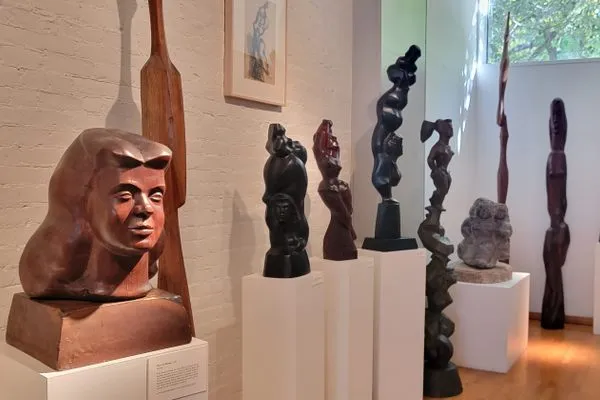
Walk into the four-story townhouse on LaGuardia Place in Greenwich Village and you're stepping into someone else's life—frozen in amber, but alive in the details. Chaim Gross lived here for three decades with his wife Renee, carving wood and stone, teaching, collecting art from across the world. When you visit the foundation that bears their names, you're not just seeing sculptures in a gallery. You're seeing the studio where they were made, the home where they were lived with, the shelves where African masks and Pre-Columbian figures sit alongside Gross's own work, arranged exactly as he and Renee left them.
Gross arrived in New York in 1921 with almost nothing. He was born in Hungary—in a region where borders kept shifting and antisemitism was written into law—and he'd learned to carve in Budapest and Vienna before boarding a ship to America. He was 19. He studied at several New York art schools, then moved quickly from student to teacher, spending 50 years instructing printmaking and sculpture at institutions across the city. He also worked for the WPA during the Depression, creating public commissions when the government decided art mattered enough to fund it.
By the time he and Renee bought the townhouse in 1963, Gross was already established. Museums wanted his work—the Hirshhorn holds 27 pieces, and the Met, the Whitney, the Smithsonian all have examples of his direct carving. He wrote The Techniques of Wood Sculpture in 1957, a book that became influential enough that people still reference it. A monumental bronze called The Family, made in 1979, sits in Bleecker Playground just a short walk from where he worked.
We're a new kind of news feed.
Regular news is designed to drain you. We're a non-profit built to restore you. Every story we publish is scored for impact, progress, and hope.
Start Your News DetoxThe foundation itself came later. Gross and Renee established it in 1974, and it didn't open to the public until 2009—decades after his death in 1991. But when it did, it opened with something rare: over 12,000 objects, from his sculptures and drawings to his personal collection of art from Africa, Oceania, Pre-Columbian cultures, and Europe. The photographs. The studio tools. The way the rooms were arranged when they lived there.
It's the kind of place that reminds you why artist's homes matter. Not as museums, exactly, but as evidence. Evidence that someone lived here and made things. Evidence of taste, of curiosity, of a life spent looking at art and making it. The foundation is part of the Historic Artists' Homes and Studios program now, which means it's recognized as something worth preserving—not just the work, but the context it came from.