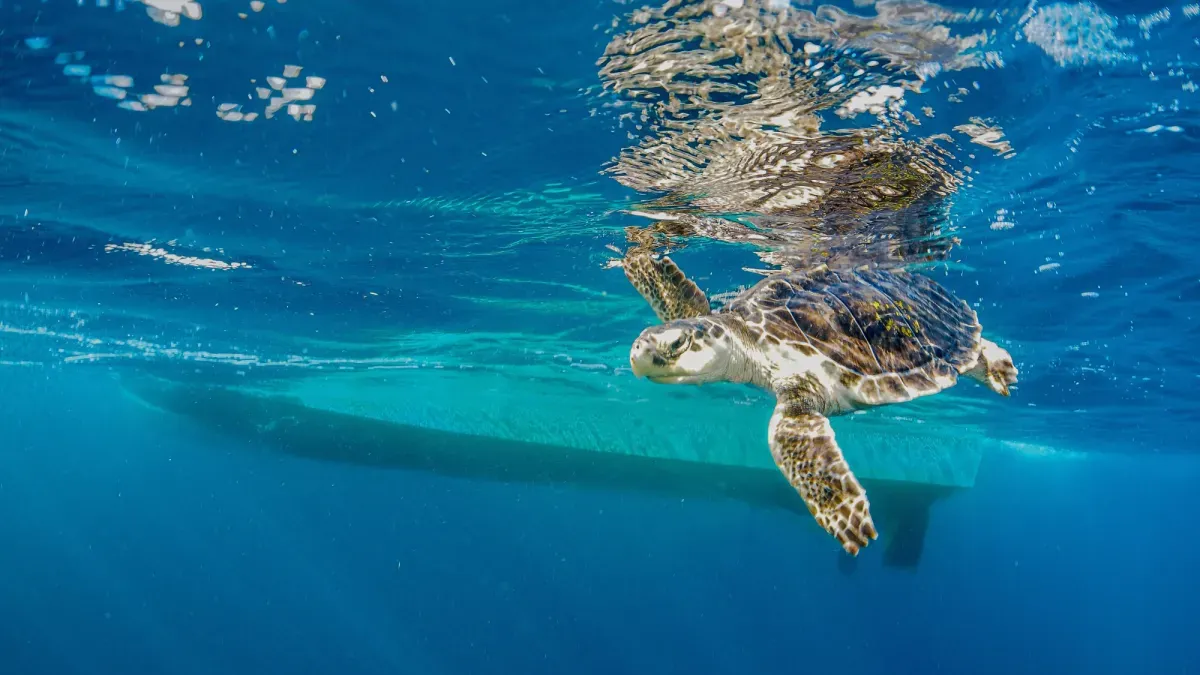
At 75 to 100 pounds, Kemp's ridley sea turtles are the ocean's smallest. They're also the most critically endangered, caught between fishing nets, ship propellers, plastic, and now something harder to see: the relentless noise of industrial shipping and drilling that fills the waters where they live.
For years, scientists assumed these turtles navigated by other senses. But a team at Woods Hole Oceanographic Institution decided to actually listen—literally. They attached sensors to Kemp's ridleys' heads and played sounds ranging from 50 to 1,600 hertz while recording the electrical signals traveling through the turtles' auditory nerves. What they found was striking: these turtles hear best at around 300 hertz, exactly the frequency band where most ocean noise lives—the low rumble of cargo ships, oil rigs, and drilling platforms.
"Understanding hearing ability is a fundamental step in determining whether human-generated noise could affect a species," says Charles Muirhead, co-author of the study published in The Journal of the Acoustical Society of America. "Our goal was to provide a more robust understanding of their hearing sensitivity so that future research and conservation efforts can be built on stronger scientific foundations."
We're a new kind of news feed.
Regular news is designed to drain you. We're a non-profit built to restore you. Every story we publish is scored for impact, progress, and hope.
Start Your News DetoxThe finding matters because Kemp's ridleys don't just share waters with shipping lanes—their movements and distribution overlap directly with the noisiest parts of the ocean. The turtles can detect these sounds. Whether that detection causes harm is the next question, and it's complicated. "Detecting sound does not automatically mean it causes harm or disturbance," Muirhead notes. "Whether noise 'bothers' turtles depends on several factors, including sound level, duration, distance from the source, and the behavioral or ecological context."
This is where the research becomes a foundation for action. Knowing what these turtles can hear opens the door to measuring whether industrial noise actually disrupts their feeding, navigation, or breeding. If it does, there are levers to pull: quieter shipping routes, noise reduction technologies, protected corridors. If it doesn't, conservation efforts can focus energy elsewhere—toward the fishing gear entanglement and habitat loss that remain immediate threats.
The Kemp's ridley recovery has already shown what's possible. In the 1980s, fewer than 1,000 nests remained. Today, thanks to decades of protection and international cooperation, that number has climbed into the tens of thousands. Adding sound to the conservation picture doesn't erase that progress—it refines it. Understanding how these turtles perceive their world is the work of building solutions that actually fit the way they live.