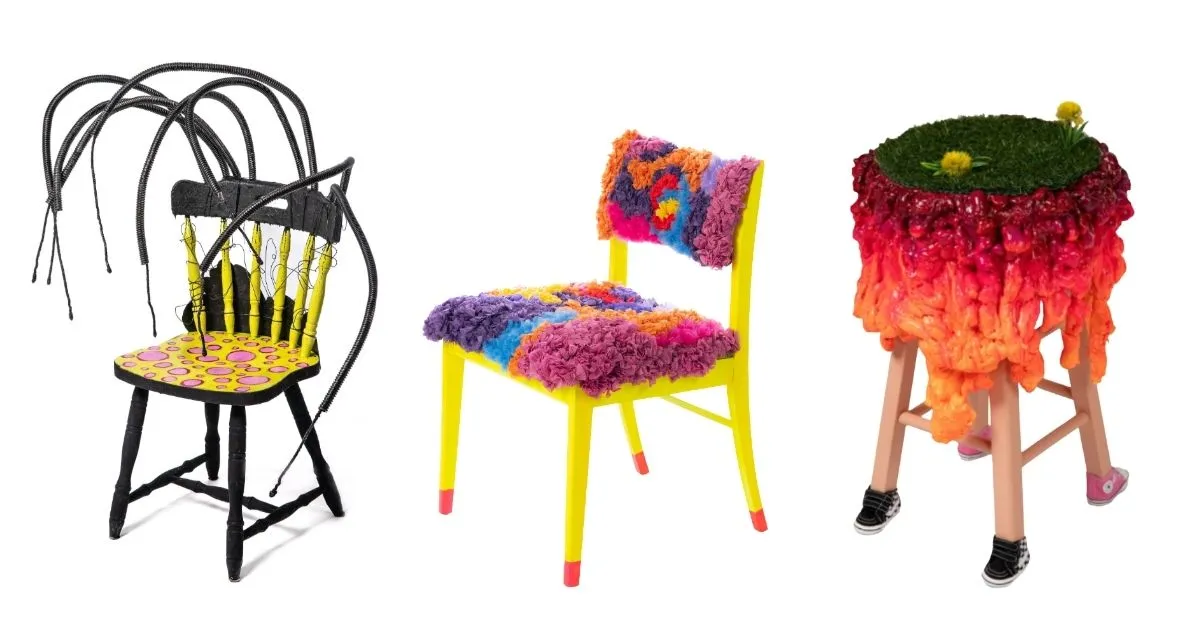
Sandra Davis hung 14 handmade chairs in a Maryland gallery last year, and each one was a portrait of someone's pain.
Courtney Mohring's "Buttoned Up" was black and high-backed, its surface crowded with buttons and bunched fabric—the physical grammar of discomfort. Molly McCracken's "Panic" chair sprouted tentacles in bright colors, a visual twin to the anxiety character in Pixar's "Inside Out 2" (she'd designed it before the film came out). Davis herself contributed "Color Me Manic," a plush rainbow explosion that captured something her spouse had lived through during 42 years of marriage: the garishness, the loudness, the extreme feeling of a manic episode.
These weren't metaphors printed on canvas. They were things you could sit in.
Making Space for the Conversation
The "Pull Up a Chair 2.0" exhibition at the Arts Barn in Gaithersburg wasn't just about displaying art. It was an experiment in how we talk about mental health when we stop treating it like something to discuss and start treating it like something to sit with.
We're a new kind of news feed.
Regular news is designed to drain you. We're a non-profit built to restore you. Every story we publish is scored for impact, progress, and hope.
Start Your News DetoxWhen the artists gathered for an opening roundtable, something unexpected happened. They came to explain their work, but the conversation drifted into deeper territory—the anxiety, loss, and isolation they'd all felt during the pandemic's early days. "It ended up feeling very much like a group therapy session," Davis said. The room had transformed.
For some artists, the project itself was the breakthrough. Mohring had never worked in three dimensions before. "It was nice to have something to ground myself to," she explained, "and it was a near and dear to me topic, exploring mental health. And then just the chair—it was a way to get off of a canvas and onto something different."
Davis saw the potential in scaling that moment. She opened the gallery to the public and invited visitors to do what the title suggested: pull up a chair, sit, and talk. Not about art theory or technique, but about what the pieces stirred in them. About their own mental health journeys.
The timing felt urgent. Mental health conversations are everywhere now—in the news, in schools, in our feeds. Yet Davis noticed something missing: the feeling that these conversations were actually welcome. We talk about mental health the way we talk about weather: acknowledging it exists without quite inviting people to sit down and be honest about it.
Change starts small, Davis believes. It starts when someone makes space—literally, a chair—and says: this is a safe place to talk about the hard things. The exhibition was that space.