A small clinical trial has shown something researchers rarely see: a cancer treatment that made tumors disappear while sparing patients from the brutal side effects that typically come with this class of drugs.
Twelve patients with advanced cancers—melanoma, breast cancer, kidney cancer—received injections of an experimental antibody called 2141-V11. None experienced the serious toxicity that has plagued other drugs targeting the same immune pathway. Six patients saw their tumors shrink significantly. Two saw them vanish entirely.
One of those two was a woman with melanoma that had spread across her leg and foot in dozens of separate tumors. Doctors injected the drug into just one tumor on her thigh. Within weeks, all the others—including those in distant parts of her body—had disappeared. The same pattern emerged in a patient with metastatic breast cancer whose tumors had seeded in her skin, liver, and lungs. Only the skin tumor received the injection. The rest dissolved anyway.
We're a new kind of news feed.
Regular news is designed to drain you. We're a non-profit built to restore you. Every story we publish is scored for impact, progress, and hope.
Start Your News DetoxHow This Works
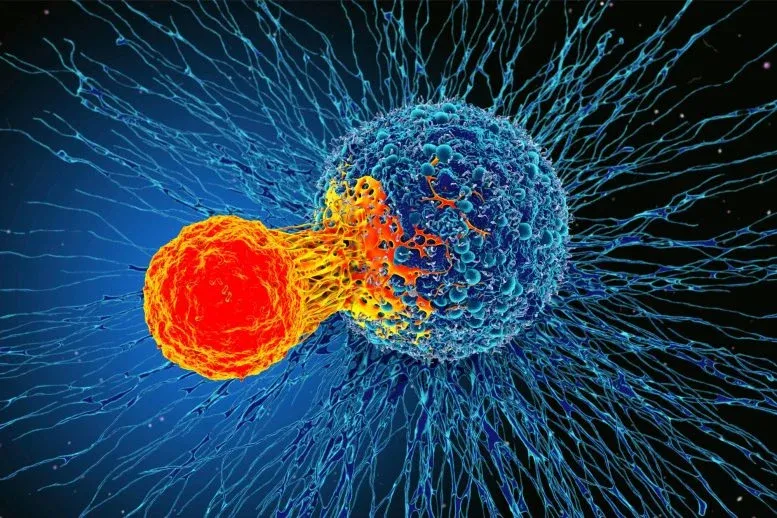
The drug's power lies in its design. In 2018, Jeffrey Ravetch's team at Rockefeller University engineered 2141-V11 to bind more tightly to CD40 receptors—immune switches that, when flipped correctly, can turn the body's own T cells into tumor hunters. The modification made it roughly ten times more potent at triggering an anti-tumor immune response than earlier versions.
But the real breakthrough was simpler: they stopped injecting it into the bloodstream. Instead, they injected it directly into a tumor. This local approach kept toxicity minimal while still triggering a systemic response—the immune system woke up at the injection site and then went to work across the entire body.
That's the puzzle these results hint at. The two patients who experienced complete remission both had something in common at the start: high clonality of T cells, meaning their immune systems already had populations of cells primed to recognize and attack their cancer. This suggests 2141-V11 doesn't work for everyone—at least not yet. It works best when the immune system is already paying attention.
Ravetch's lab is now running larger trials with Memorial Sloan Kettering and Duke University, testing the drug against bladder cancer, prostate cancer, and glioblastoma. Those studies will help answer the harder questions: Which patients benefit most. Why some respond and others don't. Whether this approach can expand beyond melanoma and breast cancer.
The results don't mean a cure is here. Twelve patients is tiny. But it does mean researchers have found a way to wake up the immune system without poisoning the patient in the process—and in cancer treatment, that's the kind of balance that changes what becomes possible next.