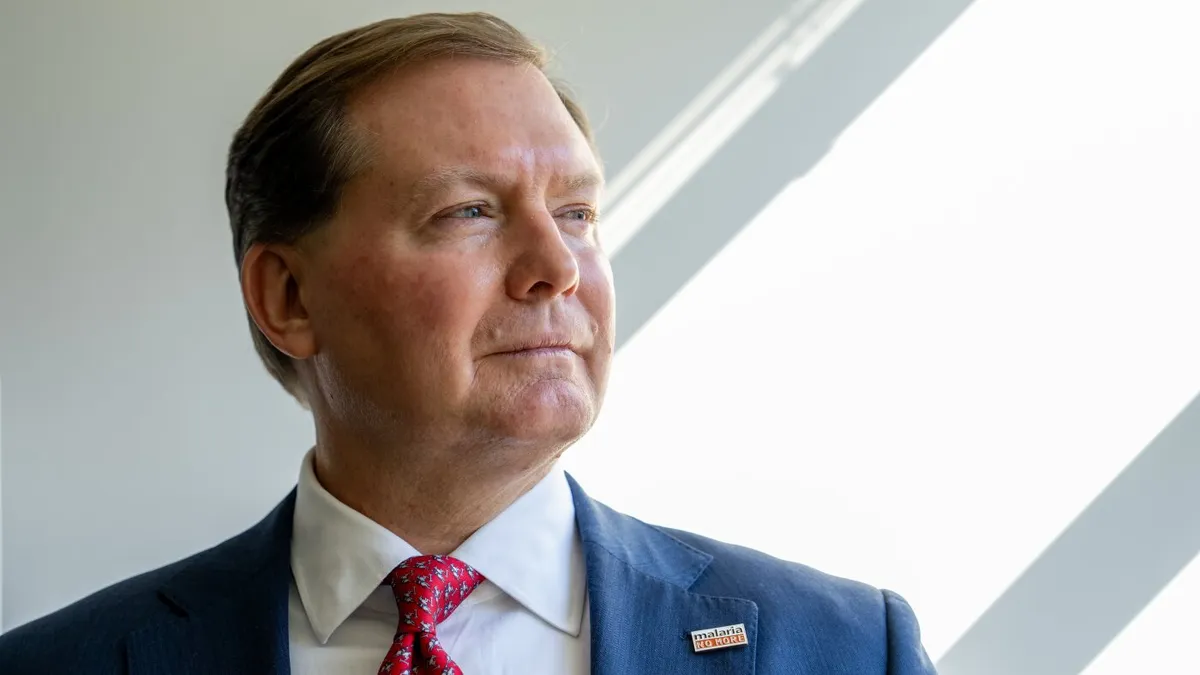
Bill Steiger has spent 25 years moving between government and global health work. He shaped U.S. foreign aid policy during the first Trump administration, and now he's taking those connections into a new role: CEO of Malaria No More, a nonprofit focused on eliminating one of the world's most persistent killers.
Malaria killed 610,000 people in 2024. That number hasn't budged much in recent years — which is why Steiger's optimism about the fight ahead matters. He's not ignoring the constraints. The Trump administration has reshaped U.S. global health spending, cutting some programs while tightening others to align with American interests. But Steiger sees this as clarifying, not paralyzing. "The programs that survive are more targeted, more efficient," he says. More importantly, they continue to save lives.
New tools changing the game
What drew Steiger to Malaria No More wasn't nostalgia for the old funding landscape. It was a genuine shift in what's possible. The organization's work is mostly translation — taking complicated science and explaining it to policymakers and the public so they understand what new technologies can actually do.
We're a new kind of news feed.
Regular news is designed to drain you. We're a non-profit built to restore you. Every story we publish is scored for impact, progress, and hope.
Start Your News DetoxThree tools are catching his attention. Rapid diagnostic tests can now distinguish malaria from other fever-inducing diseases with much greater accuracy, which means fewer people get treated for the wrong illness. Gene drive technology can genetically modify mosquitoes to stop transmission altogether — a long-shot idea that's moving closer to real-world deployment. And then there's the spatial emanator, a small device from SC Johnson that hangs in homes and repels mosquitoes for a year at roughly 18 cents per person.
These aren't theoretical breakthroughs. They're tools that work at scale, at costs that matter in the places where malaria hits hardest. That's the shift Steiger sees — not more money necessarily, but smarter money.
He worries about one thing: complacency. In some regions, the fatalism around malaria runs deep. People assume it's just part of life. But the economics tell a different story. U.S. investment in malaria control generates $5.80 in economic growth for every dollar spent. That's not charity. That's infrastructure.
"We can win this fight, and we actually benefit at the same time," Steiger said. The next phase isn't about maintaining the old system. It's about proving these new tools work, then scaling them fast enough that malaria stops being inevitable.