Someone just solved a problem

This Light-Powered AI Chip Is 100x Faster Than a Top Nvidia GPU

A revolutionary optical AI chip promises to shatter energy barriers, powering next-gen generative models at unprecedented speeds. Yet, this breakthrough remains confined to the lab - for now.

25 min readSingularity Hub
Shanghai, China
This Light-Powered AI Chip Is 100x Faster Than a Top Nvidia GPU
75
...
4

Why it matters: this energy-efficient ai chip could significantly reduce the carbon footprint of generative ai models, benefiting the environment and enabling more widespread adoption of these transformative technologies.

Training generative AI models requires an enormous amount of computing power and energy. But as demand explodes, the process of actually running the models to create images, text, or video—known as inference—is quickly becoming an even bigger drain on resources.

Video and image generation models are particularly energy intensive. While the efficiency of these models is constantly improving, a 2023 study found that generating 1,000 images using a leading model produced carbon emissions equivalent to driving a gas-powered car more than four miles.

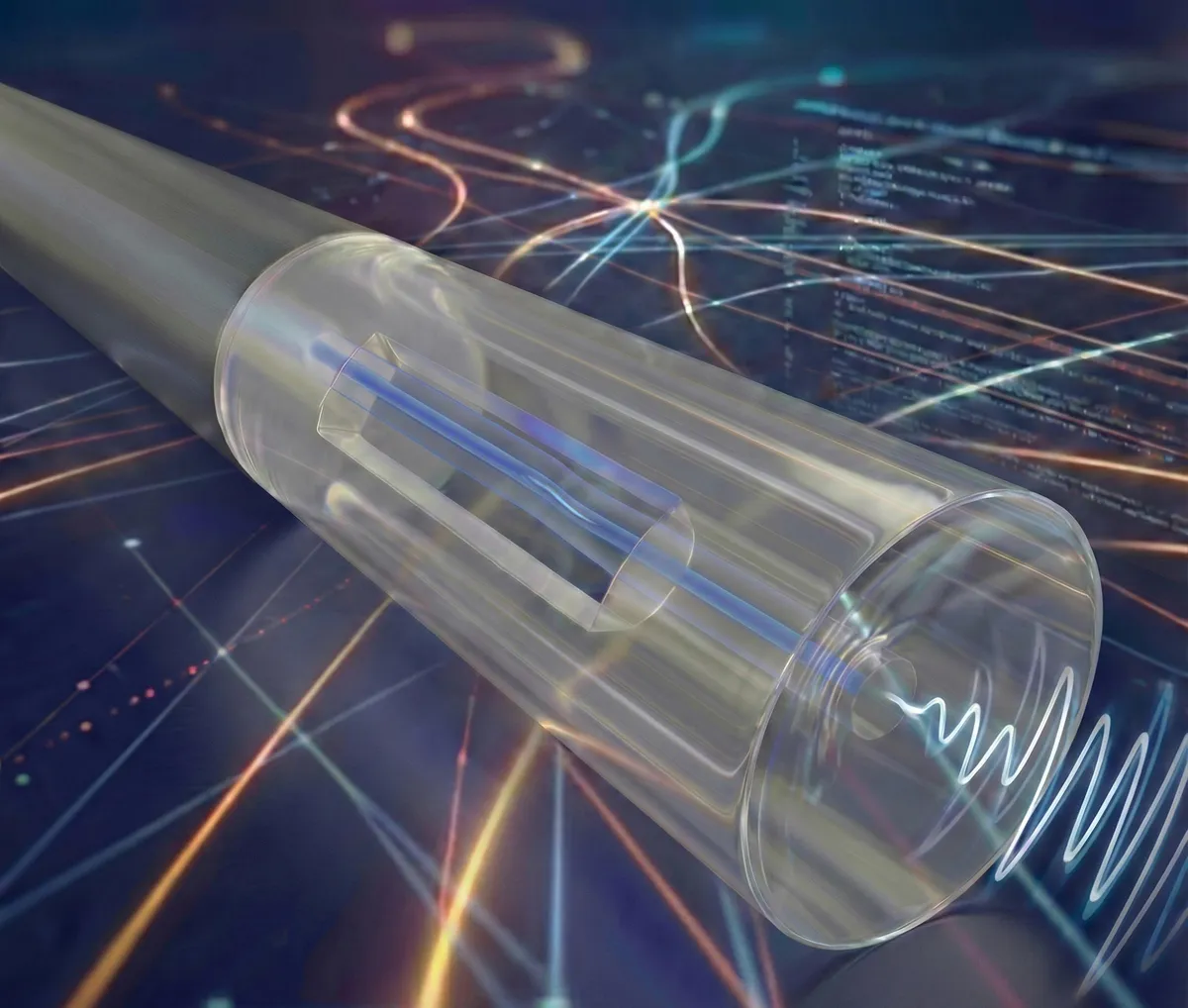
One promising approach for slashing energy use is photonic computing, where processors use light instead of electricity. It’s a tactic multiple well-funded startups are pursuing in earnest. But most advances have been limited to simpler tasks like image classification or text generation. Now, researchers from Shanghai Jiao Tong University and Tsinghua University in China have demonstrated an all-optical chip they call LightGen that is more than 100 times faster and more energy efficient than a leading Nvidia GPU on tasks like video and image generation.

LightGen provides a new way to bridge the new chip architectures to daily complicated AI without impairment of performance and with speed and efficiency that are orders of magnitude greater,” the researchers write in a recent paper on the chip in Science. A key aspect of the new design is its density. Generative models typically require millions of parameters to produce high-quality outputs, but previous photonic chips have had, at most, a few thousand artificial neurons.

Using 3D packaging, however, LightGen integrates more than two million onto a device measuring just a quarter of a square inch. The resulting processing boost allows the chip to work with images at resolutions up to 512-by-512 pixels. Older photonic chips typically broke up high-resolution images into smaller patches to process them. This not only takes longer but also reduces a model’s ability to draw statistical correlations between the different patches.

The researchers also innovated something called an optical latent space. Generative AI models work, in part, by compressing high-dimensional data into simpler representations. This forces them to remove less important information and only retain the bits that are integral to the input. These condensed representations are then stored in a multi-dimensional map of concepts called a latent space.

Models use these representations to generate new outputs when given a prompt. LightGen’s developers replicated this process entirely optically. In their chip, a full-resolution image is transmitted through an optical encoder made up of several metasurfaces—ultra-thin structures designed to manipulate light—and then coupled into an array of optical fibers.

This process naturally filters out higher-order data, effectively condensing the information into simpler representations, which are then stored in the fiber array as the optical latent space. Another set of metasurfaces at the other end of the device, which can be switched depending on the task, then take the output from this latent space and use it to generate high-resolution images.

The researchers also came up with a novel training approach. Here, the chip learns probabilistic representations of training data, which makes it possible to tackle more complex tasks, like creating novel outputs.

This is a promising development. So far, most photonic chips have focused on inference not training. The team tested their chip on several demanding tasks, including the generation of high-resolution images of animals, converting images into different artistic styles, and even turning 2D images into 3D models.

Notably, the chip achieved speeds and energy efficiencies more than two orders of magnitude better than Nvidia s A100 GPU, one of the company s most powerful AI chips. The new optical chip isn’t ready to break out of the lab just yet. It still relies on bulky lasers and spatial light modulators to generate input signals, and the metasurfaces central to its design are currently made with specialized processes rather those you might find in standard chip factories.

Nonetheless, with further development, the work suggests optical processors could be a fast, energy-efficient way to power the cutting-edge of an increasingly power-hungry AI industry. The post This Light-Powered AI Chip Is 100x Faster Than a Top Nvidia GPU appeared first on SingularityHub.

Brightcast Impact Score (BIS)

75/100Groundbreaking

This article highlights a promising new AI chip called LightGen that is 100x faster and more energy-efficient than leading GPUs for generative AI tasks like image and video generation. The chip uses photonic computing, which could help address the growing energy demands of powerful AI models. While the chip is not yet ready for commercial use, the research represents an important step forward in developing more sustainable AI hardware.

Hope Impact25/33

Emotional uplift and inspirational potential

Reach Scale25/33

Potential audience impact and shareability

Verification25/33

Source credibility and content accuracy

Significant positive development

Comments(0)

Join the conversation and share your perspective.

Sign In to Comment
Loading comments...

Get weekly positive news in your inbox

No spam. Unsubscribe anytime. Join thousands who start their week with hope.

More stories that restore faith in humanity

Australia activates 1.6 GWh energy storage facility with 444 Tesla Megapacks
Innovation
2 wks ago
Mark Elder: Building the Future of Spacewalking for Artemis and Beyond
Innovation
3 wks ago
US engineers develop 3D chip that offers order-of-magnitude speed gains, accelerates AI
Innovation
1 wks ago