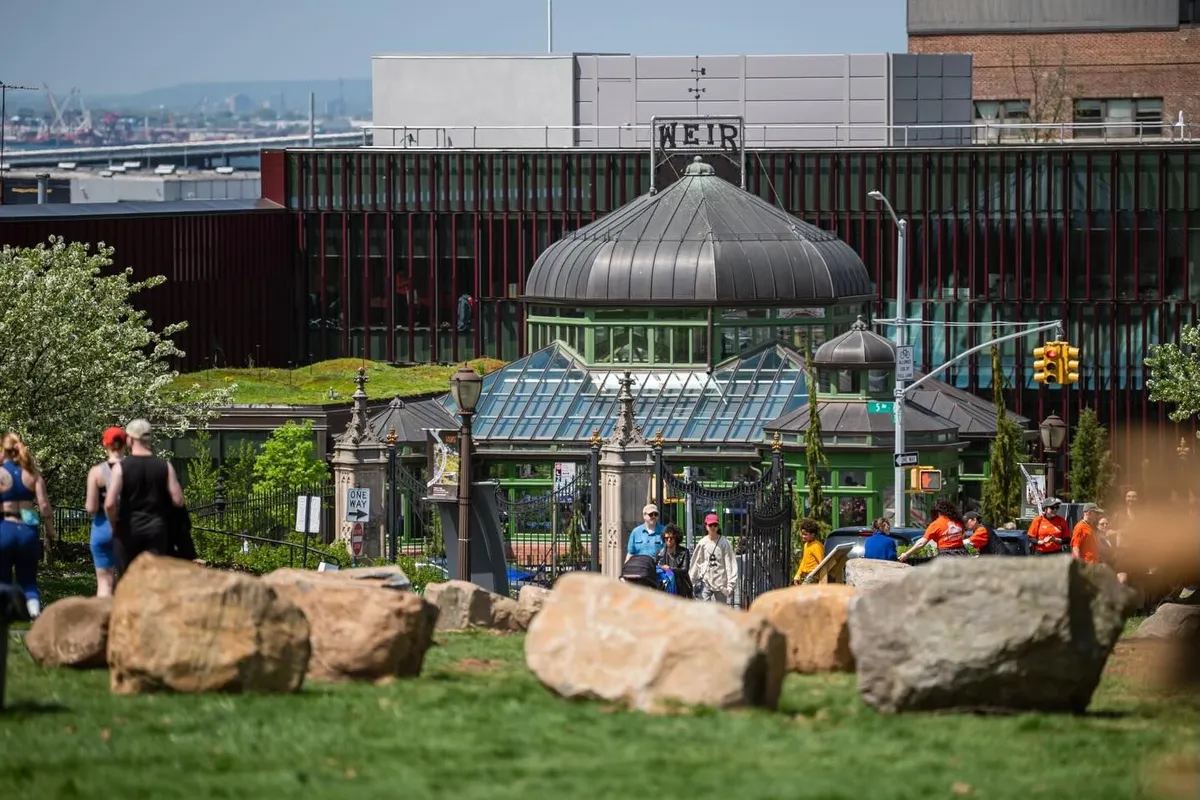
Brooklyn's Green-Wood Cemetery, established in 1838, has always been known for its beauty. It draws hundreds of thousands of visitors each year to see its trees, ponds, and valleys.
Now, the cemetery has a new visitor's center. It's called the "Green-House" and opened in April.
A New Welcome for Visitors
The new center is a restored 19th-century building called the Weir Greenhouse. It used to sell flowers to people visiting graves. Green-Wood president Meera Joshi calls it a "new front door" for the cemetery.
We're a new kind of news feed.
Regular news is designed to drain you. We're a non-profit built to restore you. Every story we publish is scored for impact, progress, and hope.
Start Your News DetoxThe Weir Greenhouse was built in 1880 and expanded in 1895. Green-Wood bought it in 2012. At the time, it was "neglected" but still beautiful, according to Joshi.

The restoration project was long and costly. The old greenhouse was fixed up and a new L-shaped building was added. This new section includes a reading room, archives, and two galleries for changing exhibitions.
The greenhouse now has a tile floor with a giant map of Green-Wood Cemetery. It also features a flower stand. The goal is to help visitors get their bearings before exploring the grounds.
Joshi explained that people often fear or avoid places related to death. The new visitor center helps ease this feeling. It provides context for the cemetery.
A Cemetery Designed for Beauty
Green-Wood was one of the first "rural cemeteries" in the U.S. In the 19th century, people started to believe burial grounds should be pleasant, not dark and cramped. Mount Auburn Cemetery in Boston, opened in 1831, was an early example. Visitors described it as a "pleasure garden."
Green-Wood's designer, David Bates Douglass, wanted a name that suggested "verdure, shade, ruralness, natural beauty." He rejected "necropolis" because it sounded like just a place for dead bodies.
The Green-House displays artifacts like handwritten records from the cemetery's founding. Green-Wood is the final resting place for 580,000 people. These include Civil War generals, baseball stars, artist Jean-Michel Basquiat, and composer Leonard Bernstein. Teddy Roosevelt's wife and mother are also buried there; they died on the same day in 1884.
While new burials are still possible, space is limited and expensive. A single grave can cost over $20,000. This scarcity is why the cemetery wanted to make the greenhouse a public space.
Lisa West Alpert, Green-Wood's senior vice president of development, noted that cemeteries eventually run out of burial space. They need to think about how to make the green space an asset for the community.