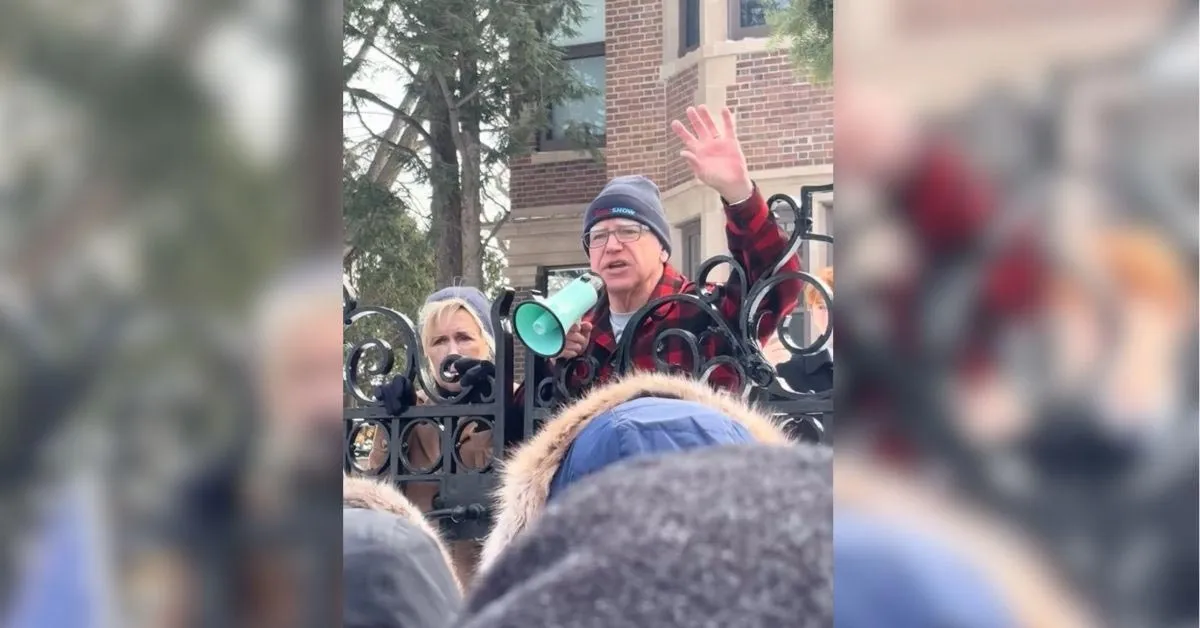
Minnesota Governor Tim Walz stepped outside his mansion into the January cold to meet protesters gathering in response to ICE raids across the state. The crowd had come to demand action following the death of Renee Good, a local woman caught up in enforcement operations, and to voice support for undocumented neighbors facing deportation.
"Thank you for standing up for our neighbors who don't have a fence and who don't have people to take them around and don't have lawyers to defend them," Walz said into a megaphone, his wife Gwen beside him. The message was clear: the governor saw the protesters as moral actors, not obstacles.
Walz drew on his own history to legitimize the moment. He recalled bringing Chinese political prisoners into the United States during his time in Congress—a deliberate choice to show that breaking unjust systems has precedent. "The resistance matters," he told the crowd. But he also set a boundary. He urged people to continue speaking up while keeping protests peaceful, invoking the legacy of civil rights leader John Lewis and his concept of "good trouble"—disruption that serves justice without causing harm.
We're a new kind of news feed.
Regular news is designed to drain you. We're a non-profit built to restore you. Every story we publish is scored for impact, progress, and hope.
Start Your News Detox"We're not telling people to be silent, but we're not telling people to go out and cause problems," Walz said. "We're going to cause good trouble."
The stakes felt immediate. Walz acknowledged that children in Minnesota homes were hiding—a reality that prompted him to reference Anne Frank. "The people who were helping Anne Frank, they were the ones breaking the law," he said, positioning sanctuary and resistance as moral imperatives even when they sit outside legal boundaries.
Meanwhile, communities across Minnesota were already organizing. Mutual aid networks were feeding neighbors, fundraising efforts were gaining momentum, and organizers had called for a statewide general strike on Friday, January 23. The moment reflected a particular kind of civic moment: when elected officials and grassroots movements align around a shared conviction that the current system is failing vulnerable people.
Walz's final message to the crowd was almost deceptively simple: "You know what's right. You know what your neighbors are going through." It was an appeal to conscience, not ideology—a recognition that people already understand their moral obligations, and that sometimes the role of leadership is simply to stand beside them and say so publicly.