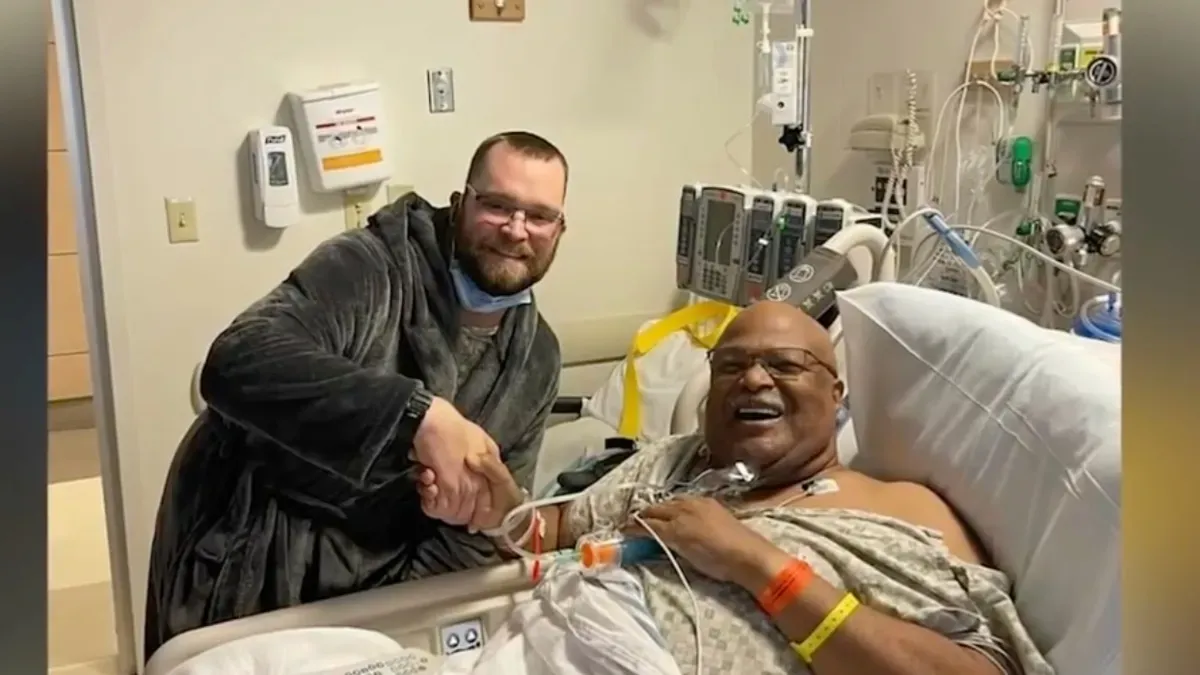
Bill Sumiel Jr. had been waiting years for a kidney transplant when he climbed into Tim Letts' Uber after a dialysis appointment in 2021. By the time they reached Bill's house twenty minutes later, Tim had offered to give him one of his own.
It started with conversation—the kind that doesn't always happen in a car between strangers. Bill mentioned his medical situation, his years on the transplant waiting list, the exhaustion of dialysis. Tim listened. When they arrived, he asked for Bill's number. "If you'll take my name and number, I'd like to donate a kidney to you," he said.
Bill could barely read it down. His hands were shaking.
What followed was the part that seemed impossible: when they were tested for compatibility, they matched perfectly. Tim went through with the surgery. Bill got his second chance.
We're a new kind of news feed.
Regular news is designed to drain you. We're a non-profit built to restore you. Every story we publish is scored for impact, progress, and hope.
Start Your News DetoxWhy This Matters More Than the Miracle
On the surface, this is a story about extraordinary generosity. But dig slightly deeper and it reveals something about how we've normalized isolation in everyday spaces. Bill's own reflection is telling—he was struck by the simple fact that Tim "talked back when you start a conversation." That shouldn't be remarkable. But in a world where we've learned to treat rideshare drivers as background characters in our commute, it is.
Tim's decision wasn't impulsive either. He'd been considering organ donation for years. What changed wasn't his values—it was proximity. He met someone whose face matched the abstract idea of need. He heard their story directly, not filtered through a news report or charity appeal. That shift from abstract to concrete, from "people need kidneys" to "this person needs a kidney," is what moved him to act.
There's also an uncomfortable truth embedded here: Bill's access to this outcome depended on him being able to afford an Uber, to have a driver willing to engage in genuine conversation, and to have the health literacy to explain his situation clearly. Not everyone on a transplant waiting list has those advantages. According to UNOS data, the average wait for a deceased donor kidney is five to seven years, and disparities in access persist along racial and economic lines. Tim's generosity was real. But so is the fact that many people never meet their Tim.
What's genuinely significant is that Tim's act may shift how others see the strangers in their cars, their checkout lines, their waiting rooms. One person's willingness to see someone fully—to listen, to care enough to act—can ripple outward. It's not a replacement for systemic change in organ donation or transplant access. But it's not nothing either.
Tim has said that the decision reflected his deepest convictions: "If a person like that can't have somebody stand in their corner, then kind of what's the point of it all?" Both he and Bill are now part of a growing movement toward living kidney donation, which accounts for roughly 35 percent of all kidney transplants in the United States—up from just 10 percent in the 1990s. More people are recognizing that one healthy kidney is enough, and that the gift of donation can transform waiting from a passive state into a moment of connection.
Bill and Tim's story isn't the exception. It's a reminder of what becomes possible when we actually listen to each other.