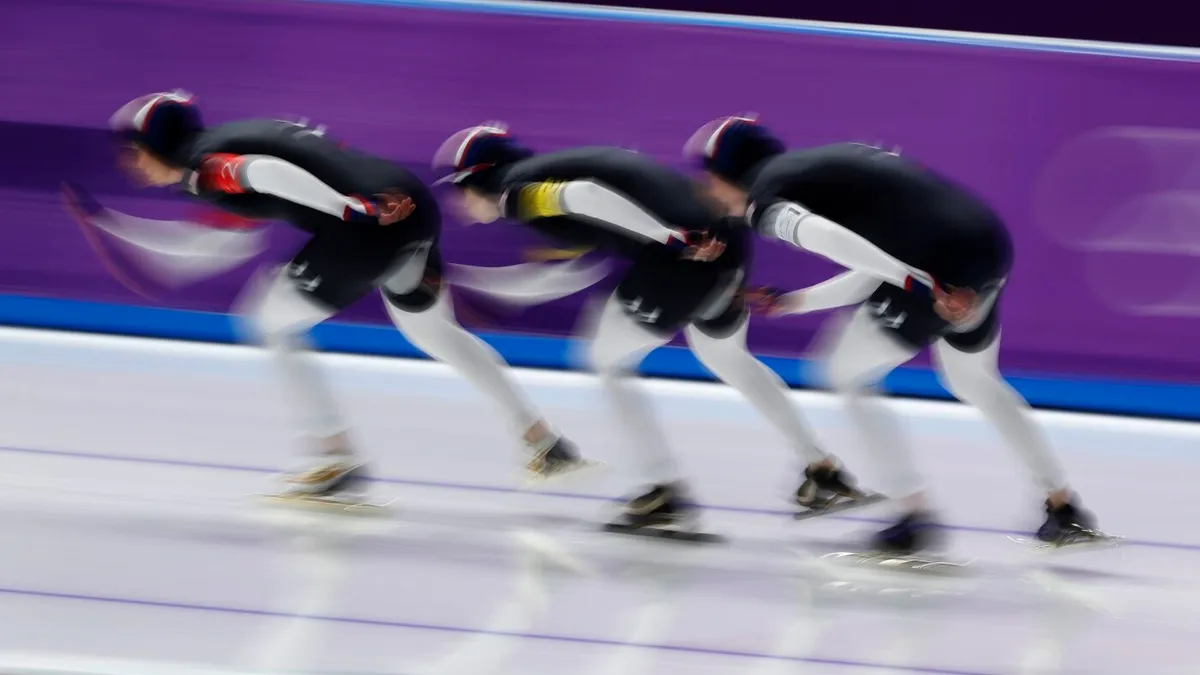
American speed skaters competing in the Team Pursuit event are executing a technique that would look completely foreign to anyone who's watched the sport for more than a decade. They're pushing each other.
Not metaphorically. Literally placing their hands on the back of the skater in front of them, moving at 30 mph around a 400-meter track in near-perfect synchronization. It sounds chaotic. It's actually physics.
The Problem That Started This
For years, the U.S. Team Pursuit squad was finishing eighth in world rankings. They were using the traditional "drafting" technique borrowed from cycling — where skaters follow in the slipstream of the person ahead, reducing wind resistance. It made intuitive sense. It wasn't working.
We're a new kind of news feed.
Regular news is designed to drain you. We're a non-profit built to restore you. Every story we publish is scored for impact, progress, and hope.
Start Your News DetoxAround 2015, U.S. Speedskating's chief of sports performance Shane Domer brought in sports aerodynamicist Ingmar Jungnickel to study why. Together, they built an AI-powered simulation tool that modeled the aerodynamics of different skating formations. What the data showed was surprising: pushing the skater in front of you — keeping your hand on their lower back and actively driving them forward — was substantially faster than following in their wake.
"We could show that pushing is so fast that you can go from eighth in the world to first in the world using this technique," Jungnickel said.
The technique isn't entirely new. It mirrors "bump drafting" in NASCAR, where drivers use the nose of their car to push the car ahead, reducing drag for both vehicles. But applying it to speed skating required rethinking everything about how the sport trains.
From Skepticism to Standard
Speed skating coaches were skeptical at first. The push technique felt wrong, unrefined. But as the U.S. team's world rankings climbed — and kept climbing — other nations started paying attention.
Now each American skater specializes in one position: first, second, or third. They train obsessively on synchronization. Giorgia Birkeland, who skates third, can't see anything ahead of her except the skater directly in front. She relies entirely on reading their body language, their stroke rhythm, their weight shifts. "You have to have complete trust in their skating," she said. "It's really a team event."
The trust isn't abstract. Three skaters need to move as a single organism for six laps (eight for men), inches apart, without clipping skates or losing rhythm. Shane Domer describes it plainly: "Not only are you looking to put power down on the ice to make yourself go forward fast, but to synchronize with each other, and to get so close to one another while not tripping over one another — that's a skill our athletes have worked very, very hard to perfect."
By the 2022 Winter Olympics, the top three finishers in Team Pursuit were all using the push technique. What started as an American experiment has become the worldwide standard. Most elite teams now rely on it to be competitive.
For Birkeland and her teammates, this Olympic appearance is a chance to prove the technique works when it matters most. The physics say it will.