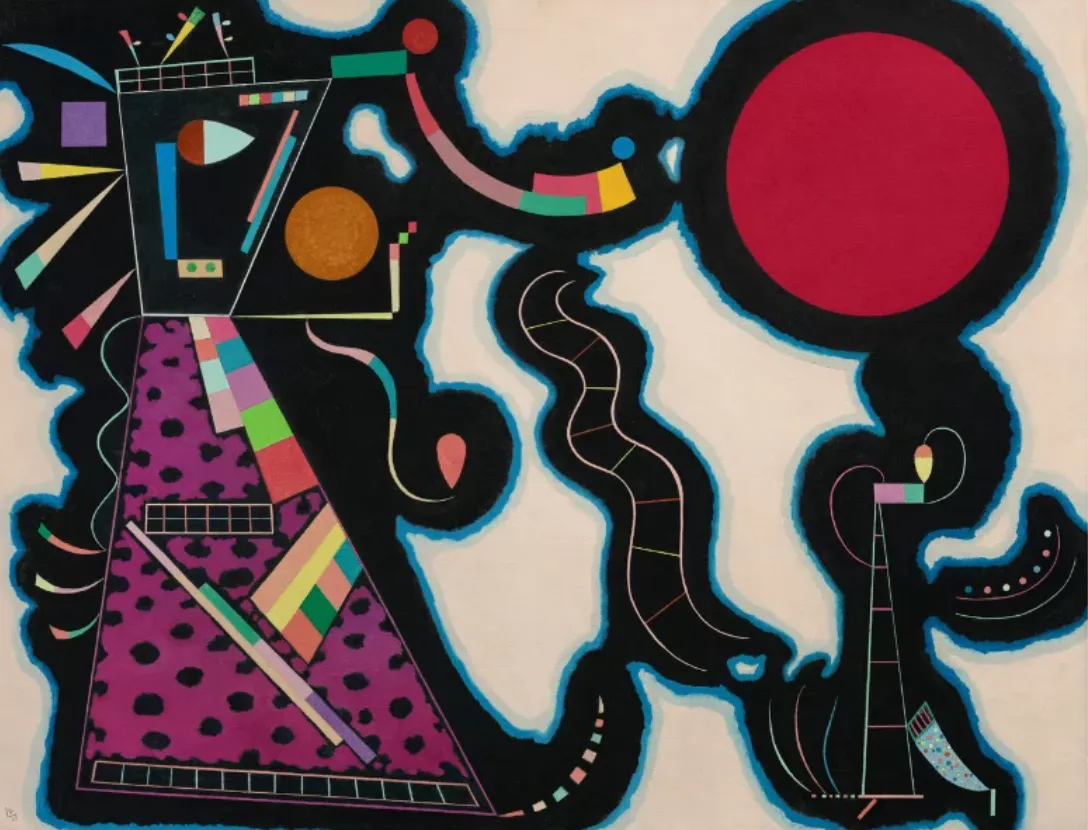
When Wassily Kandinsky painted "Le Rond Rouge" in 1939, he was living in self-imposed exile in Paris with his wife Nina, having fled Nazi Germany six years earlier. The canvas—a bold red circle surrounded by playful biomorphic forms and geometric shapes—represents something quietly defiant: an artist in his seventies, displaced from his homeland, still pushing abstraction into new territory.
Christie's will offer the painting at their 20th/21st Century evening sale in London on March 5, with a high estimate of £15.5 million. At 35 by 45.7 inches, it's a substantial work, and it carries particular weight in Kandinsky's story. This is a painting from his late period, when he'd absorbed Surrealist influences without abandoning the Bauhaus principles that defined his earlier work. The composition feels both playful and urgent—a visual argument for abstraction's emotional power.
"Le Rond Rouge" never left Kandinsky's hands during his lifetime. When he died in 1944, it passed to Nina, who kept works she believed best represented his artistic vision. That's a telling detail. This wasn't a painting he sold to a dealer or collector. It was one he wanted to keep.
We're a new kind of news feed.
Regular news is designed to drain you. We're a non-profit built to restore you. Every story we publish is scored for impact, progress, and hope.
Start Your News DetoxKandinsky's trajectory—from revolutionary to refugee to late-career experimenter—gets compressed in auction house language into "key work" and "powerful expression." But the human reality matters here. He was 76 when he painted this. He'd already reinvented abstraction once, in the early 1900s, when the concept barely existed. By Paris, he was doing it again, adapting, staying curious in a world that had become hostile to everything he represented.
Alongside the Kandinsky, Christie's is also headlining Henry Moore's "King and Queen" (1952-53), a 64-inch bronze sculpture with a £15 million high estimate. Both works will be on public view from February 25.
What's worth noting is that paintings and sculptures like these—created by artists who lived through catastrophe and kept making art anyway—have become increasingly sought after. There's something in the market's appetite for these works that reflects our own moment: a hunger to see what happens when artists refuse to stop experimenting, even when circumstances demand it.