BMW has moved beyond testing. After a year of humanoid robots working successfully at its South Carolina plant, the automaker is now deploying a different generation of AI-powered machines at its Leipzig factory in Germany—signaling that this isn't a one-off experiment, but a shift in how cars get built.
Last year, Figure AI robots spent 1,250 hours on the line at BMW's Spartanburg facility, handling the precise, repetitive work of positioning sheet metal for welding. They moved 90,000 components across their shifts, working 10 hours a day, five days a week. The result: over 30,000 BMW X3s built with robotic assistance. The robots didn't break down. They didn't need constant human supervision. They worked.
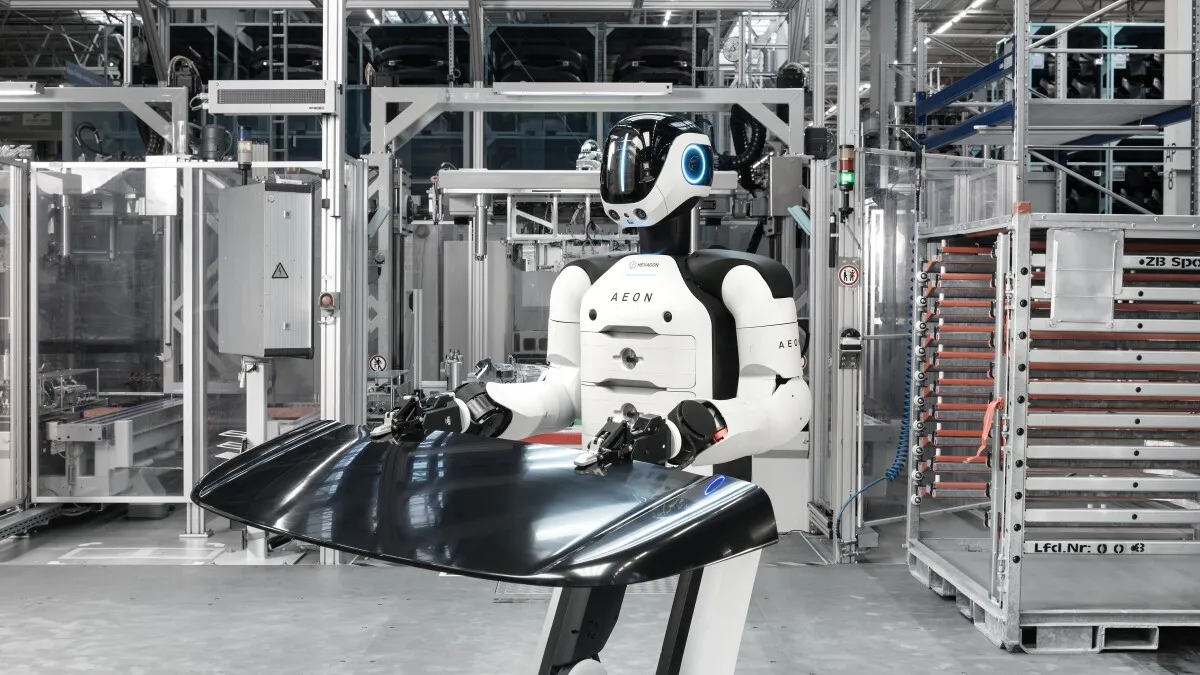
That success opened the door to what's happening now in Leipzig. BMW is testing AEON bots made by Hexagon—machines equipped with what engineers call "physical AI." Unlike traditional factory robots programmed for a single task, these bots use environmental sensors and AI-based motion control to make decisions on the fly. They learn from what they encounter and update their own programming based on real-world conditions. A robot that struggles with a particular grip angle can adjust it next time without waiting for a human to reprogram it.
We're a new kind of news feed.
Regular news is designed to drain you. We're a non-profit built to restore you. Every story we publish is scored for impact, progress, and hope.
Start Your News DetoxThe AEON bots are built for the factory floor specifically. They're 165 centimeters tall (roughly human height), weigh 60 kilograms, and move on wheeled legs at speeds up to 2.4 meters per second. They can carry 15 kilograms for short bursts or 8 kilograms for longer stretches. When their batteries run down after about four hours, they autonomously swap in fresh ones and keep working—no human intervention needed.
At Leipzig, they'll start with broad testing across various assembly tasks before settling into battery assembly and component manufacturing work. Michael Nikolaides, BMW's senior vice president, described it as part of a deliberate strategy: testing new technologies in real production conditions, not in controlled labs where everything works perfectly.
What's worth noting here is the scale difference. The Figure robots at Spartanburg proved humanoid machines could survive the chaos of an actual factory—the vibrations, the temperature swings, the unpredictable variations in materials. Now, with a second deployment using different hardware and different AI approaches, BMW is essentially saying: this works across different robot designs, different tasks, different continents. That's the shift from "interesting experiment" to "this is how manufacturing happens now."
The broader pattern matters too. Humanoid robots in factories aren't new as a concept—companies have been talking about them for years. What's changed is that they're actually working, which means the next wave of deployment will likely accelerate. If BMW succeeds with AEON bots in Germany the way Figure performed in South Carolina, expect other automakers to move quickly. The competitive pressure alone will push adoption forward.
For now, Leipzig becomes the real-world testing ground for whether physical AI can learn and adapt at the pace manufacturing demands. The next few months will tell us whether these robots are genuinely becoming smarter on the job, or whether they still need more development before they're ready for the full line.