
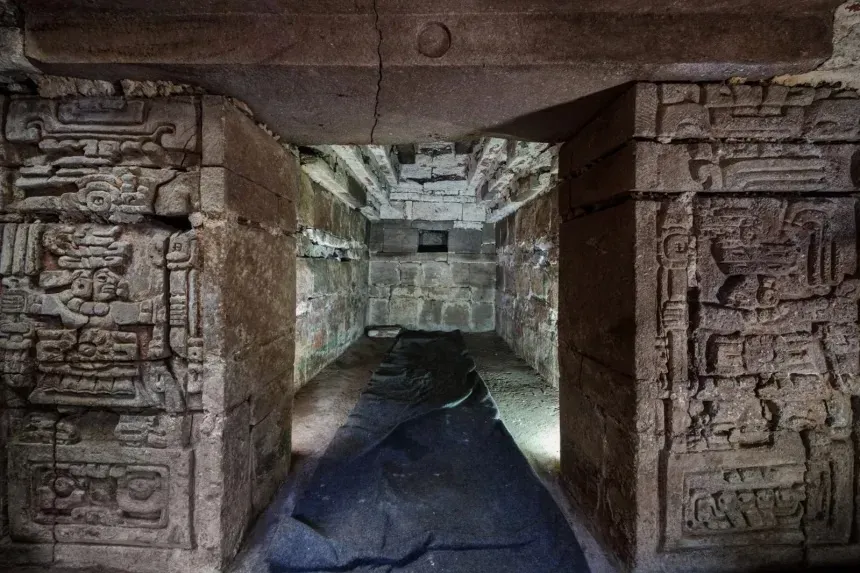
A burial chamber discovered in southern Mexico has stopped archaeologists in their tracks. Unearthed in San Pablo Huitzo, Oaxaca, the 1,400-year-old Zapotec tomb is so perfectly preserved that its murals still glow with ocher, white, green, red, and blue pigment — colors applied around 600 CE that have survived fourteen centuries underground.
What makes this discovery so rare is not just age, but what it shows. The tomb's entrance is guarded by an owl carved in stone, a bird that held profound meaning in Zapotec culture as a symbol bridging night and day. Inside the owl's beak sits a sculpted human head, believed to represent the person buried within. The walls tell stories in paint and stone: multicolored murals depict a ceremonial procession of figures carrying bags of copal, the tree resin burned in sacred rituals. Flanking the threshold are carvings of two human figures holding artifacts, likely guardians of the dead.
Mexico's National Institute of Anthropology and History (INAH) released the find this week, and the response from experts has been emphatic. President Claudia Sheinbaum called it "the most significant archaeological discovery of the last decade in Mexico" — a statement grounded not in hyperbole but in what the tomb actually reveals. The preservation is exceptional. The information it yields about ancient Zapotec society, funerary practices, and spiritual beliefs is equally so.
We're a new kind of news feed.
Regular news is designed to drain you. We're a non-profit built to restore you. Every story we publish is scored for impact, progress, and hope.
Start Your News DetoxFor context: the Zapotec civilization was one of Mesoamerica's great powers, and their cultural legacy remains alive. Hundreds of thousands of people in Mexico still speak the Zapotec language today. A tomb like this — with its murals intact, its symbolic vocabulary still legible, its architectural details undisturbed — is a direct line to how the Zapotec understood death, authority, and the sacred.
The INAH team is now working to preserve the site and continue research. What emerges from that work will likely reshape how we understand not just the Zapotec, but the sophistication of Mesoamerican burial practices more broadly.